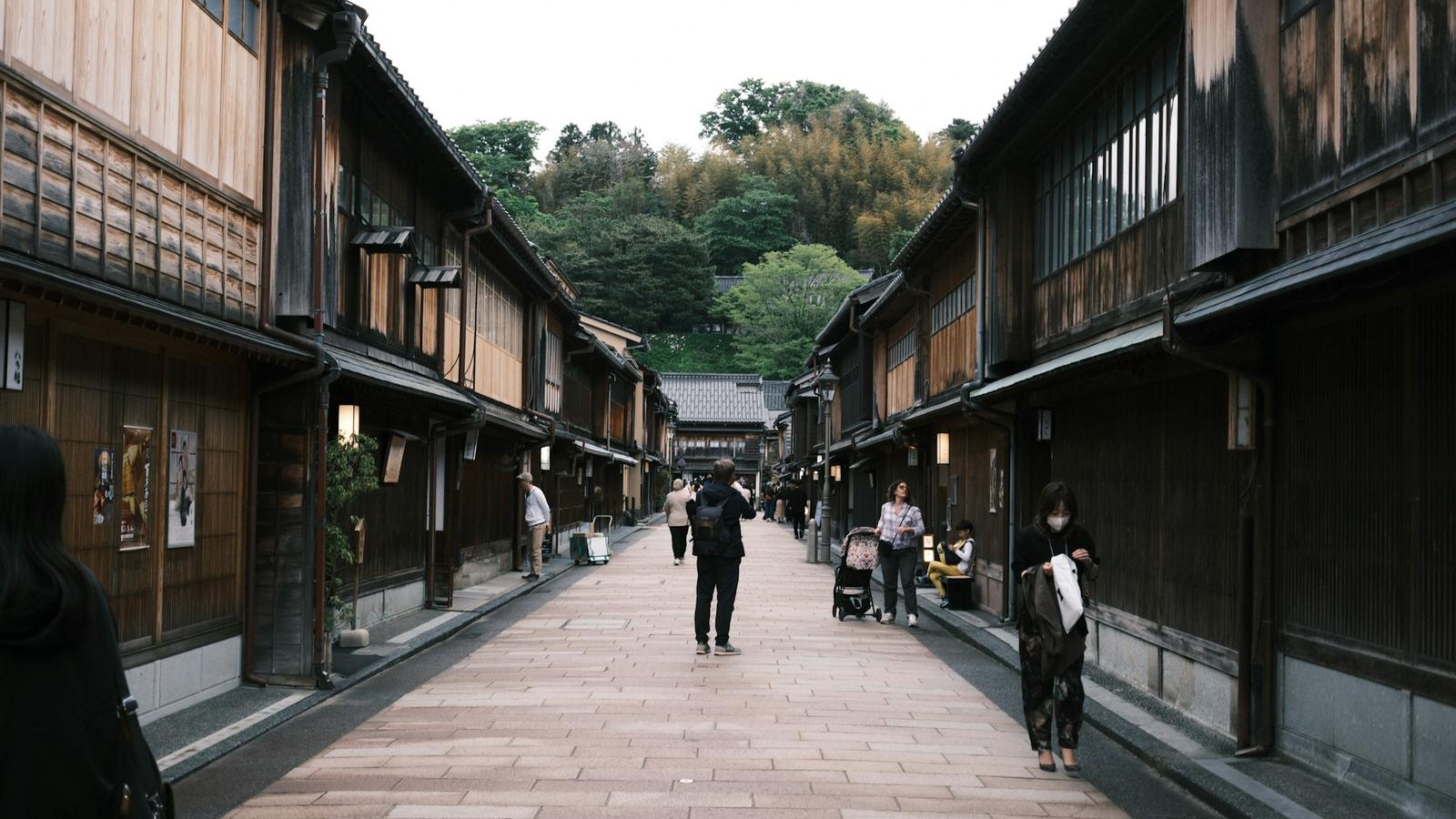
Many Japan itineraries run out of days before they reach the Sea of Japan coast. Kanazawa is two and a half hours from Tokyo on the Hokuriku Shinkansen, close enough for a three-night extension, and a city that rewards travelers who give it time.

Where it is
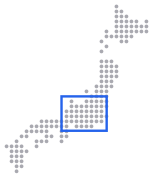
On the Sea of Japan side of Honshu, in Ishikawa Prefecture, in the Hokuriku region.
- Tokyo Station to Kanazawa Station, by Shinkansen, about 2 hr 24 min
Times come from the railways' official timetables. Map based on Natural Earth and OpenStreetMap (© OpenStreetMap contributors).
Kanazawa was the seat of the Maeda clan, second only to the Tokugawa shogunate in wealth during the Edo period. That wealth built gardens, Noh theatres, gold leaf workshops, and a deep artisan culture. Unlike Nagasaki or Sendai, it was not bombed during the Second World War. What remains is intact, and most of it is still in daily use.
Key points
- Kanazawa is about two and a half hours from Tokyo on the fastest Kagayaki trains of the Hokuriku Shinkansen, which makes it a natural three-night extension.
- Arrive at Higashi Chaya before 9am. Kenroku-en is at its most striking in winter, when the pines carry yukitsuri rope supports from the beginning of November.
- Ishikawa's snow crab season opens on November 6. The male kano-gani is landed until March 20 and the smaller female kobako-gani only until December 29, so November and December give the fullest overlap of garden and table.
- Kanazawa makes virtually all of Japan's gold leaf. A half-day of craft workshops, gold leaf, lacquerware and ceramics, is the part of a visit most closely tied to this city.
- The article's suggested close is a night at Beniya Mukayu in Yamashiro Onsen, about an hour away by car.
WHY KANAZAWA NOW
The Hokuriku Shinkansen was extended to Tsuruga in March 2024, completing the route that connects Tokyo directly to Kanazawa and beyond. The fastest Kagayaki trains make the journey in about two and a half hours. Kanazawa is now, in practical terms, a day trip from Tokyo, and a two-night stay from Kyoto.
What the Shinkansen has not done is overrun the city. Higashi Chaya is still a street of private homes and working teahouses, and the people who live there ask visitors to respect their daily life. Kenroku-en, one of Japan's three great gardens, is usually much calmer than Arashiyama, especially early in the day.
For the quietest hours, go early: from November to February, Kenroku-en's Hasuike and Zuijinzaka gates let visitors in free from 6:00, before regular opening.
HIGASHI CHAYA: A TEAHOUSE DISTRICT STILL AT WORK
The Higashi Chaya district, literally the "eastern teahouse district", was laid out in 1820, when the Kaga domain gathered the teahouses scattered around this area into one quarter, and it is now a nationally designated preservation district for groups of traditional buildings. Where Gion in Kyoto has become a destination photographed by thousands of tourists daily, Higashi Chaya remains a working neighborhood. The okiya (geisha houses) are still active. The ochaya (teahouses where entertainment takes place) still operate for a clientele of local business patrons who have used them for generations.
The wooden machiya buildings line narrow streets that have changed very little since the Edo period. The district is walkable in twenty minutes. Arrive early, before 9am, and walk it slowly without a plan. The smell of wood, the sound of shamisen practice from behind closed shutters, the lacquered signs above the ochaya, these details are easiest to notice before the day's visitors arrive.
To see inside a teahouse, visit Shima, an ochaya built in 1820 and left unaltered since the Edo period. Its whole second floor is given over to guest rooms, with no cupboards or storage, because the house was built for entertaining. Shima is open daily from 9:30 to 17:30 (to 17:00 from December to February) for 600 yen, and its tea room, Kansonan, serves matcha with a fresh sweet for 1,000 yen. Bags go into lockers, only a phone may be carried inside, and bare feet are not allowed, so bring socks.
Kanazawa makes virtually all of Japan's gold leaf, and the city's Yasue Gold Leaf Museum says that all of it is made here. The workshops in and around Higashi Chaya offer private experiences in which a craftsman demonstrates the beating process and guests apply gold leaf to lacquerware or ceramics. Traditional engitsuke leaf, beaten between sheets of handmade paper, averages about 0.1 micron thick. For the background, the Yasue Gold Leaf Museum in Higashiyama shows the tools and the stages of beating (9:30 to 17:00, closed Tuesdays, 310 yen). The studios are small and the craftsmen are working practitioners. For travelers who want more time at the bench than a standard demonstration allows, we can request a private session, subject to the studio's schedule.
Kanazawa's craft culture extends well beyond gold leaf. Wajima-nuri lacquerware, made on the nearby Noto Peninsula, runs to 124 steps from materials to finish. The January 2024 Noto earthquake and the heavy rain of September 2024 hit Wajima hard. The cooperative's Wajima-nuri Kaikan hall is still temporarily closed, a temporary lacquer-refining plant is now running, and many craftspeople have kept working from other workshops while they rebuild. Buying pieces from the makers and their shops is a direct way to support them. Kutani ceramics, with their bold red, green, and gold painted patterns, are produced in studios that accept private visitors. A half-day dedicated to Kanazawa's craft workshops (gold leaf, lacquerware, and ceramics in sequence) brings together three crafts closely tied to this region.
KENROKU-EN AND THE KEY SIGHTS
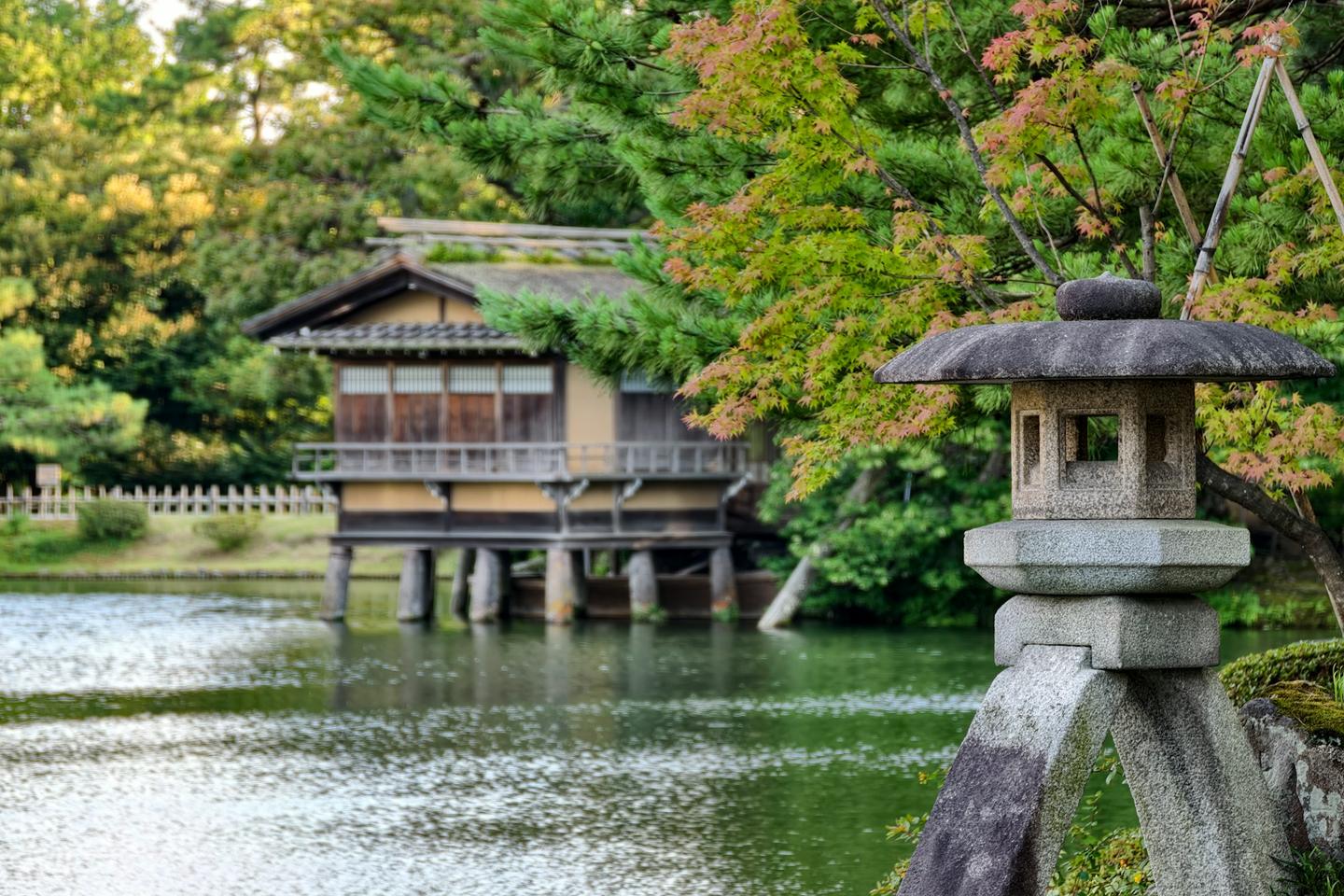
Kenroku-en, "the garden of six attributes", is listed alongside Kairaku-en in Mito and Koraku-en in Okayama as one of Japan's three great landscape gardens, and it is a nationally designated Special Place of Scenic Beauty. Successive Maeda lords shaped it over some two centuries. The name, in use from 1822, borrows the six qualities that the Song-dynasty Chinese text Luoyang Mingyuan Ji says a garden can rarely combine: spaciousness, seclusion, artifice, antiquity, water, and panoramic views.
Winter gives the garden its best-known look. From the beginning of November, the park's pine trees are fitted with yukitsuri, conical rope supports radiating from a central pole that protect the branches from the weight of snow. Each year the gardeners start on November 1 with the Karasaki pine, whose branches hang from about 800 ropes on five poles, and expect to finish in mid-December. The image of Kenroku-en in deep winter, with snow covering the garden and the yukitsuri silhouetted against the white, is one of the best-known images of winter in Japan. Winter mornings are also quieter, which is a good reason to consider a visit between December and February.
The garden opens at 7:00 from March 1 to October 15 and at 8:00 from October 16 to the end of February, closing at 18:00 and 17:00 respectively; adults pay 320 yen. Before opening time, entry through the Hasuike and Zuijinzaka gates is free, from 6:00 between November and February and from 4:00 between April and August. That early hour, with only gardeners and local walkers about, is when we suggest going.
Adjacent to the garden, Kanazawa Castle has been partly rebuilt. The Ishikawa-mon gate, rebuilt in 1788, and the Sanjikken Nagaya storehouse are original Edo-period structures. The Hishi Yagura turret and the long Gojikken Nagaya were reconstructed in wood with traditional methods in 2001, from Meiji-era photographs, Edo-period plans and excavation. The 21st Century Museum of Contemporary Art (free to enter the public zone, ticketed for the exhibition galleries, which open 10:00 to 18:00, to 20:00 on Fridays and Saturdays, and close on Mondays) is one of Japan's leading contemporary art venues. James Turrell's permanent installation "Blue Planet Sky," a skyspace in which a square opening in the ceiling frames the sky above, is worth planning the visit around. The museum closes for major renovation from May 6, 2027 until March 2028 (planned), so in 2027 it can be visited until May 5. To stand beneath Leandro Erlich's "The Swimming Pool" you need an exhibition ticket and a same-day timed reservation, and the stay underneath is limited to five minutes.
OMICHO MARKET
Omicho is Kanazawa's covered seafood market, 170 shops under one roof, operating continuously since the Edo period. It is the domestic supply point for the city's restaurants and a good place to begin eating in Kanazawa. The market opens at dawn and is at its most animated by 8am, when the stalls are fully stocked and the sushi restaurants inside have begun service.
The star of the market in winter is snow crab. Ishikawa sells the male as kano-gani, each with a blue tag naming the port that landed it, and the female as kobako-gani, much smaller and prized for its dense, sweet roe. The season opens on November 6; kobako-gani is landed only until December 29 and kano-gani until March 20. The sushi restaurants inside the market (straightforward counter operations with no reservations and no English menus) are the natural place to eat it. Arrive before 11am before the lunch crowd fills them.
Snow crab season runs from November 6 to March 20, and the yukitsuri go up from November 1. From November to February, the garden and the crab season fall in the same weeks.
KAGA YUZEN AND THE ARTISAN CULTURE
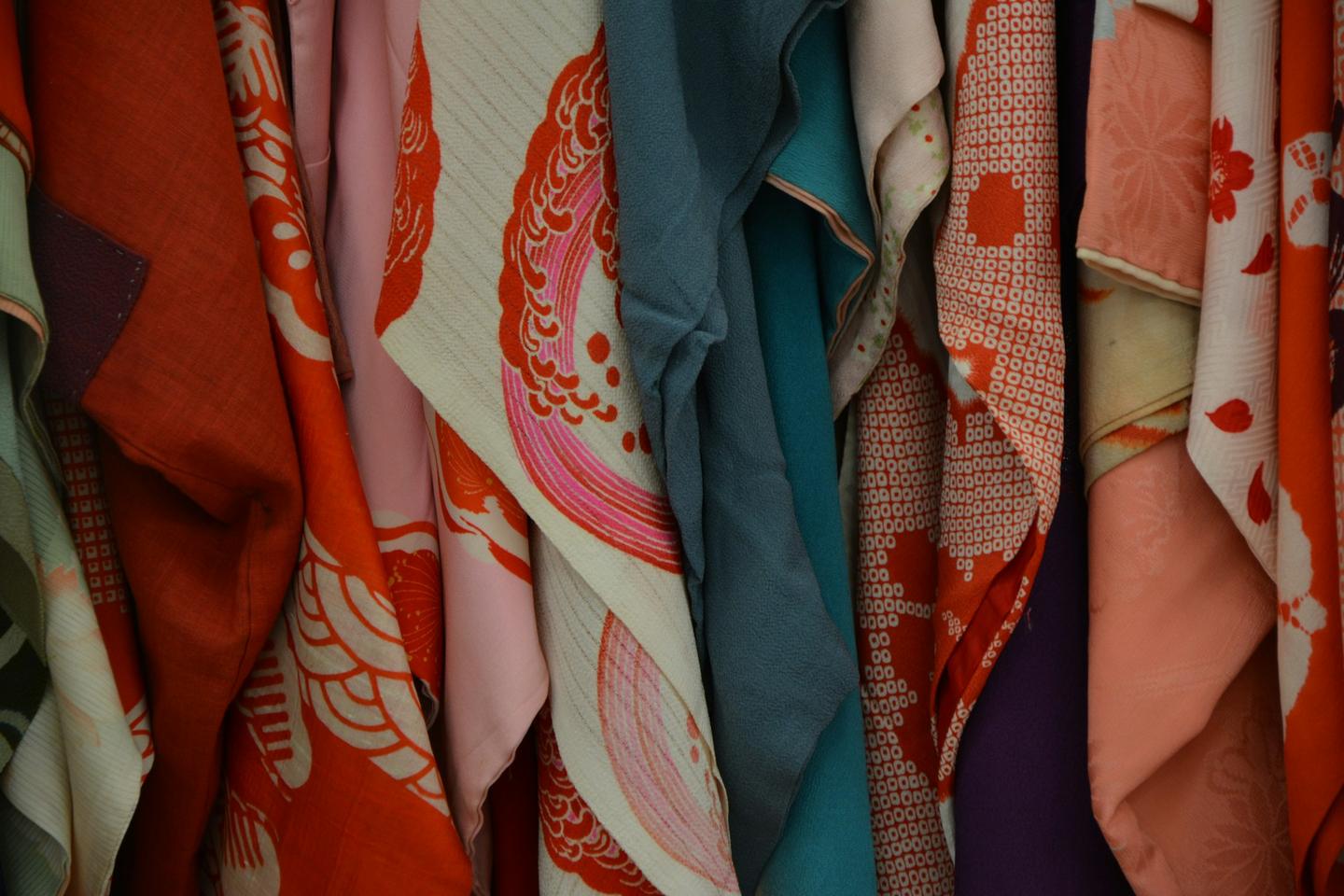
Kaga Yuzen is the traditional silk dyeing technique of Kanazawa. Its makers describe it as pictorial, with motifs drawn from nature and the classics, a palette built on the "Kaga five colours", and two signature touches: mushikui, leaves painted with insect holes as they appear in nature, and saki-bokashi, shading toward the edge of a motif. Gold work and embroidery are rarely added after dyeing. It is a living tradition. There are still working artists in Kanazawa producing Kaga Yuzen garments for the domestic luxury market.
Some studios offer private sessions, typically two to three hours, working with a dyer on a piece that guests take home. Guests go beyond watching: they use the resist-dyeing technique, apply the dye and see the fixing process. Studio schedules change. The Nagamachi Yuzen-kan in the samurai quarter, long a place to try hand-painting, has opened only occasionally since 2024, so we confirm which studios are receiving guests before planning the afternoon. It is a hands-on way to meet a craft that is still practised in the city.
Noh runs deep in Kanazawa too. The local style is Kaga Hosho, and the Kanazawa Noh Museum in Hirosaka, near the 21st Century Museum, holds costume try-on days. From December 11 its next exhibition, the second part of the collection of Sano Kichinosuke, runs until March 28. For travelers with an interest in classical Japanese performing arts, Kanazawa offers a close, local way into Noh.
BENIYA MUKAYU: THE RYOKAN EXTENSION
Yamashiro Onsen is a hot spring town in Kaga, approximately one hour from Kanazawa by car. It is the location of Beniya Mukayu, a 16-room member of Relais & Châteaux, and the ryokan we suggest for the closing night of a Kanazawa extension.
Beniya Mukayu departs from the classic ryokan look. The architecture is contemporary minimalist, restrained, precise, and undecorated. All 16 rooms face the Forest Garden, and each has a private open-air hot spring bath. Dinner at Kaiseki Horin is Kaga-style kaiseki built on the region's rivers, mountains and Sea of Japan catch, served on locally made tableware and changed with the season, and the owner, Mr. Nakamichi, performs the tea ceremony for guests.
We suggest ending a Kanazawa itinerary this way, because it closes the trip with an onsen night after the city days: two nights in the city, a half-day in the market and Higashi Chaya, Kenroku-en in the morning, a private craft workshop in the afternoon, and then the hour south to Yamashiro Onsen.
Within Kanazawa itself, a machiya townhouse rental suits travelers who want the feel of living in an old quarter. Several have been converted to private accommodation in the Higashi Chaya and Kazuemachi districts. The Kanazawa Hakuchoro Hotel Sanraku is a well-regarded hotel in the city centre. For travelers who prefer a full-service hotel with traditional elements, the Hotel Nikko Kanazawa is a few minutes' walk from Kanazawa Station, which keeps the Shinkansen days simple. A city hotel followed by a final night at Beniya Mukayu is one sequence that works well.
KANAZAWA OR A SECOND KYOTO STAY
Kyoto and Kanazawa differ in scale and character. Still, this is the comparison that matters for travelers who have already done Kyoto and are considering where to spend additional days in Japan. The case for Kanazawa over a second Kyoto visit is simple: lighter crowds in most seasons, everyday life close to the sights, and a craft culture closely tied to the region.
The gold leaf culture alone (the workshops, the markets, the application of gold to lacquerware and ceramics and temple interiors) is a reason to come. Add Kenroku-en in winter, Omicho market at dawn with snow crab, a Kaga Yuzen private workshop, the intact streets of Higashi Chaya before the tour buses arrive, and one night at Beniya Mukayu: together they give a Japan extension a clear shape and an unhurried pace.
SOURCES AND HOW WE CHECKED
We read every page below on October 28, 2026, and did not contact the workshops, the market, the inn or the garden. The list mixes the operators' own pages, museums, the prefectural office that runs the garden and castle, the fishery and lacquer cooperatives, a regional newspaper and two magazines, most of them in Japanese.
- JR West, Hokuriku Shinkansen: Kanazawa to Tokyo in 2 hours 28 minutes on the fastest train
- JR East, timetable for November 2026, Kagayaki 503 (Japanese): Tokyo 7:20 to Kanazawa 9:44, the fastest train from Tokyo
- Ishikawa Prefecture, Kanazawa Castle and Kenroku-en Management Office, Kenroku-en visitor information (Japanese): opening hours, the 320 yen fee and free early-morning entry
- Same office, notice on the 2026 Kenroku-en yukitsuri (PDF) (Japanese): work from November 1, the Karasaki pine's 800 ropes and five poles, finish in mid-December
- Same office, About Kenroku-en (Japanese): Special Place of Scenic Beauty and one of Japan's three great gardens
- Kanazawa Castle Park, Hishi Yagura, Gojikken Nagaya and Hashizume-mon Tsuzuki Yagura (Japanese): reconstructed in wood with traditional methods in 2001
- Waraku web (Shogakukan), on Kenroku-en (Japanese): the name taken from the Luoyang Mingyuan Ji and in use from 1822
- Ochaya Shima, About Shima (Japanese): the district laid out in 1820, the 1820 building and its second-floor guest rooms
- Ochaya Shima, admission and hours (Japanese): 600 yen, opening hours, matcha prices and the rules on bags and socks
- Kanazawa Yasue Gold Leaf Museum, About the museum (Japanese): all of the gold leaf made in Japan comes from Kanazawa
- Same museum, The nature of gold leaf (Japanese): engitsuke leaf averages about 0.1 micron
- Same museum, English page: hours, Tuesday closing and the 310 yen admission
- Wajima Lacquerware Cooperative (Japanese): the 124 steps of Wajima-nuri, the hall closed since the 2024 earthquake and the temporary refining plant
- Time Out Tokyo, Discover Noto tour (September 30, 2024): workshops lost in the earthquake and craftspeople working from other workshops
- 21st Century Museum of Contemporary Art, Kanazawa, visitor information: zone hours and Monday closing
- Same museum, The Swimming Pool reservations: exhibition ticket, same-day timed reservation and the five-minute limit
- Omicho Market (Japanese): about 170 shops and some 300 years of history
- JF Ishikawa, Wajima branch, on the crab season (Japanese): season dates for kano-gani and kobako-gani and the blue port tag
- Hokkoku Shimbun, first crab of the season in shops (November 8, 2025) (Japanese): the same closing dates, March 20 and December 29
- Ishikawa Prefecture Fisheries Research Center, fishing bulletin no. 463 (PDF) (Japanese): kano-gani is the male, kobako the female, and the season opens on November 6
- Nagamachi Yuzen-kan, About Kaga Yuzen (Japanese): pictorial motifs, the Kaga five colours, mushikui, saki-bokashi and little gold or embroidery
- Nagamachi Yuzen-kan, notice of continued closure (Japanese): closed since 2024 apart from occasional openings
- Kanazawa Noh Museum (Japanese): the 20th-anniversary exhibition on the Yokoyama family and Kaga Hosho, and costume try-on days
- Beniya Mukayu, Guest Rooms: 16 rooms facing the Forest Garden, each with a private open-air hot spring bath
- Beniya Mukayu, Cuisine: Kaiseki Horin and its local ingredients
- Relais & Châteaux, Beniya Mukayu: membership, Kaga-style kaiseki on local tableware and the owner's tea ceremony
QUESTIONS, ANSWERED
How do you get from Tokyo to Kanazawa?
The Hokuriku Shinkansen connects Tokyo and Kanazawa directly. The fastest Kagayaki trains take about 2 hours 24 minutes from Tokyo; the Hakutaka makes more stops and takes longer. The line was extended through to Tsuruga in March 2024. The JR Pass covers this route.
What is Beniya Mukayu and why do travelers choose it?
Beniya Mukayu is a contemporary minimalist ryokan in Yamashiro Onsen, approximately one hour from Kanazawa by car, and a member of Relais & Châteaux. Its 16 rooms each have a private open-air hot spring bath, dinner is Kaga-style kaiseki made with local ingredients, and the owner performs the tea ceremony for guests.
Is Kanazawa better than Kyoto for travelers who have already been to Japan?
For many repeat visitors, Kanazawa is a good alternative to a second Kyoto stay. Everyday life sits close to the cultural sites, the crowds are usually lighter, and its artisan culture (gold leaf, Kutani ceramics, Kaga Yuzen dyeing, Noh theatre) is closely tied to the region. Kenroku-en is one of Japan's three great gardens, and Higashi Chaya is a nationally designated preservation district where teahouses still operate.
When should you visit Kanazawa?
Winter (December to February) gives the garden its best-known look, when snow can cover Kenroku-en's pine trees. The yukitsuri (rope supports), put up from November 1, create a distinctive silhouette. Autumn (October to November) is also a fine time for the garden and the surrounding countryside. Snow crab season opens on November 6 and runs to March 20 for the male kano-gani (the female kobako-gani only to December 29), making winter visits particularly rewarding for dining.
ADD KANAZAWA TO YOUR JAPAN ITINERARY
We plan Kanazawa extensions around what you would like to do there: a gold leaf workshop, the morning market, Kenroku-en in season, and a final night at an onsen ryokan such as Beniya Mukayu.
Start planningWe reply within 24 hours, in writing
Some of the restaurants and bars we arrange seat guests only by introduction or membership. We ask on your behalf; the table and the evening are the house's decision. We do not publish their names.