In 2025 the rainy season settled over Kyoto around May 17. In 2019 it held off until around June 27. The Japan Meteorological Agency puts the average start for Kinki, the region that includes Kyoto, at around June 6, and the average end at around July 19. Those are the dates the guidebooks repeat, and the reason most of them steer you away from the month. The agency's own record for the last eight years tells a less tidy story: in 2025 the rain was gone by around June 27, the date on which it had only begun in 2019, and in 2020 it lasted until around August 1. The one thing every guide can say about June with confidence is that it rains. The one thing nobody can say is when.
This article is for a traveller whose dates fall in June 2027 and who wants to know what the month gives that April and November cannot. It covers when the rain actually comes, the gardens that look their best wet, the dishes of the month, the dry week in Hokkaido, and how we would shape a fortnight around them. The month-by-month weather tables are in When to Honeymoon in Japan, and Why We Would Choose May; the spring and autumn comparison is in Should You See Japan in Cherry Blossom or Autumn Leaves?.
Key points
- The agency's average for Kinki is around June 6 to July 19, but between 2019 and 2026 the start ranged from around May 17 to around June 27. A June plan is built with one fixed day and the rest movable, so that the forecast chooses the date and the reservation does not.
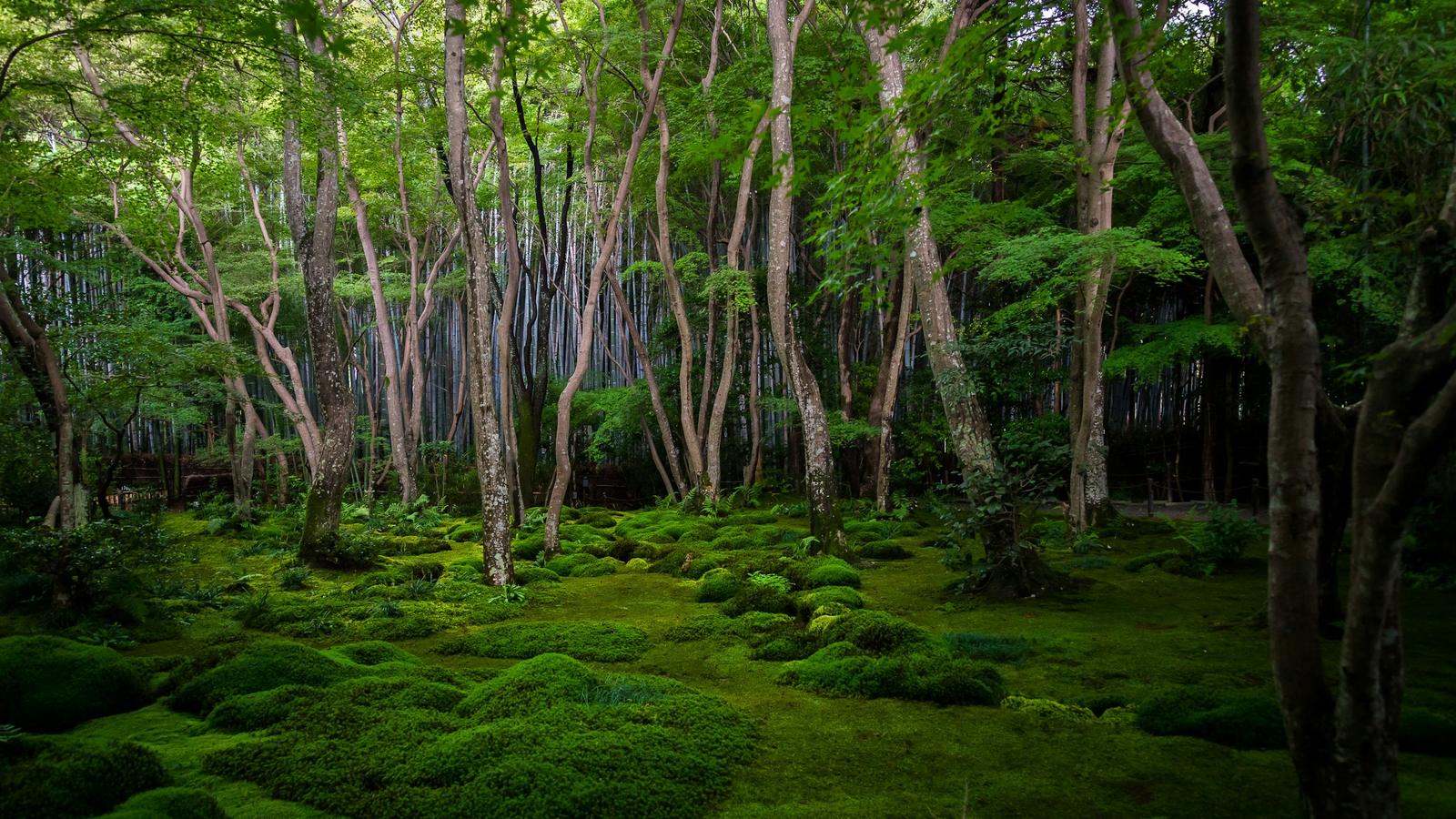
- Saiho-ji, the moss temple, has admitted only small numbers by reservation since 1977: at least a day ahead, two people to a reservation, visitors aged 13 and over, sutra copying and then the garden, about 60 minutes in all. Moss has no roots and takes its water from rain, so this is the garden that gains from the month.
- Mimurotoji in Uji currently gives May 29 to July 4 for its 2027 hydrangea garden, 8:30 to 15:10, with weekend illuminations from June 12 to 27. In Kamakura, Hasedera sold a 500 yen hydrangea ticket in 2026, released on Tuesdays at 10:00 for the seven days from that weekend, and Meigetsu-in opened at 8:30 through June.
- June puts hamo, the conger eel of Gion Matsuri's second name, on Kyoto's tables; Kibune's riverside kawadoko ran from May 1 in 2026; the new tea picked on May 2 is on the shelves; Hotel Chinzanso Tokyo's firefly evenings ran from May 17 to June 30 in 2026.
- Sapporo's June has 60.4 mm of rain and 180.0 hours of sunshine against Kyoto's 199.7 mm and 133.1 hours. Kyoto first, Hokkaido second, and the lavender, which peaks in early to mid July, left for another year.
WHEN THE RAIN ACTUALLY COMES
The agency declares the start and end of tsuyu for twelve regions, Okinawa and Amami at one end and northern Tohoku at the other, and it settles the dates only after the season is over, looking back at how the weather actually ran. The averages are the mean of 1991 to 2020. For Kinki they are the dates above, around June 6 and July 19; for Kanto-Koshin, which takes in Tokyo and Kamakura, around June 7 and July 19; for Okinawa around May 10 and June 21. Hokkaido is not on the list, and that matters later.
What the averages hide is the spread. In the agency's confirmed record, Kinki's start fell around May 17 in 2025, May 29 in 2023, June 2 in 2026, June 10 in 2020, June 12 in 2021, June 14 in 2022, June 17 in 2024 and June 27 in 2019. The end moved between around June 27 in 2025 and around August 1 in 2020. A fortnight planned to the average date misses in several of those years. That is the first rule of June: build the plan so that it does not depend on the forecast being right.
The averages also need the wet years set beside them. In June 2026 the Kyoto Local Meteorological Observatory recorded 382.0 mm of rain in the city, 191 percent of the normal 199.7 mm, with heavy rain on June 2 and 3, on the 20th and on the 25th and 26th, when the front and a typhoon together brought what the observatory called record rainfall. Sunshine was 117.5 hours against a normal of 133.1. The same report notes days of clear skies under high pressure. That is what a wet June looks like, and even that June had clear days in it.
In an ordinary year Kyoto's June has about 11.5 days with 1 mm or more of rain and 133.1 hours of sunshine; November has about 6.3 such days and 140.7 hours. Across the whole month that is about five more wet days and eight fewer hours of light. The difference is real, and it is smaller than the reputation.
GARDENS MADE FOR RAIN
Moss has no roots. Porada and Giordani, writing in Frontiers for Young Minds, put it plainly: without roots, mosses take up water by collecting rainfall or the moisture of dew and fog, and when there is none they dry out and go inactive until water returns. A Japanese planting handbook says the same of the group as a whole: no division into root, stem and leaf, water absorbed through the whole body, a plant that declines wherever the air stays dry. A moss garden is therefore a garden at its best in the week the rain has just fallen. In Kyoto in June that is most weeks.
Saiho-ji, the temple in western Kyoto known as Kokedera, the moss temple, is the garden this argument was made for. The Kyoto City Tourism Association counts more than 120 kinds of moss across its two-tiered garden, the upper tier a dry rock garden whose stones stand like islands in a green sea. The temple was remade as a Zen temple in 1339 by the monk Muso Soseki, who is also said to have designed that upper tier. Since 1977 the temple has admitted only small numbers of visitors, by reservation.
The daily visit, as the temple now runs it, is reserved at least a day in advance through its online system, with two people to a reservation and no groups of more than five; visitors must be 13 or over; the visit is sutra copying in the main hall and then the garden, about 60 minutes in all. Cancellation is free up to four days before; the closer terms are on the temple's page. Photographs are taken from the path only, without tripods, monopods or selfie sticks, and never inside the buildings. Anyone may reserve on the same terms; there is no other door. For the fee and the opening of the reservation window, see Katsura Imperial Villa Reservation and the Moss Temple.
This is the one day in a June itinerary we hold fixed. The reservation ties it to a date, and the garden gains from rain, so a wet forecast is no reason to move it. If the morning turns out to be a downpour, the sutra is copied under a roof and the garden is walked in it.
Two gardens that take no reservation make the movable days. Sanzen-in in Ohara, north of the city, is open from 9:00 to 17:00 from March to October, with admission of 700 yen; on June 20, 2026, the temple itself wrote that it had entered the season when the green maples and the moss are beautiful. Gio-ji in Sagano is smaller, a thatched hermitage inside a moss garden under green maples, open from 9:00 to 17:00 with the last entry at 16:30, 500 yen, or 1,000 yen on a joint ticket with Daikaku-ji. Both are visited without a reservation, which is why they belong on the days that may move. The same notices from Sanzen-in carry a warning: in 2026 an unexpected pest infestation meant its hydrangeas hardly flowered at all. No garden promises a bloom, and we do not promise one on a garden's behalf. The Kyoto places that open only by application, a different kind of fixed day, are in our article on the city's closed doors.
HYDRANGEA HILLSIDES
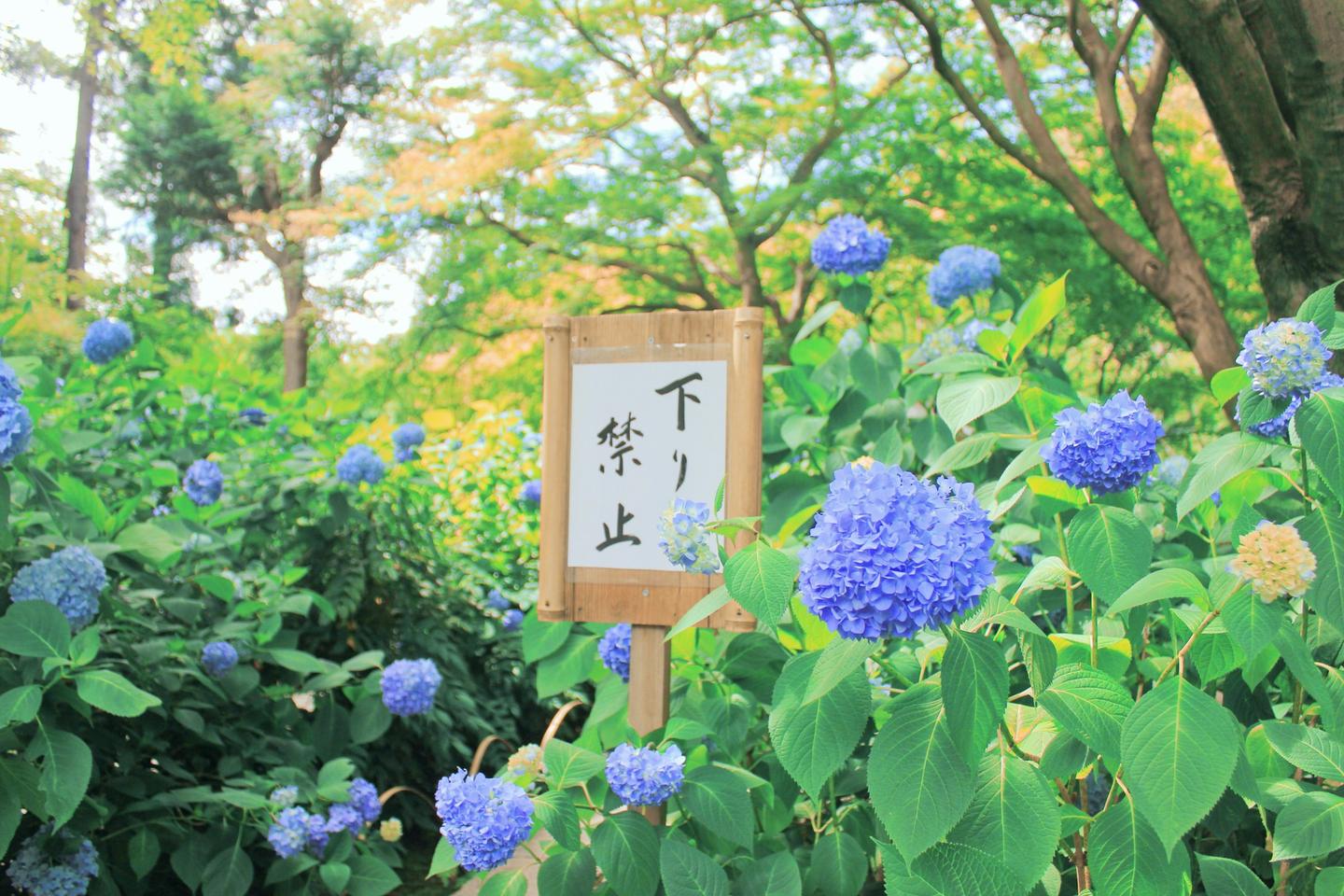
Hydrangeas are the flower of the rainy season, and the temples that have built their June around them stand in two places, Uji and Kamakura. Mimurotoji, in Uji south of Kyoto, is already looking ahead to 2027. The temple's page currently gives the hydrangea garden as open from May 29 to July 4, 2027, from 8:30 to 15:10 with the gate closed at 16:00, and the temple describes 20,000 plants flowering between the cedar trunks like a purple picture scroll. Admission is 1,000 yen for adults and 500 yen for children. On Saturdays and Sundays from June 12 to 27, 2027, the garden reopens for illumination from 19:00 to 21:00, last entry 20:30, at the same prices. Because the garden runs for five weeks, Uji is a movable day; within that window, the forecast chooses the date. A dry morning in the middle of the week, at opening, is the one to take. In Kyoto itself, Fujinomori Shrine opens a hydrangea garden for the month as well.
Kamakura, south of Tokyo, has two more. Meigetsu-in, whose hydrangeas are known as Meigetsu-in blue, opened from 8:30 to 17:00 through June 2026, with the last entry at 16:30, in place of its usual 9:00 to 16:00. The Kamakura City Tourist Association counts about 2,500 plants along the approach, and admission is 500 yen. The garden behind the main hall opens for a further 500 yen only in the iris season and the autumn colour season, which is to say it is open in June.
Hasedera, the other great hydrangea temple of Kamakura, takes online reservations for its hydrangea ticket, and the ticket can also be bought at the gate on the day. Entry to the hydrangea path needs a 500 yen hydrangea ticket for anyone of primary school age and above, on top of the 400 yen admission. Online, the slots are released every Tuesday at 10:00 for the seven days beginning that weekend, 60 minutes to a slot and up to ten people to a booking. The paid period in 2026 began on June 5, and from April to June the temple is open from 8:00 to 17:00 with the gates closed at 17:30. The 2027 arrangements are announced in the spring, and we plan on the same shape until the temple says otherwise.
The Tuesday release is useful. If you are in Tokyo in the first half of the week, the week's forecast is already readable, and the slot for Saturday or Sunday can be taken once the sky is known. If the week allows a night away from Tokyo, the hydrangeas along the Hakone Tozan line are in our Hakone article.
WHAT JUNE PUTS ON THE TABLE
Kyoto's July festival, Gion Matsuri, has a second name, hamo matsuri, the conger eel festival, and the Kyoto Prefectural Library files its reading on the festival's food under the heading that Gion Matsuri means hamo. Hamo is full of fine bones, and the cook's answer is honegiri, cutting through flesh and bone every few millimetres while leaving the skin intact; the magazine Serai gives the professional's standard as 25 cuts to the sun, about three centimetres. Blanched, the cut fish becomes hamo otoshi, the cold dish of the Kyoto summer. In 2022 the same magazine listed Nijo Yamagishi, which put hamo hot pot and hamo shabu-shabu on its June and July menus, among the places to eat it. June is the month to eat it, before the festival fills the city in July. For the festival itself, see Gion Matsuri 2027.
North of the city at Kibune, fifteen restaurants set their tables on platforms over the river for the kawadoko season, which in 2026 ran from May 1 to September 30, with dates that vary by house. Rain can close the platforms. Hirobun, one of them, suspends its kawadoko in rain, in high water or while a weather warning is in force, and serves the meal in its dining room instead. A kawadoko evening in June is therefore a movable one, with the restaurant's own room as the fallback.
Tea is a June pleasure of a different kind. Picking begins on the 88th night after the start of spring, May 2, or May 1 in a leap year, and Uji marks it with a tea-picking gathering that day; in 2026 Ippodo in Kyoto released its new tea, shincha, on May 23 and serves it until the new leaf runs out. By June the tea is on the shelves, so June is the month to drink it, and a tea shop is a good hour of a wet afternoon. The fields themselves, and the shortage, are in our Uji matcha article. If your last day in Kyoto is June 30, there is minazuki, a triangle of white uiro topped with sweet adzuki eaten on that day; its shape recalls ice cut from the old icehouses, and the red beans are for warding off ill fortune.
If the journey passes through Tokyo, one June evening belongs to fireflies. Hotel Chinzanso Tokyo has shown them in its garden since 1954; the hotel says they begin to fly in mid May, peak in early June and can be seen until late June, with fireflies raised on a slower schedule shown in the biotope from late June into early July. The 2026 Firefly Evening dinners ran on set dates from May 17 to June 30. The 2027 dates are announced in spring, and the insects keep their own calendar.
THE DRY SECOND WEEK
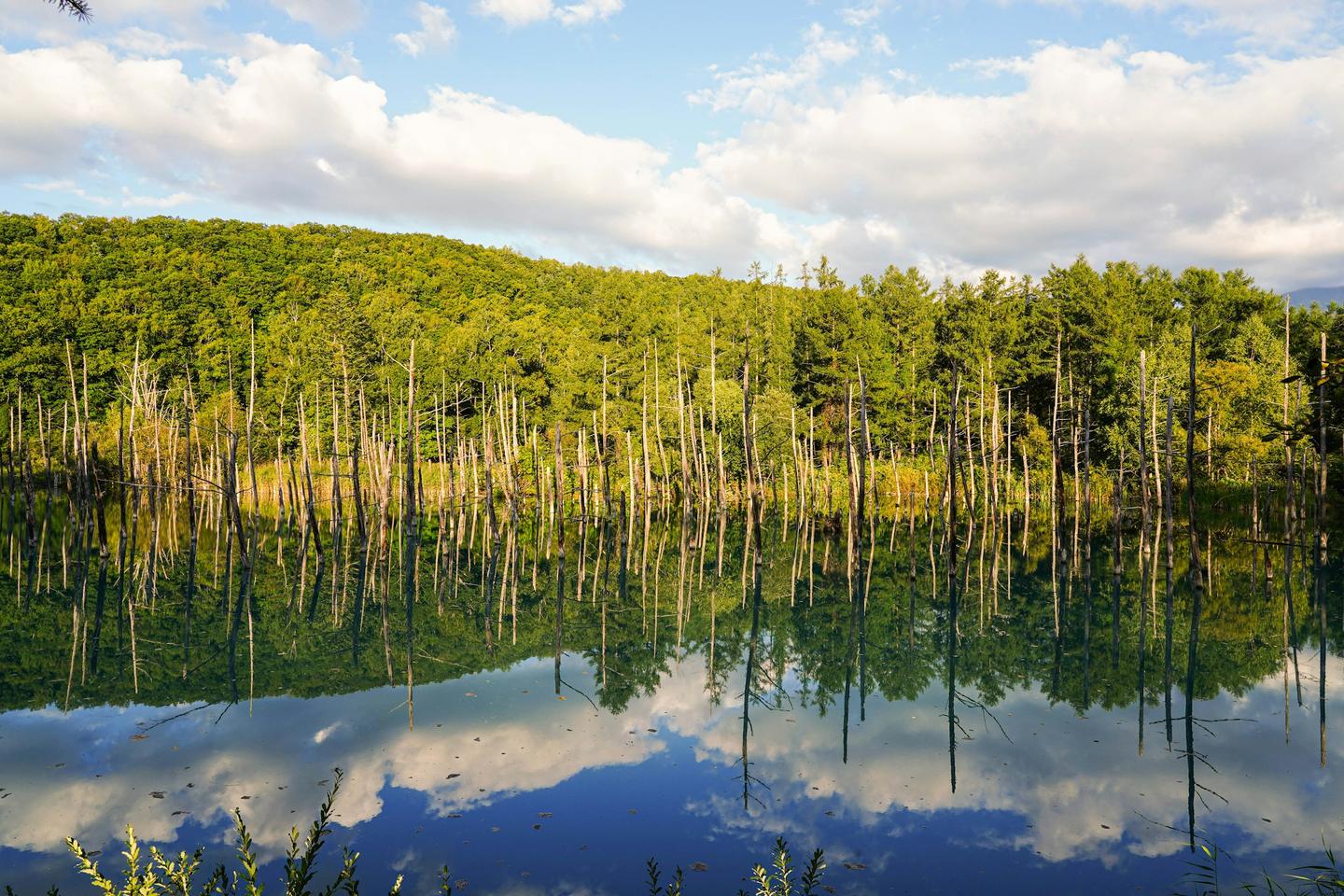
Sapporo in June gets 60.4 mm of rain over about 7.5 days, 180.0 hours of sunshine and an average of 17.0 degrees. Kyoto, the same month, gets 199.7 mm, 133.1 hours and 23.3 degrees. Sapporo's June is close to its spring figures, 55.5 mm in May and 54.6 in April, and July is already wetter at 90.7 mm. Hokkaido sits outside the twelve regions for which the agency declares a rainy season. It still rains there, on those 7.5 days. What the island lacks is the season itself.
That is why the order matters. Put Kyoto in the first week of a June journey and Hokkaido in the second, and the Kyoto days fall around the average start of the rain, when it is still intermittent, while the Hokkaido days fall in a month that is drier and brighter than Kyoto's by a wide margin. Reverse it and the Kyoto week drifts toward late June, which in 2026 was the week of the record rain. In June, Kyoto first and Hokkaido second. The order is set by the rain, and the map has to follow.
The second week has one thing it cannot give. Farm Tomita's Lavender East opened on June 20 in 2026 and closed on July 20, and the farm itself puts the best of the bloom in early to mid July. A June visit to Furano comes before the lavender, however it is placed. What Hokkaido gives in June is the light and the open country, the hills around Biei, and the sea, whose summer uni season is in our sea urchin article.
In Sapporo, the Hokkaido Shrine Festival runs each year from June 14 to 16, with the procession on the 16th; in 2025 it set out at 9:00 with four mikoshi, nine floats and about a thousand people, and stalls filled Nakajima Park. If the dates fall in the second week, it is worth an afternoon. The island in summer, as a family sees it, is in Hokkaido in Summer, Where Gulf Families Wear a Jacket at Night.
HOW WE WOULD SHAPE JUNE 2027
A fortnight, then, in this order. Seven or eight nights in Kyoto, one or two nights in Tokyo if the fireflies or Kamakura are wanted, and four or five nights in Hokkaido. One fixed day, Saiho-ji. Around it the movable days: Ohara or Sagano, Uji, Kibune, and a day kept under a roof as the receiving day for whichever of those the weather takes. Two places a day, and a long lunch between them; a wet day shortens both the light and the legs. The reason for a single fixed day is simple. Every reservation that binds a date removes a day the rain can move, and with two or more of them the slack is gone.
The private car is what makes the movable days work, and its value in June is less about staying dry than about being able to wait. A hard hour of rain is spent in the car, and the garden is entered in the lull that follows; neither a train timetable nor a taxi rank allows that decision. As a reference, Tokyo MK's published fare for eight hours within Tokyo starts from 74,000 yen for an Alphard, tax included, as of May 21, 2026. Arranging the car is part of Signature, our planning for journeys of 7 to 21 days; the fare itself is settled with the hire company.
The roof day has its own content. Tsujikura, on Kawaramachi just north of Shijo, dates itself to 1690 and calls itself the oldest umbrella shop in Japan. It is open from 12:00 to 18:00, closed on Wednesdays, on the seventh floor of its own building a few minutes north of the Hankyu station, and offers workshops in making and painting a small hime-wagasa. Hiyoshiya in Kamigyo-ku has made Kyoto umbrellas since the late Edo period, more than 160 years, and publishes no visiting hours, so a visit there is asked for. A wagasa is the one thing to buy that the month explains.
The other half of the roof day is the room. In June we place a stay with a garden, a machiya or a ryokan where an afternoon can be spent watching rain on stone from inside; the houses are in Kyoto's Ryokan With a Private Onsen and Where to Stay in Kyoto. June also loosens the city's hotels. In the Kyoto City Tourism Association's figures, June is a quiet month that usually runs about five points under May in occupancy, and the rooms that are hardest to secure in April and November are easier to ask for. The average rate has gone on rising all the same, so the month's gain is availability rather than price.
Nobody can tell you when the rain will come in June 2027. Built this way, the journey does not need to know.
SOURCES AND HOW WE CHECKED
We read the pages below on November 7, 2026. We did not contact any temple, shrine, shop, hotel, tourism office or agency. The only 2027 dates shown so far are Mimurotoji's, as its page currently has them; everything else is given as it ran in 2026 or 2025, with the year. Prices and hours are those shown on each page on the day we read it.
- Japan Meteorological Agency, rainy season start and end (Japanese): the twelve regions, Hokkaido not among them; averages are the 1991 to 2020 mean; dates confirmed after the season
- Japan Meteorological Agency, Kinki (Japanese): average around June 6 and July 19; confirmed dates 2019 to 2026
- Japan Meteorological Agency, Kanto-Koshin (Japanese): average around June 7 and July 19
- Japan Meteorological Agency, Okinawa (Japanese): average around May 10 and June 21
- Japan Meteorological Agency, Kyoto monthly normals 1991 to 2020 (Japanese): June 199.7 mm, 133.1 hours, 23.3 degrees; April and November; days with 1 mm or more
- Japan Meteorological Agency, Sapporo monthly normals 1991 to 2020 (Japanese): June 60.4 mm, 180.0 hours, 17.0 degrees; April, May and July; days with 1 mm or more
- Kyoto Local Meteorological Observatory, June 2026 monthly report (Japanese, PDF): 382.0 mm, 191 percent of normal; 117.5 hours of sunshine; heavy rain on June 2 to 3, 20 and 25 to 26; record rainfall from the front and a typhoon
- Saiho-ji: small numbers by reservation since 1977
- Saiho-ji, daily visit: at least one day in advance; two people per reservation; no groups over five; sutra copying and then the garden, about 60 minutes in all
- Saiho-ji, FAQ: visitors aged 13 and over; cancellation terms; photography from the path only; online payment
- Kyoto City Tourism Association, Saiho-ji: over 120 kinds of moss, two tiers, the upper rock garden, Muso Soseki
- Porada and Giordani, Frontiers for Young Minds (November 3, 2022): mosses have no roots and take water from rain, dew and fog; dry out and go inactive without it
- Sekisui House, planting catalogue, mosses (Japanese, PDF): no division into root, stem and leaf; water absorbed through the body; decline in dry places
- Sanzen-in, hours and admission (Japanese): 9:00 to 17:00 from March to October; 700 yen
- Sanzen-in, notices of June 8 and June 20, 2026 (Japanese): hydrangeas hardly flowered after pest damage; the season of green maples and moss
- Kyoto Prefecture Tourism Federation, Gio-ji (Japanese): 9:00 to 17:00, reception until 16:30; 500 yen; joint ticket with Daikaku-ji 1,000 yen; the thatched hut in the moss garden
- Mimurotoji, hydrangea garden 2027 (Japanese): May 29 to July 4, 2027; 8:30 to 15:10, gate closed at 16:00; 20,000 plants among the cedars; the page's weekday for May 29 does not match the 2027 calendar, recheck in spring 2027
- Mimurotoji, illumination 2027 (Japanese): Saturdays and Sundays from June 12 to 27; 19:00 to 21:00, last entry 20:30; 1,000 yen and 500 yen
- Mimurotoji, visitor guide (Japanese): admission 1,000 yen adults, 500 yen children
- Kamakura City Tourist Association, hydrangea information 2026 (Japanese): Hasedera's 500 yen hydrangea ticket, Tuesday 10:00 release for seven days, 60-minute slots, paid period from June 5; Meigetsu-in 8:30 to 17:00 in June, about 2,500 plants
- Kamakura City Tourist Association, Meigetsu-in (Japanese): Meigetsu-in blue; usual hours 9:00 to 16:00; 500 yen; rear garden 500 yen in the iris and autumn seasons
- Hasedera, Kamakura, visitor guide (Japanese): April to June 8:00 to 17:00, gates close 17:30; 400 yen
- Tetsudo Channel (Japanese, May 23, 2026): the online hydrangea ticket, 2025 paid period June 6 to 26, over 40 varieties and about 2,500 plants
- Hasedera announcement of May 6, 2026, via Best Calendar (Japanese): up to ten people per booking
- Fujinomori Shrine (Japanese): the hydrangea garden and its season
- Serai (Japanese, June 11, 2022): Gion Matsuri as hamo matsuri; 25 cuts to the sun; Nijo Yamagishi's hamo hot pot and shabu-shabu in June and July, as listed in 2022
- Kyoto Prefectural Library, Gion Matsuri reading list (Japanese, PDF): the heading on Gion Matsuri and hamo
- Kyodo Ryori Monogatari, hamo otoshi (Japanese): bone cutting with the skin intact; the blanched summer dish
- Kyoto City Tourism Association, Kibune kawadoko 2026 (Japanese): May 1 to September 30, 2026; varies by restaurant; fifteen restaurants
- Hirobun, Kibune kawadoko (Japanese): kawadoko suspended in rain, high water or a weather warning; the meal served in the dining room instead
- Kyoto Prefecture, Yamashiro tea calendar (Japanese): the 88th-night tea picking on May 2, May 1 in a leap year
- Ippodo, shincha diary 2026 (Japanese): picking from the 88th night; release on May 23, 2026; served until it runs out
- JAL Skyward+ (Japanese, April 28, 2026): minazuki on June 30, its shape and the adzuki
- Hotel Chinzanso Tokyo, news release of April 17, 2026 (Japanese, PDF): fireflies since 1954; flight from mid May, peak early June, to late June; 2026 dinners May 17 to June 30; biotope fireflies late June to early July
- Farm Tomita, Lavender East: open June 20 to July 20, 2026; best early to mid July
- Sapporo Tourist Association, Hokkaido Shrine Festival 2025 (Japanese): June 14 to 16, 2025; procession on the 16th from 9:00; four mikoshi, nine floats, about 1,000 people; stalls in Nakajima Park
- Hokkaido Shrine (Japanese): festival period June 14 to 16 in its notices for 2021, 2022 and 2026
- Tsujikura (Japanese): founded 1690; seventh floor, Kawaramachi Shijo-agaru; 12:00 to 18:00, closed Wednesdays; hime-wagasa workshops
- Hiyoshiya (Japanese): founded in the late Edo period, more than 160 years; Kamigyo-ku address; no visiting hours published
- Kyoto City Tourism Association, monthly report June 2025 (Japanese, PDF): 110 hotels, 80.0 percent occupancy; average room rate 17,286 yen, up 5.2 percent
- Travel Voice (Japanese, July 31, 2023): June 2023 occupancy 76.5 percent, 4.3 points below May; June a quiet month, usually about five points under May
- Tokyo MK, fares (Japanese): eight hours and 120 km within Tokyo from 74,000 yen for an Alphard and from 84,000 yen for a Lexus LM500, tax included, as of May 21, 2026; drivers with foreign languages and meet service extra
QUESTIONS TRAVELLERS ASK
Does it rain every day in June?
No. Kyoto's normal June has about 11.5 days with 1 mm or more of rain, against 6.3 in November and 9.4 in April. Even in June 2026, when rainfall reached 191 percent of normal, the observatory recorded clear days under high pressure. The pattern is heavy days and dry days, which is why the plan separates the fixed day from the movable ones.
When should we reserve Saiho-ji?
As soon as the temple opens the dates for your week. Reservations are made through the temple's online system, two people to a reservation, and close the day before the visit; cancellation is free up to four days before. We place the request for you and hold that day fixed in the itinerary. The fee and the reservation window are in Katsura Imperial Villa Reservation and the Moss Temple.
When are the hydrangeas at their best?
In Kamakura, Meigetsu-in's season usually runs from early to late June, and Hasedera's paid period began on June 5 in 2026 and ran from June 6 to 26 in 2025. Mimurotoji in Uji currently gives May 29 to July 4 for its garden in 2027. No temple promises the bloom; in 2026 Sanzen-in's hydrangeas hardly flowered.
Should we leave Kyoto out and go only to Hokkaido?
If the gardens are the reason for the journey, no. Hokkaido in June is dry and clear, and it is also before the lavender; the moss, the hydrangeas, hamo and the new tea are all in Kyoto. The fortnight that works puts Kyoto first and Hokkaido second.
Can children come to Saiho-ji?
From the age of 13. For a family with younger children we leave Saiho-ji out and see moss at Sanzen-in and Gio-ji, which are visited without a reservation, and hydrangeas at Mimurotoji.
ASK US ABOUT JUNE 2027
Tell us your dates, who is travelling and how you like your days to run. We will set out a fortnight for June, with the fixed day and the movable ones marked and the reason for each, so that you can decide.
Begin planningWe reply within 24 hours, in writing
Some of the restaurants and bars we arrange seat guests only by introduction or membership. We ask on your behalf; the table and the evening are the house's decision. We do not publish their names.