Hakone is the classic escape from Tokyo, the mountain resort, the hot springs, the view of Fuji across the lake, and it is one of the most visited destinations in Japan. It is also one of the most misunderstood. As a quick day trip it can feel rushed and crowded. With a night there, it becomes an unhurried evening of hot springs, kaiseki and mountain quiet.

Where it is

In the mountains of southwest Kanagawa, west of Odawara.
- Shinjuku Station to Hakone-Yumoto, by limited express, about 1 hr 25 min
Times come from the railways' official timetables. Map based on Natural Earth and OpenStreetMap (© OpenStreetMap contributors).
This article is about Hakone with a night there: which ryokan, which museums, how to approach the Fuji view, and why staying the night changes the trip.
Key points
- The Romancecar runs from Shinjuku to Hakone-Yumoto in 85 minutes with no transfers. A private car from Tokyo takes 90–120 minutes depending on traffic and allows stops on the way.
- A day trip covers the Open Air Museum and a lake view. The ryokan only reveals itself across an evening and a morning, so one night is the minimum and two nights, with a full day between, is the stay we would suggest.
- Mount Fuji is visible from Hakone, but not reliably. The odds are highest from November through February and lowest in summer, so plan as though the view will not happen.
- The Open Air Museum and the Pola Museum work better on separate mornings. The ropeway over Owakudani closes periodically for volcanic activity, so check its website before planning around it.
WHY HAKONE
Hakone sits in the caldera of an ancient volcano 90 minutes southwest of Tokyo by the Romancecar, Odakyu's private express train from Shinjuku, a pleasant rail journey in its own right. The observation car at the front, reserved seating, the view transitioning from city to suburb to forest to mountain: it is worth taking for the journey alone. An alternative approach is the Shinkansen to Odawara (35 minutes) then the Hakone Tozan mountain railway, slower, more intimate, tunneling through forest and climbing by switchbacks.
The Tozan line is a slow pleasure of its own. Nippon.com describes the roughly 16-kilometre run from Hakone-Yumoto to Sounzan, by train and then cable car, climbing to 750 metres, and from mid-June through July the steep track is bordered by around 10,000 hydrangeas. Serai, the travel and culture magazine published by Shogakukan, gives the numbers for the train itself: 8.9 kilometres from Hakone-Yumoto to Gora in about 40 minutes, a climb of 445 metres, a gradient of 80 per mille (80 metres up for every kilometre) that begins as soon as the train leaves Yumoto, and three switchbacks where the train changes direction to keep climbing.
What the area offers is specific: 17 distinct hot spring zones fed by volcanic activity that continues at Owakudani, a concentration of serious art institutions that would be remarkable in a major city, a cluster of highly regarded ryokan in a small area, and on clear days, which are not guaranteed, the well-known view of Mount Fuji across Lake Ashi.
"A day trip to Hakone and an overnight are two different trips. The ryokan only fully reveals itself after the dinner, after the night onsen, after the mountain air, and in the particular quiet of a Hakone morning."
THE ART, TWO INSTITUTIONS WORTH PLANNING AROUND
Hakone has a concentration of art that would be surprising in any context, let alone a mountain resort. Two institutions each warrant a full morning.
Hakone Open Air Museum spreads about 120 works by modern and contemporary sculptors across some 70,000 square metres of hillside and lawn facing the Hakone mountains. What makes the museum unusual is the setting, walking between works through changing light and mountain air, some pieces positioned to interact with the landscape behind them. The Picasso Pavilion holds a permanent exhibition, Gabriel Loire's Symphonic Sculpture is an 18-metre tower of stained glass, and a hot spring foot bath faces the forest. The museum is open every day from 9:00 to 17:00. Allow three hours minimum.
Pola Museum of Art, set in the forest at Sengokuhara, shows its own collection alongside long special exhibitions; the current one runs from June 17, 2026 to April 7, 2027. It opens from 9:00 to 17:00 (last entry 16:30), adult admission is ¥2,200, and the museum restaurant takes reservations through TableCheck. Allow two to three hours. Waraku, Shogakukan's culture magazine, notes that the museum's 19 paintings by Monet, among them The Water Lily Pond and a Rouen Cathedral, were collected by Suzuki Tsuneshi, of the second generation of the Pola founding family.
Plan the two museums for separate mornings. The Open Air Museum requires walking energy that is diminished by a prior museum visit. If combining with an onsen overnight, the practical sequence is: arrive Hakone Day 1 afternoon, check in to ryokan, kaiseki dinner, morning onsen; Day 2 morning at Open Air Museum; Day 3 (if staying two nights) Pola Museum. For a single overnight, choose one museum and do it properly.
THE ONSEN BELT, 17 ZONES, THREE PROPERTIES THAT MATTER
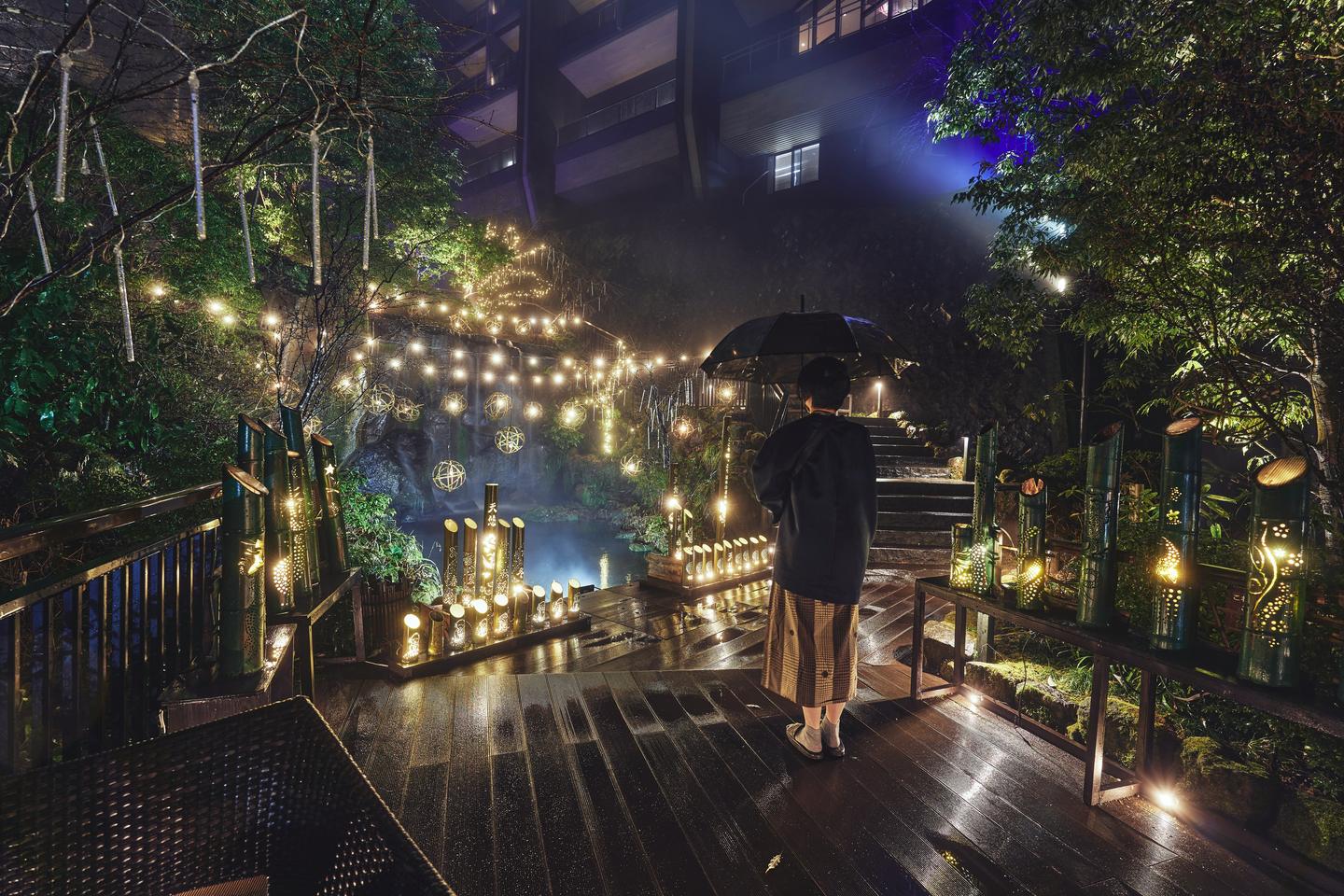
Hakone has 17 designated hot spring zones, each fed by the volcanic system centered on Owakudani. The quality of the water varies significantly by location. The three places below stand in Gora and Miyanoshita, on the way up the valley from Yumoto: Gora Kadan in Gora, Hakone Ginyu and the Fujiya Hotel in Miyanoshita.
The scale is real: the Hakone ryokan association puts the area's hot spring output at about 25,000 tonnes a day. One cost to note for later trips: Kyodo News reported in June 2026 that Hakone town plans an accommodation tax of ¥350 per person per night from April 2028, with children of primary-school age and younger and school trips among the exemptions. It is still a plan, so we check it against your dates.
Three properties represent the upper end of what Hakone offers, and each has a distinct character. At the two ryokan, rates are usually quoted per person per night with kaiseki dinner and breakfast included. This is the common way Hakone ryokan price a stay, and the meals are a large part of it.
Gora Kadan began as the villa of the Kan'in-no-miya, a branch of the imperial family, and the name Gora Kadan dates from 1948. The MICHELIN Guide gives it Three Keys, its highest hotel distinction, and its 2026 selection counts seven Three-Key hotels in Japan. The guide lists 41 rooms, some with open-air baths in wood or stone, and singles out a mineral pool ringed with enormous rocks. The garden suites include private rotenburo, outdoor hot spring baths, set within mature garden spaces, and the kaiseki is composed entirely around the season. In the same selection, four other Hakone hotels hold One Key, among them Hakone Gora Karaku and The Hiramatsu Hotels & Resorts Sengokuhara.
More contemporary in aesthetic than Gora Kadan, Hakone Ginyu stands at about 420 metres in Miyanoshita above the Hayakawa gorge, and its rooms look across the river valley to the Hakone mountains. Every room has its own open-air hot spring bath on the terrace. The kaiseki dinner leans modern without abandoning the seasonal discipline that defines the form. For guests who want the full ryokan experience, a private onsen, a valley view and a kaiseki dinner, in a less formal atmosphere, Ginyu suits well.
Founded in 1878 in Miyanoshita by Yamaguchi Sennosuke, the Fujiya Hotel is one of Japan's first Western-style resort hotels. The main building dates from 1891 and the Flower Palace wing from 1936, and many of the buildings were registered as tangible cultural properties in 1997. The hotel's own history lists Charlie Chaplin in 1932, Helen Keller in 1937 and John Lennon with his family in 1978. After seismic renovation it reopened on July 15, 2020. It is a Western-style hotel with no kaiseki and no onsen in the traditional sense, and a genuinely beautiful building that keeps the record of Japan's early encounter with modernity.
THE FUJI VIEW, HOW TO SET EXPECTATIONS
Mount Fuji is visible from Hakone, but not reliably. Fully clear days from this vantage are far fewer than most travelers expect. The odds are highest in the winter months, November through February, when dry air and low humidity give the clearest views. Summer has the lowest odds: humidity, haze, and the monsoon season conspire to keep the mountain invisible for weeks at a time.
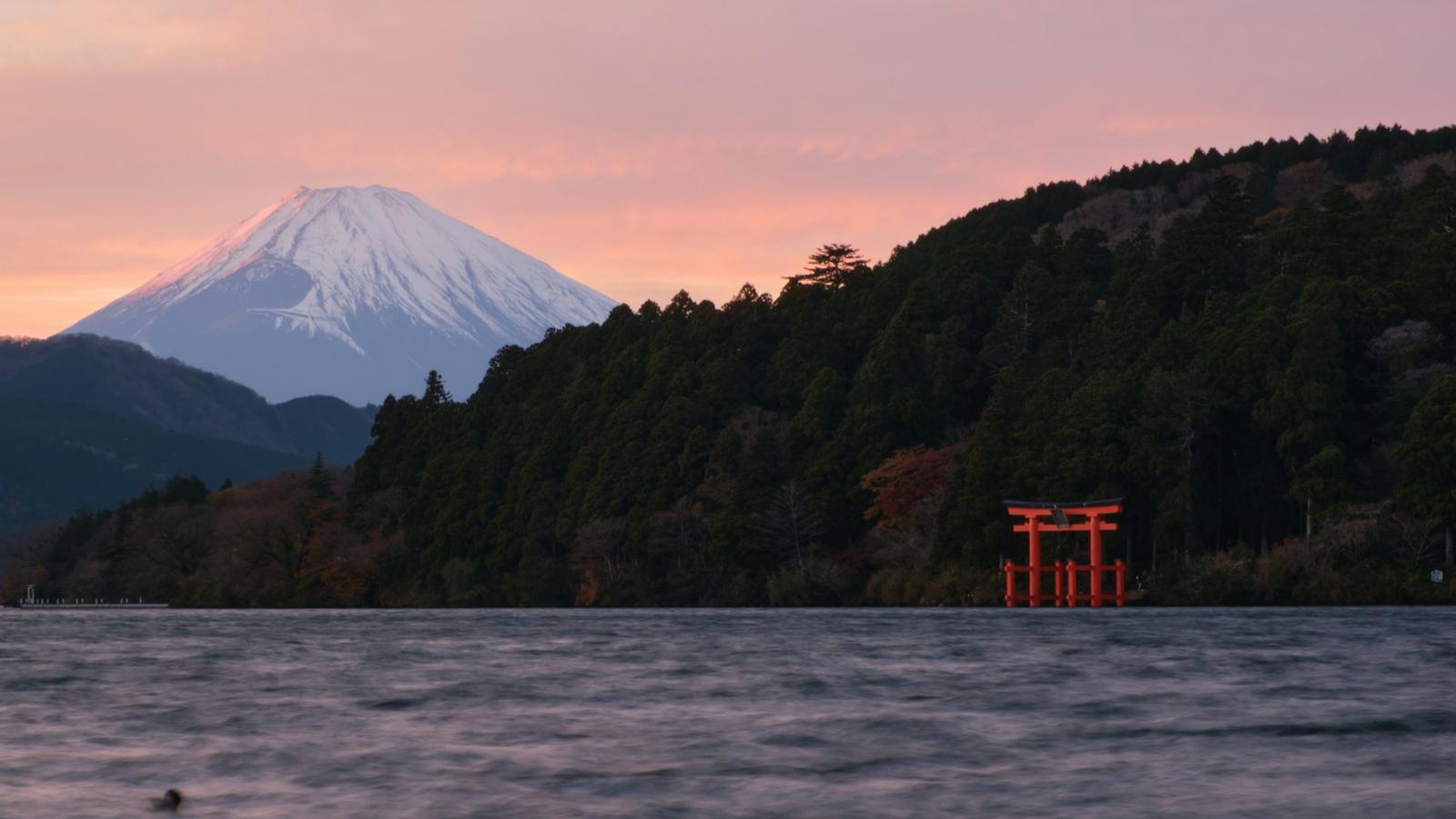
The classic viewing position in Hakone is Lake Ashi (Ashinoko), the caldera lake in the south of the area. The classic image, Fuji's cone reflected in the lake, framed by a red torii gate, is taken from the lakeside at Moto-Hakone. Dawn, before cloud builds, gives the clearest views. The ropeway from Owakudani descends to the lakeside at Togendai and provides aerial views across the lake on clear days.
The practical advice: plan your itinerary so the Fuji view would be a welcome addition to days that stand on their own. If the mountain appears, it adds something to the day. If it does not, Hakone has more than enough else to offer. Choosing your dates only for a Fuji view and organizing the visit entirely around it is a reliable way to be disappointed.
"Mount Fuji visible from Hakone: plan your trip as though it will not happen, and be delighted when it does. The mountain is on its own schedule."
OWAKUDANI, THE VOLCANIC VALLEY
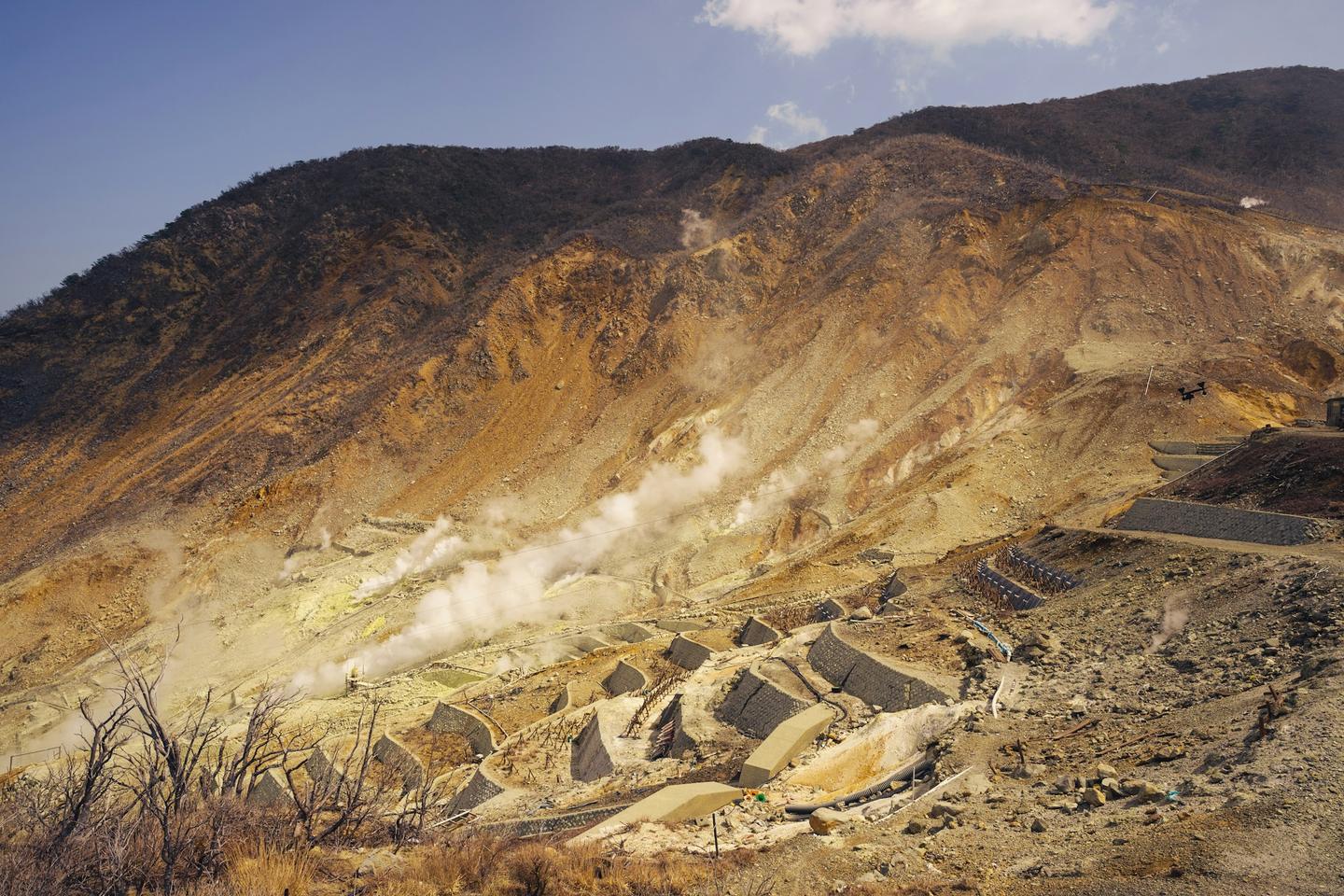
Owakudani is the active volcanic zone at the center of the Hakone area, a landscape of sulfurous fumaroles, grey rock, and constant venting steam that looks unlike anywhere else in the region. The black eggs cooked in the sulfurous water (kuro-tamago) are a local specialty and a legitimate curiosity: iron sulphide forming on the shell turns it black, and the egg inside is entirely normal. The legend that each one extends your life by seven years is not to be taken seriously.
The ropeway passes directly over Owakudani and is one of the more dramatic transport experiences in Japan, gondolas moving across a fuming volcanic landscape, the smell of sulfur rising as you pass. Note: the ropeway closes periodically due to elevated volcanic activity, and this is not predictable. Check the Hakone Ropeway website before planning around it. When it is running, the full route from Sounzan to Togendai and descent to Lake Ashi is worth doing in its entirety.
Owakudani was formed by volcanic activity about 3,000 years ago, and the Japan Meteorological Agency monitors Hakoneyama continuously. After a long closure, the nature trail into the steaming ground has reopened by advance online reservation at ¥800, and the car park is open only from 9:00 to 16:00. The ropeway runs from 9:00 to 17:00 from February to November and until 16:15 in December and January, with 18-person gondolas about every minute and around ten minutes per section. It stops when its own volcanic gas readings rise, which, the operator notes, is separate from the eruption alert level.
PRIVATE CAR VS ROMANCECAR, AND WHY OVERNIGHT MATTERS
The Romancecar is iconic and worth doing for the train experience itself. The observation seats at the front of the GSE (70000 series) trains face forward behind full glass and cost nothing beyond the ordinary fare and limited express charge, though there are few of them and Odakyu advises buying early. Book this car specifically when reserving. The journey from Shinjuku to Hakone-Yumoto takes 85 minutes with no transfers required. It is a pleasant ride and a complete experience in its own right.
A private car from Tokyo takes 90–120 minutes depending on traffic. We arrange it with a hire-car company, usually an Alphard or Lexus LM with a professional driver, and the fare is paid to that company. It offers complete flexibility: stops at viewpoints along the way, door-to-door delivery to the ryokan, luggage directly loaded, departure on your schedule. For guests arriving with luggage, with families, or who want to make stops that no train route allows, the private car suits better. Both have genuine merit, and they give different experiences.
On the question of day trip versus overnight: a day trip is possible and covers the Open Air Museum and a lake view. It leaves out what Hakone does best. The ryokan experience, the thing Hakone is known for, only fully reveals itself across an evening and morning: the kaiseki dinner as its own multi-hour event, the communal or private onsen at night when the outdoor bath is empty and the air is cold, the quiet morning before the day-trippers arrive, breakfast laid in the same careful way as dinner. One night is the minimum. Two nights, with a full day in between for museums and the lake, is the stay we would suggest. Staying puts you in the smaller group: Honichi Lab, a trade site on inbound travel, reports that of 21.12 million visitors to Hakone in 2025, 16.97 million came for the day and 4.15 million stayed the night.
SOURCES AND HOW WE CHECKED
We first wrote this page from desk research on October 5, 2026, and read every page below again on October 28, 2026. We did not contact the hotels, museums or transport companies. Opening hours, fares and the state of the ropeway change, so we check them again for your dates when we arrange the trip.
- Hakone Onsen Ryokan Hotel Cooperative, about Hakone Onsen (Japanese): the 17 hot spring areas, about 25,000 tonnes a day, about 85 minutes from Shinjuku by Romancecar
- Odakyu, Romancecar seats (Japanese): the GSE observation car, no extra charge, limited seats
- Hakone Open-Air Museum and its Japanese site: about 120 works, about 70,000 m², hours, the Picasso Pavilion, the 18 m Symphonic Sculpture by Gabriel Loire, the foot bath
- Pola Museum of Art, its ticket page and restaurant reservations on TableCheck (Japanese): hours, ¥2,200 adult admission, exhibition dates
- Gora Kadan, official site (Japanese): the Kan'in-no-miya villa and the 1948 name
- Hakone Ginyu, official site (Japanese): Miyanoshita, about 420 m, an open-air bath in every room, the Hayakawa gorge view
- Fujiya Hotel, official site and history (Japanese): the founder and 1878, building years, the 1997 registration, guests by year, the July 15, 2020 reopening
- Hakone Navi, Hakone Ropeway (Japanese): stations, time per section, hours, gondolas, suspensions for volcanic gas
- Hakone Navi, Owakudani (Japanese): formation about 3,000 years ago, the black eggs, the nature trail reservation and fee, car park hours
- Japan Meteorological Agency, Hakoneyama (Japanese): constant monitoring, the 1,438 m summit of Kamiyama, past steam eruptions around Owakudani
- Nippon.com, A Ride Through Nature: Hakone's Hydrangea Train: the 16 km run to Sounzan, 750 m, about 10,000 hydrangeas, the season
- Nippon.com, Traversing Hakone's Golden Course by Land, Air, and Water: the loop by train, cable car, ropeway, boat and bus
- MICHELIN Guide, Gora Kadan and All the Key Hotels in Japan 2026 (September 18, 2026): Three Keys, 41 rooms, the baths and the mineral pool, seven Three-Key hotels in Japan, the One-Key hotels in Hakone
- Serai.jp (Shogakukan), Hakone Tozan train and hydrangeas (Japanese, May 2, 2026): 8.9 km and about 40 minutes from Hakone-Yumoto to Gora, 445 m, the 80 per mille gradient, three switchbacks
- Waraku web (Shogakukan), museums in Japan where you can see Monet (Japanese): the Pola Museum's 19 Monet works and the collector Suzuki Tsuneshi
- Kyodo News on Kumanichi.com, Hakone plans an accommodation tax (Japanese, June 26, 2026): ¥350 per person per night, the April 2028 target, the exemptions
- Honichi Lab, Hakone visitors in 2025 (Japanese, June 10, 2026): 21.12 million visitors, 4.148 million overnight and 16.974 million day visitors
QUESTIONS, ANSWERED
How do you get from Tokyo to Hakone?
The classic scenic route is the Romancecar, Odakyu's private express train from Shinjuku, approximately 85 minutes to Hakone-Yumoto with observation car seating and reserved seats bookable in advance. Alternatively, take the Shinkansen from Tokyo or Shinagawa to Odawara (35 minutes) and transfer to the Hakone Tozan mountain railway. A private car from Tokyo, which we arrange with a hire-car company and whose fare is paid to that company, takes 90–120 minutes depending on traffic and offers full flexibility and door-to-door service.
Can you see Mount Fuji from Hakone?
Mount Fuji is visible from Hakone on clear days, but this is not guaranteed. The usual viewing position is Lake Ashi (Ashinoko), particularly from the ropeway or from the lakeside at dawn. Summer months (July–August) have the lowest visibility rates due to humidity; November through February offer the clearest skies.
Which ryokan should I consider in Hakone?
Gora Kadan, which began as the villa of the Kan'in-no-miya branch of the imperial family, holds Three MICHELIN Keys and has private rotenburo (outdoor hot spring baths) in garden suites and seasonal kaiseki. Hakone Ginyu in Miyanoshita is more contemporary in style, with an open-air bath in every room and views over the Hayakawa gorge. The Fujiya Hotel (1878), one of Japan's first Western-style resort hotels, reopened in 2020 after seismic renovation.
Is Hakone worth doing as a day trip from Tokyo?
A day trip to Hakone is possible but allows time for only one or two experiences. An overnight stay is where the destination delivers its full value: the kaiseki dinner in the ryokan, the private onsen at night and again at dawn, the mountain air, the quieter morning after day-trip crowds have left. If the purpose is to experience a traditional ryokan properly, a one-night stay is the minimum.
HAKONE AROUND YOUR DATES
We arrange the ryokan that suits your group, a private car from Tokyo if you want one, and the days of art, onsen and the lake around your dates and preferences. If you take the Romancecar, the tickets can be arranged through our travel partner, and we plan the day around the train you choose.
Start planningWe reply within 24 hours, in writing
Some of the restaurants and bars we arrange seat guests only by introduction or membership. We ask on your behalf; the table and the evening are the house's decision. We do not publish their names.