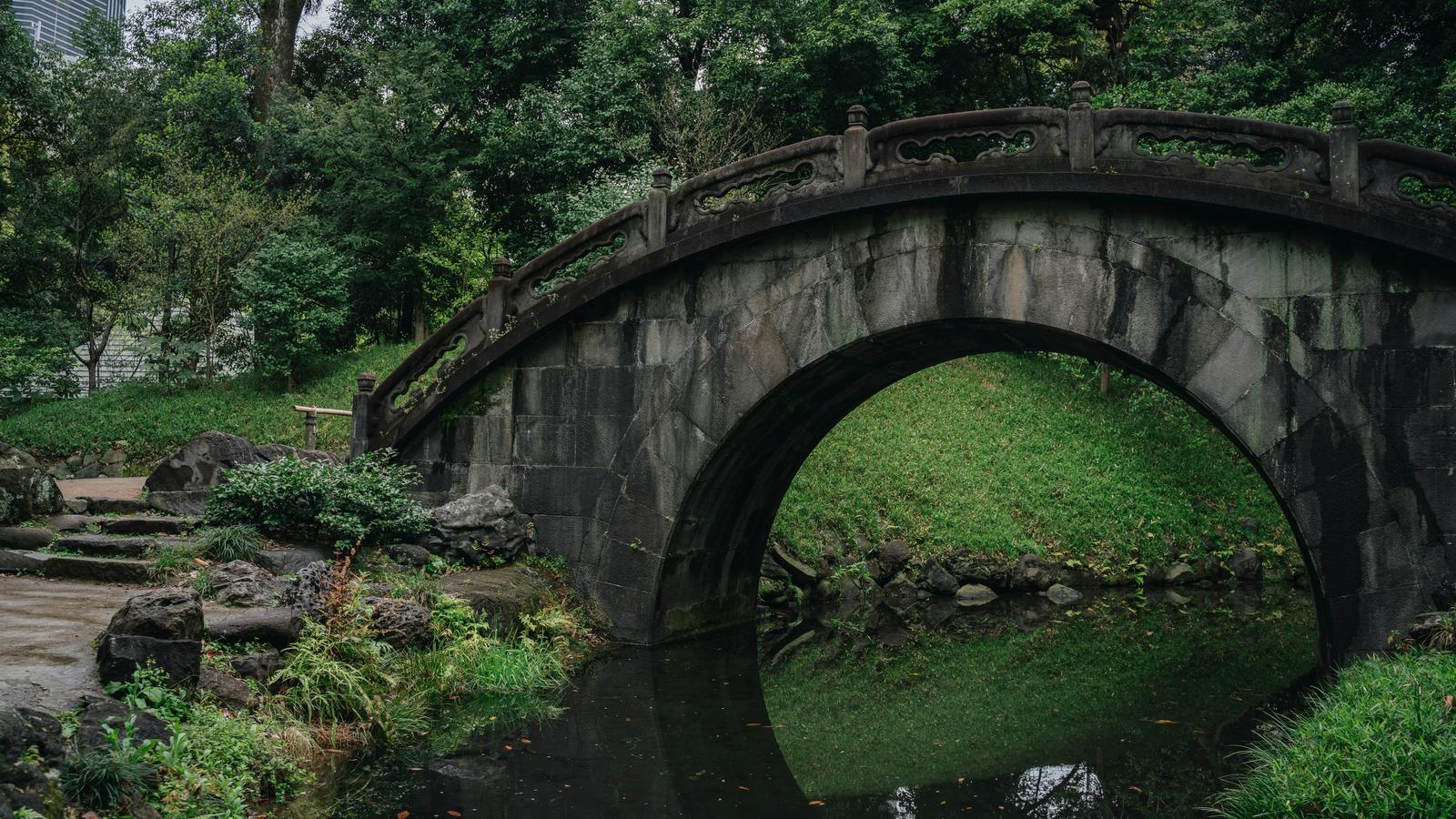
Tokyo's three great stroll gardens are Rikugien in Komagome, Koishikawa Korakuen near Iidabashi and Hama-rikyu on the bay. Each is run by the Tokyo Metropolitan Park Association, opens from 9:00 to 17:00 with last entry at 16:30, closes only from December 29 to January 1, and charges ¥300 per adult, or ¥150 for visitors aged 65 and over. All three run free garden tours in English on set days outside July and August. The peak weeks are usually late March for Rikugien's weeping cherry and late November to early December for the maples, when Koishikawa Korakuen and Rikugien also open after dark.
This guide covers seven gardens of the association, the East Gardens of the Imperial Palace and the garden at Happo-en: what each is, what it costs, when it is closed, who leads tours in English, which season suits it, and the rules for cameras, tripods and sketching. We read every rule and price on the official pages on October 28, 2026, and the sources are listed at the end. If you would rather spend a morning among tall trees than ponds and lanterns, forest bathing near Tokyo covers the certified forests within reach of the city.
Key points
- Rikugien, Koishikawa Korakuen and Hama-rikyu cost ¥300 per adult; Kiyosumi, Kyu-Furukawa, Kyu-Shiba-rikyu and Mukojima-Hyakkaen cost ¥150. All open 9:00 to 17:00, last entry 16:30, on the official pages read on October 28, 2026.
- Volunteer tours in English: Rikugien on the first and third Sundays at 11:00 and 14:00, Koishikawa Korakuen on Saturdays at 10:30 and 13:30, and Hama-rikyu at 11:00 on Saturdays, Sundays and the second and fourth Mondays. None run in July and August.
- The East Gardens of the Imperial Palace are free, but close every Monday and Friday and from December 28 to January 3, with a bag check at the gate.
- Snapshots and family photos need no permit. Model shoots, pre-wedding shoots and commercial work need an application, and Kyu-Furukawa bans tripods, monopods and selfie sticks from September 1 to December 10, 2026.
- Autumn 2026 night openings: Koishikawa Korakuen from November 13 to 24 and Rikugien from November 25 to December 6, by night ticket only, ¥1,000 in advance online. Rikugien's spring night viewing of its weeping cherry ran from March 18 to 24 in 2026; the 2027 dates for both seasons had not been announced in mid-November 2026.
LET US PLAN YOUR GARDEN DAYS IN TOKYO →
NINE GARDENS AT A GLANCE
Seven of the gardens below belong to the group the association calls the nine metropolitan gardens, and they share one set of rules. Children of primary school age and younger enter free. Ticket windows take credit cards and transport IC cards.
| Garden | Admission | Closed | Free tours in English |
|---|---|---|---|
| Rikugien, Komagome | ¥300 | December 29 to January 1 | First and third Sundays, 11:00 and 14:00 |
| Koishikawa Korakuen, Iidabashi | ¥300 | December 29 to January 1 | Saturdays, 10:30 and 13:30 |
| Hama-rikyu, Shiodome | ¥300 | December 29 to January 1 | Saturdays, Sundays, second and fourth Mondays, 11:00 |
| Kyu-Shiba-rikyu, Hamamatsucho | ¥150 | December 29 to January 1 | None listed |
| Kiyosumi, Kiyosumi-shirakawa | ¥150 | December 29 to January 1 | None listed |
| Kyu-Furukawa, Nishigahara | ¥150, Western house extra | December 29 to January 1 | None listed |
| Mukojima-Hyakkaen, Higashi-mukojima | ¥150 | December 29 to January 3 | None listed |
| Imperial Palace East Gardens | Free | Mondays, Fridays, December 28 to January 3 | Free audio guide app |
| Happo-en, Shirokanedai | Not published | Not published | Not published |
The seven metropolitan gardens open from 9:00 to 17:00, last entry 16:30. Visitors aged 65 and over pay ¥150 at the three ¥300 gardens and ¥70 at the four ¥150 gardens, and junior high school students who live or study in Tokyo also enter free. The English tours are led by volunteers, free and without booking. The other four gardens list weekend tours without naming a language, so we treat them as Japanese. Most tours stop in July and August, and any can be cancelled for weather.
RIKUGIEN
Rikugien was laid out by Yanagisawa Yoshiyasu on land the fifth shogun, Tsunayoshi, gave him in 1695. He designed it himself and spent seven years digging the pond and raising the hills, setting 88 views from waka poetry around the water. The Iwasaki family of Mitsubishi gave it to Tokyo in 1938, and it is a national Special Place of Scenic Beauty.
- The weeping cherry. Just inside the inner gate, a large shidare-zakura flowers at the end of March, the garden's best-known sight.
- Tsutsuji-chaya. An arbour of old azalea wood from the Meiji era, ringed by red maples in late November.
- Getting there. Seven minutes on foot from Komagome station on the JR Yamanote and Namboku lines. A shared ticket for Rikugien and Kyu-Furukawa costs ¥400 and does not expire.
- Fukiage-chaya. The teahouse by the pond serves matcha with a seasonal fresh sweet from 9:00 to 16:45, last order 16:30, and stays open later during the night openings. The garden's page gives no price; Time Out Tokyo listed the set at ¥1,000 in March 2025.
From November 25 to December 6, 2026, Rikugien reopens after dark from 18:00 to 20:30, last entry 19:30. Advance tickets cost ¥1,000 online from November 1 at 9:00, on-the-day tickets ¥1,200, and each evening is capped. Our Tokyo for couples guide covers the evening in more detail.
KOISHIKAWA KORAKUEN
Koishikawa Korakuen is the oldest surviving daimyo garden in Tokyo. Tokugawa Yorifusa, first lord of the Mito domain, began it in 1629, and his son Mitsukuni finished it. Where Rikugien is soft and open, this garden is a sequence of set scenes: a sea in the great pond, mountains, a river copied from Kyoto, and a small rice field still planted each year by local schoolchildren. It is one of only nine places in Japan listed as both a Special Historic Site and a Special Place of Scenic Beauty, with Kinkaku-ji and Ginkaku-ji in Kyoto.
- Engetsu-kyo. The full-moon bridge, said to be the design of the Ming scholar Zhu Shunshui, whose reflection closes the arch into a circle.
- The Karamon gate. The formal entrance to the garden, burnt in the war and rebuilt at the end of 2020.
- The seasons. Plum and wintersweet in winter, weeping cherry, wisteria and irises in spring, lotus in summer, maples in autumn.
- Getting there. The East Gate is five minutes from Suidobashi station; the West Gate is three minutes from Iidabashi on the Oedo line.
- The name. Korakuen means a garden of pleasure taken after others. It comes from a line by the Song statesman Fan Zhongyan: a ruler should worry before the people and rejoice after them. Zhu Shunshui advised Mitsukuni on the choice.
- Famous places in small. The Japanese Garden Dictionary of Ono Kenkichi and Walter Edwards defines a daimyo garden as a stroll garden around a pond, made by a lord at his Edo residence or in his castle town. The JAANUS dictionary of Japanese architecture adds that such gardens copy famous scenery of China and Japan in miniature. Here the Oi river and the Togetsu-kyo bridge recall Arashiyama in Kyoto, an embankment copies the West Lake in China, and the great pond is said to stand for Lake Biwa.
- What survived. The Japan Times noted in 1999 that the great pond was first fed by the Kanda aqueduct, and that the Tokujindo hall was the only original building still standing after the 1923 earthquake and the war.
- Kantoku-tei. The garden's teahouse serves matcha sets from 10:00 to 16:00, last order 15:30, and a Japanese lunch from 11:00 to 14:00. Hours change when the building is hired for events.
In 2026 the garden opens at night from November 13 to 24, 18:00 to 21:00, last entry 20:00, by night ticket only: ¥1,000 in advance online, ¥1,200 on the day. The daytime autumn colour event follows from November 21 to December 6.
HAMA-RIKYU AND KYU-SHIBA-RIKYU ON THE BAY
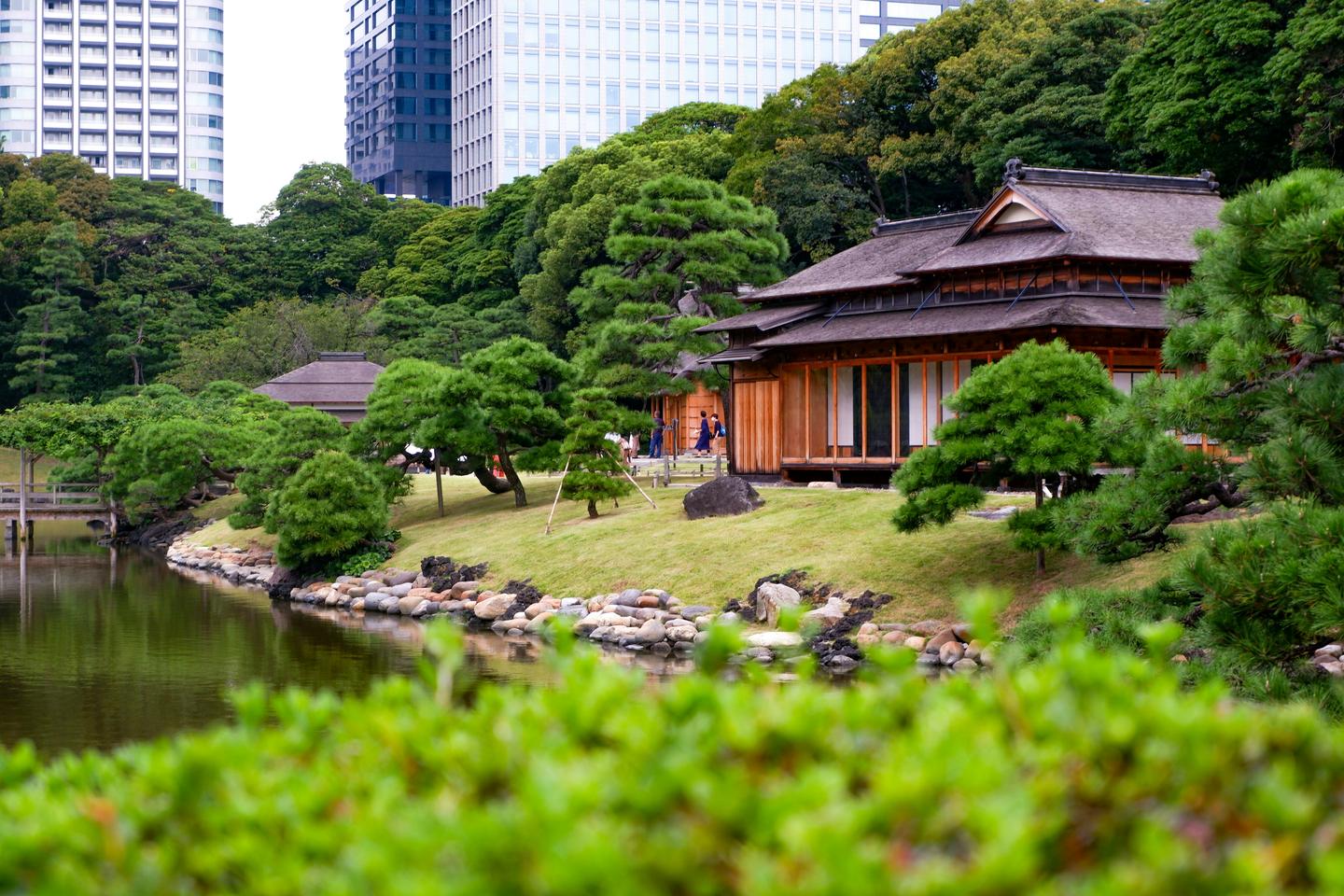
Hama-rikyu was a shogun's villa on reclaimed land on the bay, given its present form under the eleventh shogun, Ienari. It is the only garden surviving from the Edo period in Tokyo whose pond still takes in seawater: sluice gates follow the tide of Tokyo Bay, and mullet and gobies live in the pond. Two duck-hunting ponds from 1778 and 1791 survive behind earth banks, across about 25 hectares.
- Nakajima-no-ochaya. A teahouse on an island in the tidal pond, reached by a bridge and rebuilt in 1983. It serves matcha from 9:00 to 16:45, last order 16:30.
- Three restored teahouses. Three shogunal teahouses were rebuilt from records between 2010 and 2018. On Thursdays volunteers lead 40-minute teahouse tours, four times a day, for the first 25 visitors; wear socks.
- The flower fields. Rape blossom in spring, cosmos from summer into autumn, and a 300-year-old black pine.
- English tours. At 11:00 on Saturdays, Sundays and the second and fourth Mondays. In 2026 the summer break ran from July 1 to September 14, and tours are cancelled when the heat index reaches 31.
2026 is Hama-rikyu's 80th year as a public garden: it was given to Tokyo in November 1945 and opened in April 1946. To mark it, the garden stayed open until 21:00 from October 30 to November 3, 2026, and on November 15 the tea room of Matsu-no-ochaya, normally seen only on the teahouse tours, held seven short tea demonstrations. Both were one-off events for the anniversary. The 300-year pine is said to have been planted when the sixth shogun, Ienobu, remodelled the garden, in 1704 according to The Japan Times.
Kyu-Shiba-rikyu, one minute from the north exit of Hamamatsucho station, is the quieter neighbour and, with Koishikawa Korakuen, one of the two early Edo daimyo gardens left in the city. A shogunate elder, Okubo Tadatomo, received the land in 1678 and is said to have brought gardeners from his domain of Odawara, along with its Nebukawa stone. A shared ticket for the two gardens, about 15 minutes apart on foot, costs ¥400 and does not expire. The water bus from Asakusa that lands inside Hama-rikyu is described in our Tokyo for couples guide.
KIYOSUMI KYU-FURUKAWA AND MUKOJIMA-HYAKKAEN
Kiyosumi is a garden of stones. Iwasaki Yataro bought the site in 1878, and the family shipped rocks from across Japan on its own steamers. Stepping stones run along the edge of the pond so the view shifts with each step, and the Ryotei pavilion over the water was built in 1909 to receive Lord Kitchener. It is three minutes on foot from Kiyosumi-shirakawa station.
Kyu-Furukawa puts two gardens on one slope. At the top stands a stone Western house finished in 1917, the last work of the English architect Josiah Conder, with a formal rose garden below it. At the bottom, the Kyoto gardener Ogawa Jihei VII, known as Ueji, made a Japanese garden around a pond shaped like the character for heart, with a dry waterfall and a ten-metre cascade. The roses flower in spring and autumn: the 2026 autumn rose festival runs from October 10 to November 6, followed by roses and maples together from November 7 to December 6. The house charges its own fee, and the garden has many steps.
The Western house is run separately by the Otani Art Museum foundation. It opens from 10:30 to 16:30, last entry 16:00, and closes on Mondays, or on the Tuesday when Monday is a holiday. Entry costs ¥500, or ¥800 for a one-hour guided tour booked through the museum's online form. Photography inside the house is not allowed. The café on the ground floor opens from 12:00 to 16:30, and the tea room in the Japanese garden serves matcha in spring and autumn only.
Mukojima-Hyakkaen is the odd one out, a flower garden made between 1804 and 1830 by Sahara Kikuu, an antique dealer, with the help of the poets and painters of his circle. It began with 360 plum trees and grew into a garden of plants from the classics. A 30-metre tunnel of bush clover flowers in September, and chrysanthemums show from November 7 to 30, 2026. It is eight minutes on foot from Higashi-mukojima station.
THE IMPERIAL PALACE EAST GARDENS AND HAPPO-EN
The East Gardens of the Imperial Palace occupy part of the Honmaru, Ninomaru and Sannomaru of Edo Castle, and have been open to the public since 1968. Entry is free through the Otemon, Hirakawamon or Kitahanebashimon gates. Bags are checked at the entrance, so leave luggage at the hotel. Inside are the stone base of the castle keep, old guardhouses, and the Ninomaru Garden with its pond, teahouse and iris bed. The agency offers a free audio guide app.
| Period | Hours | Last entry |
|---|---|---|
| March 1 to April 14 | 9:00 to 17:00 | 16:30 |
| April 15 to August 31 | 9:00 to 18:00 | 17:30 |
| September | 9:00 to 17:00 | 16:30 |
| October | 9:00 to 16:30 | 16:00 |
| November 1 to end of February | 9:00 to 16:00 | 15:30 |
The gardens close every Monday and Friday, open on national holidays that fall on those days except the Emperor's Birthday on February 23, and close the following Tuesday when a holiday falls on a Monday. They also close from December 28 to January 3 and for court functions.
Happo-en in Shirokanedai is a private estate, today a wedding and banquet venue, around a Japanese garden of 10,000 tsubo, about 3.3 hectares, whose history it traces back some 400 years to the Edo period. Paths circle a koi pond past bonsai about 525 years old and the Mu-an teahouse, and early Kawazu cherries flower at the gate from mid to late February. Mu-an serves matcha and a sweet without booking on Fridays, Saturdays, Sundays and Mondays from 11:00 to 15:00 for ¥1,815 per person, tax and service included. Happo-en's own pages do not publish hours or an entry fee for the garden itself, so we confirm access with the venue before you go.
For a temae, where tea is prepared in front of you, Mu-an takes requests for 11:30 and 13:00 on Fridays and Mondays, at least two weeks ahead. At the table seats of the ryurei room it costs ¥3,630 per person, plus a room fee of ¥48,400 and an arrangement fee of ¥60,500, tax and service included; the larger tatami room costs more. We arrange this in your name.
WHEN TO GO
The flower calendars on the official pages give a clear year.
- February. Plum at Mukojima-Hyakkaen, Koishikawa Korakuen and Hama-rikyu, and the Kawazu cherries at Happo-en from mid to late February.
- Late March to early April. Rikugien's weeping cherry at the end of March, with cherry trees at Koishikawa Korakuen, Hama-rikyu and Kyu-Shiba-rikyu.
- April and May. Azaleas at Rikugien, wisteria at Mukojima-Hyakkaen in early May, rape blossom at Hama-rikyu, and spring roses at Kyu-Furukawa.
- June. Irises at Koishikawa Korakuen, Kiyosumi and the Ninomaru Garden in the East Gardens, and hydrangeas in most gardens.
- July and August. The gardens stay open, but most tours stop for the heat. Go at 9:00.
- September and October. Bush clover at Mukojima-Hyakkaen, cosmos at Hama-rikyu, autumn roses at Kyu-Furukawa from October 10.
- Late November to early December. Maples at Rikugien and Koishikawa Korakuen, with the night openings, and the first snow ropes on the pines.
A pattern that works on a weekday: Hama-rikyu at 9:00 with matcha on the island, then Kyu-Shiba-rikyu; or Rikugien in the morning and Kyu-Furukawa after lunch on the shared ticket. The rest of the year is set out in our guide to Japan's seasons.
PHOTOGRAPHY RULES
The Tokyo Metropolitan Government's rule is simple: family photos and landscape photos need no permit. An application and a fee are needed, commercial or not, when a shoot occupies part of a park, such as a film, a model shoot or an advertisement. Each garden adds its own conditions.
- Rikugien and Koishikawa Korakuen. Model and pre-wedding shoots need a screened application in advance, a week ahead at Rikugien, and may be refused in busy seasons. Rikugien bans sketching from November 1 to December 15, 2026.
- Hama-rikyu. Shoots need an application by telephone in advance, commercial or not, and may be refused in busy seasons.
- Kyu-Shiba-rikyu. So many shoots are requested that applications open two months before the date, first come, first served.
- Kyu-Furukawa. Snapshots and one-to-one portraits are fine; cosplay and props are refused all year. Commercial shoots, tripods, monopods, selfie sticks and sketching are banned on weekends and holidays in March and April, from April 16 to July 7, and from September 1 to December 10, 2026.
- Imperial Palace East Gardens. Personal photos need no permit. Photography as a business is prohibited, and shoots with models, drones, or for income-earning live streams and video sites are not normally permitted.
- Happo-en. It sells its own location photo plans, and its FAQ says outside photographers are not accepted for them.
For portraits in a garden, we arrange a photographer in your name, check the dates against these bans, and apply to the garden office. On any visit, stay off moss and stones and out of roped areas.
SOURCES AND HOW WE CHECKED
We read each page listed below on October 28, 2026. We did not contact the gardens. Tour times change with weather and staffing, event dates change each year, and prices may be revised; we confirm with the garden office when we arrange a visit. Prices are as published, tax included. For history and context we also used two dictionaries of Japanese gardens and architecture, a restoration report, and articles in The Japan Times, Time Out Tokyo and Tokyo Walker. Where they touch on hours or prices, we checked them against the garden's own page.
- Tokyo Metropolitan Park Association, Rikugien: hours, fees, English tours, history, highlights, shared ticket, photography
- Rikugien, autumn 2026 night opening and sketching notice: dates, hours, tickets, sketching ban
- Koishikawa Korakuen: hours, fees, English tours, history, highlights, events, photography
- Koishikawa Korakuen, autumn 2026 night opening: dates, hours, ticket prices
- Hama-rikyu Gardens and facilities: tidal pond, teahouses, tours, shared ticket, photography, Nakajima-no-ochaya hours
- Kyu-Shiba-rikyu Gardens: fees, history, stones, photography applications
- Kiyosumi Gardens: fees, history, stones, Ryotei
- Kyu-Furukawa Gardens and 2026 photography rules: fees, Conder and Ueji, rose events, tripod and sketching bans
- Mukojima-Hyakkaen Gardens: fees, closing days, history, seasonal plants, chrysanthemum dates
- Tokyo Metropolitan Government, Bureau of Construction, photography in parks: when a permit is needed
- Imperial Household Agency, East Gardens of the Imperial Palace: hours, closing days, gates, bag check, audio guide
- Imperial Household Agency, photography in the East Gardens and visiting rules: photography, drones, alcohol
- Happo-en, garden, Mu-an tea room and FAQ: size, history, bonsai, Kawazu cherries, tea times and price, outside photographers, and temae bookings and fees
- Rikugien, facilities: Fukiage-chaya hours and tea set
- Koishikawa Korakuen, facilities: Kantoku-tei hours
- Hama-rikyu, evening opening for its 80th year and Matsu-no-ochaya tea demonstration: dates, hours, gate, fees, booking
- Otani Art Museum, Kyu-Furukawa house: hours, fees, guided tour, photography, café, tea room
- Japanese Garden Dictionary (Ono Kenkichi and Walter Edwards), daimyo garden: definition
- JAANUS dictionary of Japanese architecture, daimyou teien: features of daimyo gardens, miniature scenery
- Restoration report on Taka-no-ochaya, Hama-rikyu (January 2020), Nara National Research Institute for Cultural Properties database: the teahouses rebuilt from records
- The Japan Times, Korakuen: a cultivated present from Edo (May 16, 1999): the Kanda aqueduct, Tokujindo
- The Japan Times, Linda Inoki, A garden of poetry in the city's heart (October 23, 2003): the pine of 1704
- Time Out Tokyo, Emma Steen, Japanese gardens in Tokyo (March 21, 2025): Fukiage-chaya price
- Tokyo Walker (Walkerplus, KADOKAWA), autumn night openings (October 7, 2026): cross-check of the 2026 evening dates at three gardens
QUESTIONS GUESTS ASK
Which Japanese garden in Tokyo should I visit if I have time for one?
For a first visit, Rikugien or Koishikawa Korakuen. Rikugien is the softer, more open garden with a large pond and the famous weeping cherry; Koishikawa Korakuen is older and full of set scenes, including the full-moon bridge. If you are staying near Ginza or Shiodome, Hama-rikyu is closest and has a teahouse on the water.
How much does it cost to enter Tokyo's gardens?
On the official pages we read on October 28, 2026, Rikugien, Koishikawa Korakuen and Hama-rikyu cost ¥300 per adult, and Kiyosumi, Kyu-Furukawa, Kyu-Shiba-rikyu and Mukojima-Hyakkaen ¥150. The Imperial Palace East Gardens are free. Night openings in autumn need a separate ticket from ¥1,000.
Are there guided tours in English?
Yes, free and without booking: Rikugien on the first and third Sundays at 11:00 and 14:00, Koishikawa Korakuen on Saturdays at 10:30 and 13:30, and Hama-rikyu at 11:00 on Saturdays, Sundays and the second and fourth Mondays. None run in July and August. For a private visit at a time of your choosing, we arrange an English-speaking guide.
When are the autumn leaves best in Tokyo's gardens?
From late November to early December. In 2026 Koishikawa Korakuen marks the colour from November 21 to December 6 and opens at night from November 13 to 24, and Rikugien opens at night from November 25 to December 6.
Can I use a tripod in Tokyo's gardens?
It depends on the garden and the date. Kyu-Furukawa bans tripods, monopods and selfie sticks on spring weekends, from April 16 to July 7 and from September 1 to December 10, 2026. Elsewhere, snapshots are fine, but anything that takes over a spot, such as a model or pre-wedding shoot, needs an application to the garden office.
Are the Imperial Palace East Gardens open every day?
No. They close every Monday and Friday, except on most national holidays, and from December 28 to January 3. Entry is free, hours change through the year from 9:00 to between 16:00 and 18:00, and bags are checked at the gate.
LET US PLAN YOUR GARDEN DAYS IN TOKYO
Tell us your dates, where you are staying and what you would like to see: blossom, maples, tea by the water, or portraits in a garden. We will come back with the gardens that suit those days, the hours and any night openings, and we arrange the guide, the photographer and the car in your name.
Begin planningWe reply within 24 hours, in writing
Some of the restaurants and bars we arrange seat guests only by introduction or membership. We ask on your behalf; the table and the evening are the house's decision. We do not publish their names.