
Japan's public transport is excellent. Using it with luggage, without the language, and around reservations that will not wait for you is a different problem.
Here are the ways to move in comfort, and what each one is for.
Key points
- Between cities, the shinkansen is consistently preferred over flying: no security queue, no airport transfer, city centre to city centre. Gran Class runs on the Tohoku, Hokkaido, Joetsu and Hokuriku lines.
- For in-city movement and airport transfers at the high end, the default is a Toyota Alphard or Lexus LM with a dedicated driver.
- Japan's luxury sleeper trains are sold as tours in seasonal application rounds, with a lottery when applications exceed the places, so a place is never certain until the result arrives.
- On any trip, at any budget: reserved shinkansen seats on every intercity leg, IC cards loaded before you arrive, and luggage forwarded hotel to hotel by takkyubin.
The Toyota Alphard and Lexus LM, Japan's premium large-format minivans, are the default choice for in-city movement and airport transfers at the high end. A dedicated driver, onboard Wi-Fi and captain's seating make the car usable as an office or a sitting room between stops. Nobody in the party carries a suitcase through a station.
As a published example, Tokyo MK lists hire cars with a driver from ¥74,000 for eight hours in Tokyo, up to 120 km, in an Alphard, and from ¥84,000 in a Lexus LM. Transfers start at ¥45,000 and ¥51,000 for Narita and at ¥17,000 and ¥19,000 for Haneda. The prices include tax, tolls and parking are extra, and they stand as of May 21, 2026. STAYGO arranges the car in your name. The fare is separate from our planning fee and is settled in the simplest way available, usually on your hotel bill where the hotel allows it.
What a concierge adds: the value lies in where the car is: a driver holding a name board just outside the shinkansen gate, or waiting in the arrivals hall as you come out of customs. The meeting point and the driver's contact are agreed in advance, so the handover is simple.
Between cities, Tokyo to Kyoto, Osaka or the Hokuriku region, the shinkansen is consistently preferred over flying. No security queue, no airport transfer, city centre to city centre. What changes at the premium end is the class you sit in.
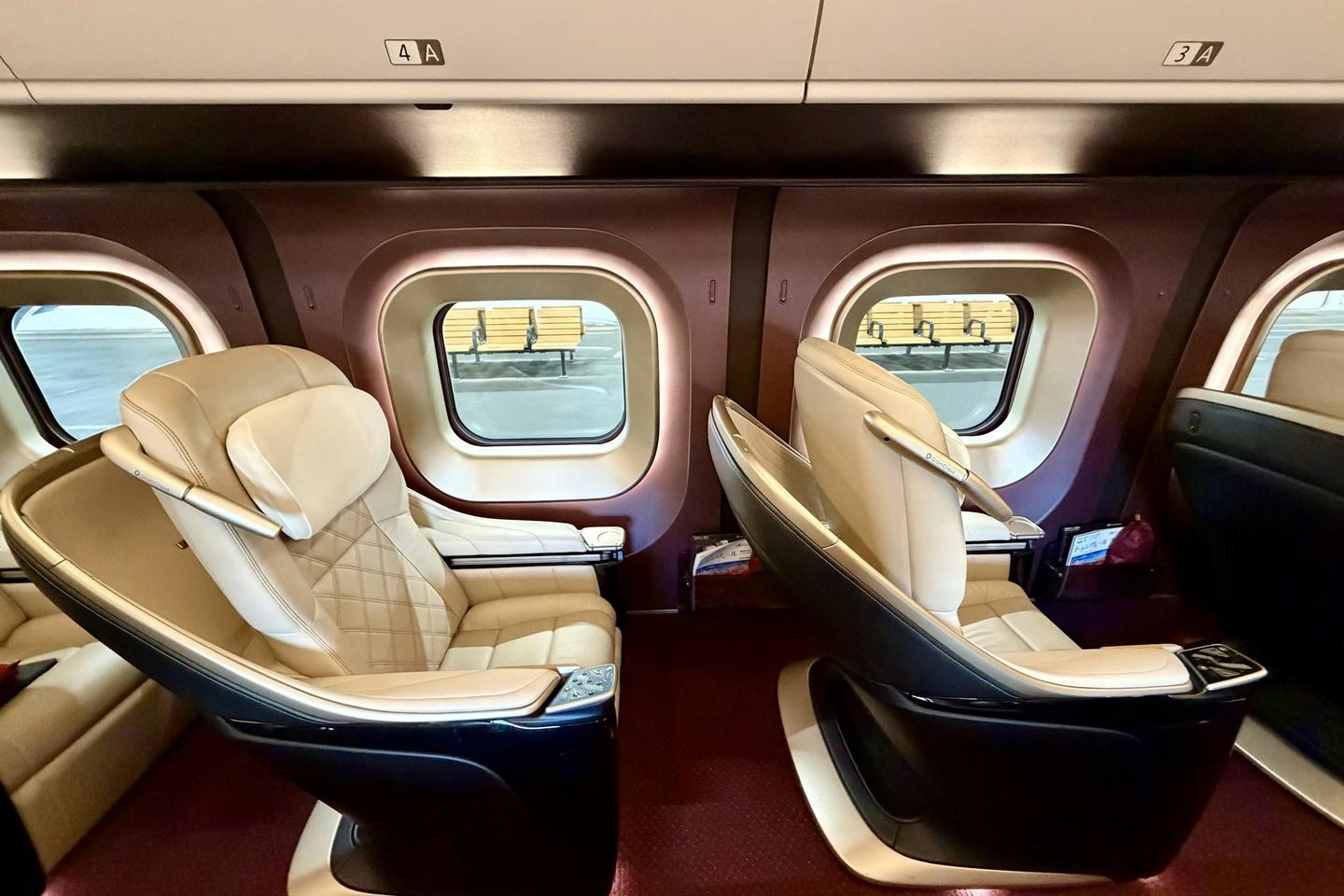
Gran Class runs on the Tohoku, Hokkaido, Joetsu and Hokuriku shinkansen, as a single car of 18 seats per train: deeply reclining leather seats in a quiet cabin, a long way from a standard reserved seat. JR East's own guide explains that many trains, such as the Hayabusa to Morioka, add an attendant who serves a light meal and drinks. The Joetsu line, Hokuriku trains other than the Kagayaki, and Hayabusa trains that run only between Tokyo and Sendai keep the same seat without the attendant service. On the Tokaido shinkansen (Tokyo–Kyoto–Osaka), Green Car is the equivalent upper tier, and it is the class we plan for on that line.
The food on board changed in October 2022. JR East renamed the light meal a refreshment, let passengers choose a Western or a Japanese menu on every route where it is served, and switched to frozen preparation to cut waste, Travel Watch reported.
The drive from central Tokyo to Hakone takes two to three hours in normal traffic, and longer in peak periods. By helicopter from the Tokyo Heliport to the Sengokuhara heliport in Hakone it is about 35 minutes, and on a clear day it comes with a view of Mount Fuji you cannot get from the ground.
That makes the transfer part of the trip. Coming into a mountain resort from the air is a different arrival from pulling up at the entrance by road.
Common routes run from Tokyo to Hakone, the Izu Peninsula, Karuizawa and Mount Fuji. AIROS, the charter service of AirX, prices a Hakone hotel plan with the flight at ¥298,100 one way for two, takes bookings from one month ahead, and lets you rebook or cancel without charge when the captain grounds a flight for weather. It asks for each passenger's weight and for the number and size of the bags in advance, because the cargo space is limited.
Japan runs three luxury sleeper trains. JR East's TRAIN SUITE Shiki-shima traverses Tohoku and Hokkaido over multi-day journeys. JR West's Twilight Express Mizukaze covers the San'in and San'yo coastlines. JR Kyushu's Nanatsuboshi in Kyushu moves through the southern island's landscapes. Each one is chosen for the dining, the service and the scenery as much as for the distance it covers.
Each train carries a few dozen guests at most. Popular departures are decided by lottery when applications exceed the places, and applications are mostly made in Japanese, though JR Kyushu also takes them in English for the Seven Stars.
What actually helps: each journey is sold as a tour by its own railway, through its tour desk and application pages. The most recent rounds have closed: JR West took applications for Mizukaze departures from March to June 2027 until October 30, 2026, and JR Kyushu for Seven Stars departures from March to August 2027 until October 31. In recent years JR West has opened the following round, for July to September departures, in early January. JR Kyushu expects to take applications for Seven Stars departures from September 2027 to February 2028 in spring 2027. On April 8, 2026 JR Kyushu warned of fraud using the Seven Stars name, so apply only through the operator's own channels. STAYGO does not buy train tickets or sell tours; you apply in your own name through the operator. We plan the rest of the trip around the departures you apply for, with a fallback if the application does not succeed.
A useful rule for the plan: one long move a day, with the luggage sent ahead the day before.
WHAT SHOULD BE STANDARD
Three things belong on any Japan trip, at any budget. Reserved shinkansen seats on every intercity leg, so your seat exists before you board; on the Tokaido line, bags over 160 cm in total need a seat with an oversized baggage area, booked with the ticket, or a ¥1,000 fee on board. IC cards loaded before you arrive, so nobody in the group is standing at a ticket machine: JR East's Welcome Suica Mobile app for iPhone issues one with no deposit, tops up through Apple Pay and expires after 180 days, with no refund of the balance. And luggage forwarded hotel to hotel on Japan's takkyubin network, so you move between cities with a day bag while the cases travel ahead of you; Yamato's TA-Q-BIN takes parcels up to 200 cm in total and 30 kg.
These three matter most in the hours between the main plans of each day. How the moves fit into a fourteen-day plan.
SOURCES AND HOW WE CHECKED
We first wrote this guide on May 29, 2026, read every page below on October 28, 2026, and checked the sleeper-train application dates again on November 3, 2026. We did not contact the operators. Fares, sales periods and rules change, so we check them again for your dates. STAYGO arranges cars, drivers and charters in your name. Shinkansen tickets are arranged through our travel partner, a registered travel agency; sleeper-train tours are applied for by you through the operator, and flights are bought by you or through our travel partner. Car fares and tickets are separate from our planning fee.
- Tokyo MK, hire car fares (Japanese): eight-hour and airport fares for the Alphard and Lexus LM, tax, tolls
- JR East, JRE Media: GranClass: the four lines, 18 seats, which trains have attendant service
- JR Central, oversized baggage: the 160 cm and 250 cm thresholds, the ¥1,000 fee
- AIROS (AirX), helicopter charter (Japanese): routes and starting prices
- AIROS Skyview, Hakone hotel plan (Japanese): Tokyo Heliport to Sengokuhara, flight time, price, cancellation
- AIROS, questions and answers (Japanese): booking from one month ahead, weather cancellations, luggage, passenger weight
- JR Kyushu, Seven Stars in Kyushu (Japanese): applications for March to August 2027, the fraud warning of April 8, 2026
- JR West, Twilight Express Mizukaze (Japanese): applications for March to June 2027 until October 30, the tour desk
- Twilight Express Mizukaze, news (Japanese): the March to June 2027 sales closing on October 30, 2026, and the January 2026 opening of the July to September round
- Seven Stars in Kyushu, applications for March to August 2027 departures (Japanese): the March to August 2027 application period, October 1 to 31, 2026
- App Store, Welcome Suica Mobile (East Japan Railway Company): no deposit, Apple Pay top-ups, 180 days, no refunds
- Yamato Transport, TA-Q-BIN: size and weight limits, where to send from
- Travel Watch, Gran Class light meals renewed from October 2022 (August 26, 2022) (Japanese): the refreshment, the choice of Western or Japanese menus, frozen preparation
QUESTIONS, ANSWERED
What is the most comfortable way to get around Japan?
For city-to-city travel, Gran Class on the shinkansen is the premium rail option. Within cities, a hire car with a driver, usually a Toyota Alphard, Lexus LM or Mercedes V-Class, takes you door to door. Private helicopters are available for scenic or time-sensitive journeys.
What is a Toyota Alphard, and why is it so common as a hire car in Japan?
The Toyota Alphard is a large MPV with executive-class rear seating, privacy curtains, and a smooth ride. Hotels and hire companies across Japan use it widely for travel with a driver. The Lexus LM is built on the same idea, with a more finished interior.
Is Gran Class on the shinkansen worth the price?
Gran Class is a single car of 18 wide, deeply reclining leather seats. On many trains, such as the Hayabusa to Morioka, an attendant serves a light meal and drinks; on the Joetsu line and some Hokuriku and Tohoku trains the seat is the same without that service. For a long journey it is a very comfortable way to travel, and with 18 seats per train it is worth reserving early for busy dates.
Can I arrange private hire transport for an entire Japan trip?
Yes. STAYGO arranges private hire covering airport transfers, city touring, and multi-day journeys. A dedicated Alphard or Lexus LM can cover Tokyo, the journey to Hakone, and transport throughout Kyoto, so nobody in the group needs a taxi app or a train map. The car fares are separate from our planning fee.
What is the difference between Green Car and Gran Class on the shinkansen?
Gran Class sits above Green Car in the shinkansen hierarchy. It offers wider seats with full recline and, on many trains, an attendant who serves a light meal and drinks. Green Car is comparable to business class; Gran Class is first class.
ONE ITINERARY FOR ALL OF IT
Cars and helicopter charters we arrange, shinkansen tickets through our travel partner, and the sleeper-train applications you make in your own name, fitted into one itinerary.
Start your tripWe reply within 24 hours, in writing
Some of the restaurants and bars we arrange seat guests only by introduction or membership. We ask on your behalf; the table and the evening are the house's decision. We do not publish their names.