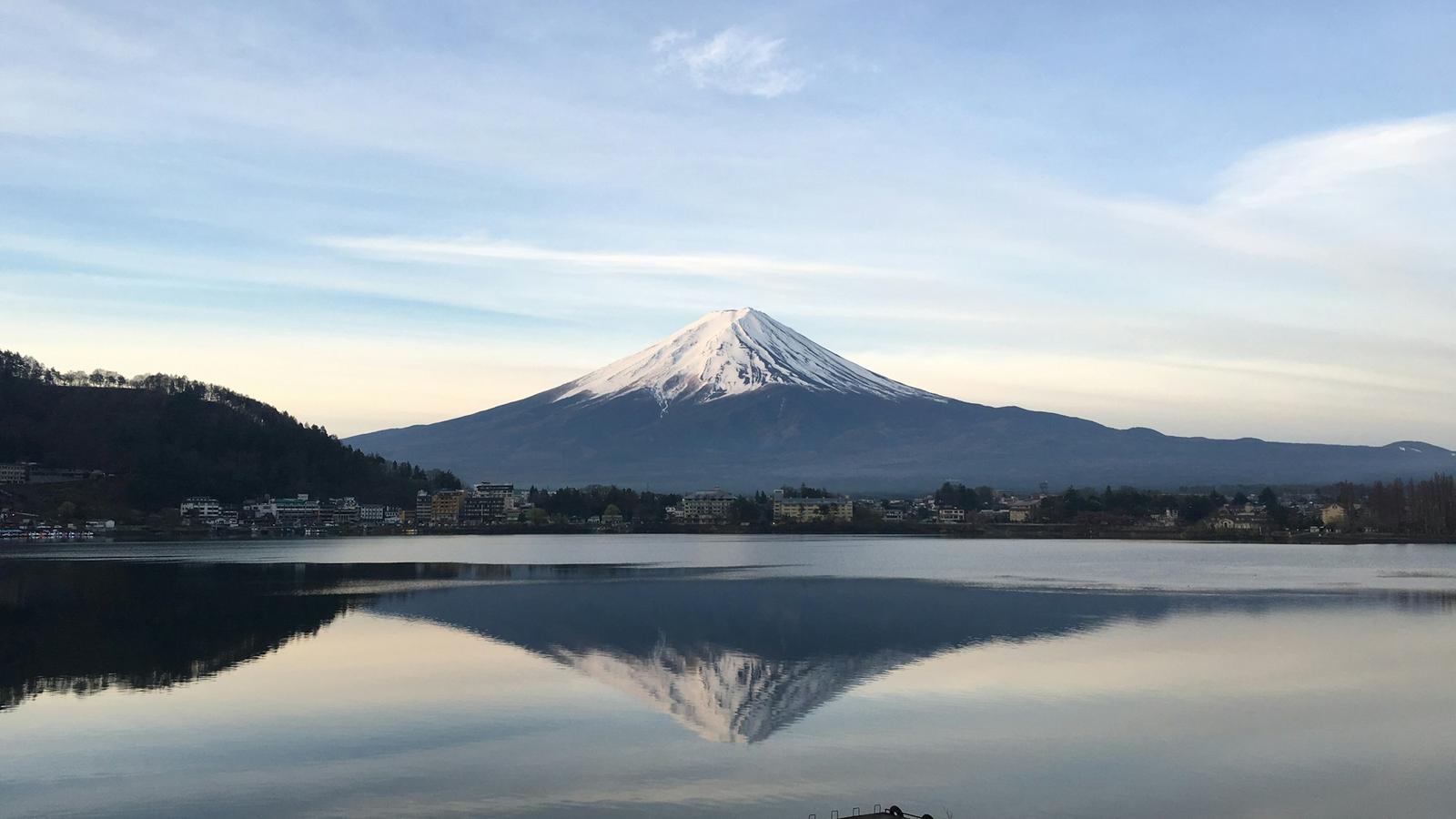
Mount Fuji is one of the most recognizable images of Japan, and one of the easiest to miss. In peak season, many visitors take the bus to the 5th station, find the summit in cloud, and leave disappointed. Most of that disappointment comes from the approach, and the approach can be changed.

Where it is
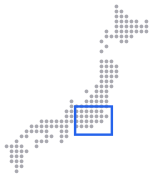
On the border of Yamanashi and Shizuoka, about 100 km west of Tokyo.
- Tokyo to Kawaguchiko, by car
Map based on Natural Earth and OpenStreetMap (© OpenStreetMap contributors).
For most visitors the draw is the view of the mountain. Fuji is a viewing experience, a landscape element, an object to be composed against sky or water or architecture. The best views usually come from three choices: a viewpoint chosen deliberately, an early hour, and a season when the air is more often clear.
Key points
- For travellers whose priority is the view rather than the climb, winter (December to February) is usually the best choice: the driest air, a snow-capped peak and fewer visitors.
- The difference between a crowded and a quiet viewpoint is mostly timing. At the Chureito Pagoda, 398 steps up above the lake, arrive before 7am.
- The climbing season runs July 1 to September 10 on the Yoshida and Subashiri trails and starts on July 10 on the other two. The Yoshida Trail is the most crowded, with midnight queues on the upper sections from mid-July, while the Subashiri and Gotemba trails are significantly quieter.
- If Fuji is the main objective of the day, base at Kawaguchiko. If it is one element alongside hot springs, art and mountain scenery, Hakone is the stronger choice.
THE PROBLEM WITH THE STANDARD APPROACH
The 5th station approach fails for compounding reasons. Fuji's summit is frequently cloud-covered from late morning onward through most of the year. In the climbing season the Fuji Subaru Line to the Yoshida Trail's 5th station is closed to private cars for a period that changes each year, so you park below at Fujisan Parking and ride a shuttle bus or taxi. Outside that period, the official climbing site warns of waits of two hours or more for parking at peak times. The 5th station itself is a gift shop precinct with a restricted view. None of this is the mountain's fault.
The crowds are real and documented. During peak summer climbing season, the Yoshida Trail alone sees queues from midnight, thousands of people ascending in a line, headlamps stretching up the slope, waiting at bottlenecks. The 8th station huts run out of space for resting climbers. In the 2026 season about 240,000 climbers passed the 8th station, back to the level before the pandemic, and about 135,000 of them, roughly 56 percent, were on the Yoshida Trail, according to the Ministry of the Environment's count announced on September 30, 2026.
The rules have also tightened. On the Yoshida Trail the hiking fee is ¥4,000 per person, the gate at the 5th station is closed from 14:00 to 3:00 the next morning to anyone without a mountain hut reservation, and no more than 4,000 climbers a day are let through, hut guests aside. Staff at the gate check that each climber carries winter clothing, two-piece rain gear and proper climbing boots. Nippon.com reports that the 2pm to 3am restriction now applies on all four trails.
The Shizuoka side has its own rules from 2026. On the Fujinomiya, Gotemba and Subashiri trails each climber pays ¥4,000, completes a short course on the rules and manners for protecting the mountain and climbing safely, and registers in advance through the prefecture's FUJI NAVI app. Climbing between 14:00 and 3:00 needs a mountain hut stay, and there is no daily cap. The Japanese travel site Tetsudo Channel set out both prefectures' rules side by side in May 2026.
A disappointing day at Fuji usually comes down to position and timing more than to the mountain itself.
QUIETER VIEWING SPOTS
The following viewpoints are all accessible without special permissions. The difference between a crowded and a quiet visit at each is mostly timing: arriving before most visitors, which means deciding the night before.
A wide and varied range of viewing angles. Multiple excellent viewpoints around the lake's northern shore. On still mornings, most common in autumn and winter, the lake surface reflects the mountain in a near-perfect inversion. The Chureito Pagoda viewpoint is technically in Fujiyoshida above the lake but is part of the same area: 398 stone steps to a five-story pagoda with Fuji behind. The most reproduced Fuji composition in photography. Arrive before 7am for the quietest hour.
The observation deck at the top of the steps was rebuilt and reopened in February 2022. The park is open around the clock and lit in the evening until 21:50. The four small car parks below charge ¥1,000 to ¥1,500 per six hours, and tour buses are not allowed up, which is one more reason to come early by private car.
Both towns have had to manage the crowds these views draw. Fujiyoshida called off the park's 2026 cherry blossom festival, which had brought around 200,000 visitors to a city of fewer than 50,000 people, Time Out reported in February 2026. In Fujikawaguchiko, a 20-metre screen went up in May 2024 opposite a Lawson convenience store that had become a Fuji photo spot. It came down on August 15 that year ahead of a typhoon, and the town said it would return if disruptive behaviour resumed. Arriving early by private car keeps you clear of both.
A traditional thatched-roof village fed by eight spring-water ponds, with Fuji as the backdrop. The water in the ponds is snowmelt filtered through Fuji's volcanic rock, remarkably clear, often with the mountain reflected. The low morning sun from the east lights the cone from the side, which is why photographers aim for the 6–8am window.
On the south side of Fuji in Shizuoka Prefecture, Tanuki Lake is one of the least visited of the Fuji lakes and offers reflected mountain views from a different angle than the north-side locations. It is usually quieter than the north-side lakes, even in peak season. It fits well into a loop itinerary from Hakone.
THE RIGHT SEASON
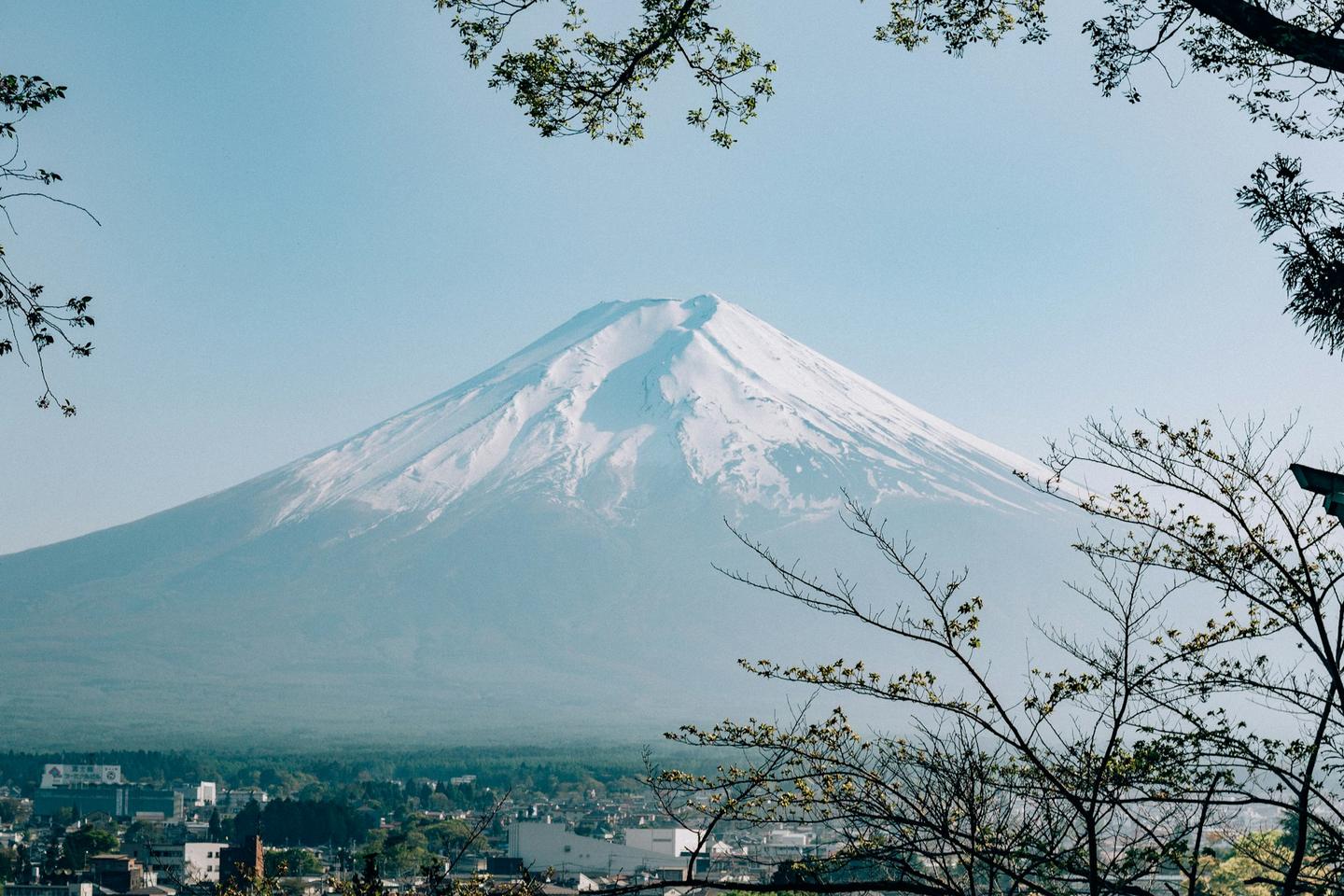
Winter is usually the best choice for travelers whose priority is the view rather than the climb. The air is driest, the peak is usually snow-capped through the season, and viewpoints see far fewer visitors than in peak season. The light in winter, low angle, long shadows across the white cone, is also better for photography than the high summer sun.
The weather records agree. At the Japan Meteorological Agency's Kawaguchiko station, the 1991–2020 normals give 212 hours of sunshine in January and 200 in December, against about 123 in June and 122 in September, the two cloudiest months. Autumn is clear too, but the snow cap can come late: in 2024 the Kofu Local Meteorological Office recorded the first snow on the summit on November 7, the latest since records began in 1894. In 2025 it came on October 23, three weeks after the October 2 normal. From autumn 2026 the agency no longer judges the first snowcap by eye from Kofu, a watch kept since 1894; it estimates snow on the summit from radar and AMeDAS data instead, as Nippon Tabi Magazine and Taiwan's Central News Agency, citing the Yomiuri Shimbun, reported. Fujiyoshida City keeps its own visual declaration of the first snow.
Spring cherry blossom, typically late March to mid-April, produces the combination views that appear most frequently in photography: pink sakura in the foreground, white-capped mountain behind. These exist and they are genuinely beautiful. They also require arriving at the right spots at or before dawn during the 7–10 day bloom window. The crowds in spring are significant at every famous viewpoint.
CLIMBING SEASON
In 2026 the Yoshida and Subashiri trails opened on July 1, the Fujinomiya and Gotemba trails on July 10, and all four closed on September 10. The Yoshida Trail (Fuji-Yoshida side) is the most popular, and the most crowded. From mid-July onward, midnight queues on the upper sections are documented and expected. The Subashiri and Gotemba trails are significantly quieter, with Gotemba being the longest but the least congested by a wide margin.
For serious climbers, the goal is goraiko, arriving at the summit crater rim at sunrise. This requires a midnight start from the 5th station or an overnight stay in a mountain hut (which must be booked months in advance). The official climbing site gives about 6 hours up and 4 down on the Yoshida Trail, about 5 up and 3 down on the Fujinomiya Trail, which starts highest at 2,400 metres, and about 9 up and 4 down on the Gotemba Trail, which starts at 1,440 metres. The quiet of the Subashiri Trail ends high up: it joins the Yoshida Trail at the Original 8th Station, and both crowds share one path from there. It is physically demanding. Altitude sickness above 3,000 meters is common, proper cold-weather gear is non-negotiable, and the final push above the 8th station is steep scrambling.
The Yoshida Trail is also the old pilgrims' road. Kitaguchi Hongu Fuji Sengen Jinja, the shrine at its foot in Fujiyoshida, records that 86 houses of oshi, the masters who lodged and guided Fuji-ko pilgrimage groups, stood in the town at the height of Edo-period Fuji worship. About 40 remain in their association and 5 still receive pilgrims. On August 26 and 27 the shrine's Fire Festival lines the old oshi district with about 80 torches, each around 3 metres tall, a night that, in the shrine's words, lets people feel the end of the summer mountain.
A Japanese saying holds that a wise person climbs Fuji once, and only a fool climbs it twice. In midsummer, a clear sunrise from the crater rim usually comes with a long queue on the way up.
HELICOPTER ACCESS
For photographers, for guests who want the view from above without the physical commitment of climbing, or for travelers whose itinerary does not allow for a pre-dawn departure to a lake viewpoint, a helicopter flight, weather permitting, gives a view no ground-based viewpoint can: the crater itself from the air.
The crater of Fuji, seen from the air, is a different visual experience than any ground view. The symmetry of the cone is only fully apparent from above, and on the southeast flank you can see the Hoei crater, left by the eruption of 1707. Charter operators such as AirX offer private flights from Tokyo, priced by duration and route. We can request one as part of a trip, including an early departure if crater photography in morning light is the goal.
For a sense of cost, AirX publishes its Fuji sightseeing charters from Tokyo Heliport in Shinkiba on its Skyview site. A 120-minute flight that circles the mountain and passes over Lake Ashi and the Fuji Five Lakes is listed at ¥732,000 per flight for up to three passengers, or ¥1,167,100 in a five-seat helicopter. A 75-minute flight to Lake Ashi, with Fuji in the distance, is ¥458,500. These are the operator's own prices as read on October 28, 2026, and every flight depends on the weather on the day.
Private charter from Tokyo Heliport, circling the summit with views into the crater, weather permitting. It fits a day in Tokyo before or after Hakone or the Fuji Five Lakes, and suits photographers or couples who want to see the mountain from above. We arrange the flight and the transfer to the heliport.
FIVE LAKES VS HAKONE
The two main bases for Fuji viewing serve different purposes and suit different itinerary types. The Fuji Five Lakes (north side, Yamanashi Prefecture) give closer, larger views of the mountain. The peak fills more of the frame. This is the better side for photography. Kawaguchiko, the most accessible of the lakes, has the infrastructure for an overnight stay with good dining options.
For a night by the lake, HOSHINOYA Fuji has 40 cabins on the slope above it, each with a large terrace facing the water. The Mt. Fuji Panoramic Ropeway on the eastern shore costs ¥1,200 return for adults from November 1, 2026, and stops for its annual inspection from December 7 to 18, 2026. The Yamanashi Prefectural Fujisan World Heritage Center in Funatsu is free, opens 9:00 to 17:00 with longer hours in July and August and shorter ones in winter, and explains the pilgrim and artistic history behind the mountain's World Heritage listing.
Hokusai's prints are a good primer before the trip. The Tokyo Fuji Art Museum dates his Great Wave off Kanagawa, from the series Thirty-six Views of Mount Fuji, to about 1830 to 1832, and notes one theory that he drew it looking across Edo Bay from Kisarazu, with the cone small and calm behind the wave.
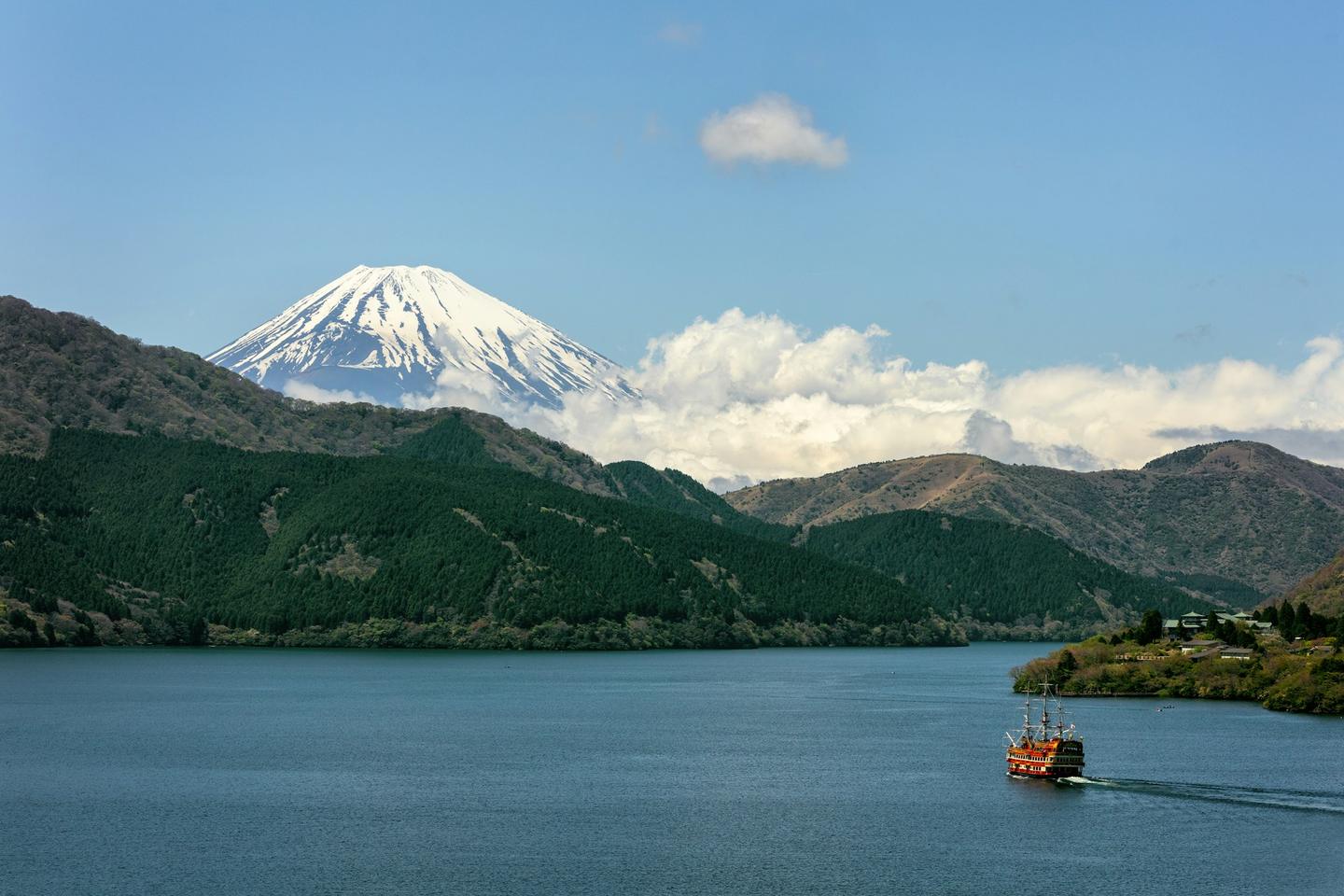
Hakone (east side, Kanagawa Prefecture) gives the classic silhouette view of Fuji across Lake Ashi, the mountain more distant but the composition more refined, with the lake and torii gate in the foreground. Hakone also offers ryokan accommodation, the Hakone Open Air Museum, the Owakudani volcanic valley, and the ropeway. It is a fuller destination in itself, with Fuji as one part of the visit.
The practical guidance: if Fuji is the primary objective of the day, base from Kawaguchiko. If Fuji is one element of a broader experience that includes hot springs, art, and mountain scenery, Hakone is the stronger choice. Both are day-trip distance from Tokyo (approximately 90 minutes); both support overnight stays that dramatically improve the early-morning viewing window.
DAWN LIGHT POSITIONING
A good photography window at any Fuji lake viewpoint is 30–45 minutes after sunrise. At this point the low eastern light falls across the mountain from the side, soft, directional, warm, while the water is still calm before wind picks up. In Kofu, the nearest city in the National Astronomical Observatory's tables, the sun rises at about 6:55 in early January and 5:14 in mid-April. This window is predictable and repeatable. It requires being in position before it opens.
From Tokyo, reaching Kawaguchiko in time for a winter or spring sunrise requires departing between 3:30 and 4:30am depending on the season. A private car can leave Tokyo or Hakone before 4am, so you can rest on the way while the driver handles the road. On a clear morning, arriving in the dark and watching the mountain turn from silhouette to full colour as the sun rises is what makes the early start worthwhile.
On a still winter morning the lake can mirror the mountain before the wind rises, and the viewpoints are at their quietest. Whether Fuji shows depends on the cloud, so a second early morning in the plan helps.
SOURCES AND HOW WE CHECKED
We first wrote this page from desk research on October 5, 2026, and read every page below again on October 28, 2026. We did not contact the prefecture, the city, the shrine or the operators. Trail rules, fares and flight prices change every year, so we check them again for your dates when we arrange the trip.
- Official Website for Mt. Fuji Climbing, Yoshida Trail rules for 2026: the season of July 1 to September 10, the ¥4,000 fee, the 14:00 to 3:00 gate closure, the 4,000-a-day limit and the gear check
- Official Website for Mt. Fuji Climbing, comparison of the four routes: 5th station altitudes, ascent and descent times, where the Subashiri and Yoshida trails meet, private-car restrictions
- Nippon.com, Mount Fuji Climbing Season: the 2pm to 3am restriction on all four trails and the fee introduced in 2025
- Nippon.com, First Snow on Mount Fuji Latest Ever: the first snow of November 7, 2024 and the record since 1894
- Japan Meteorological Agency, climate normals for Kawaguchiko (Japanese): monthly sunshine hours, 1991–2020
- Japan Meteorological Agency, Fujisan volcano (Japanese): the 3,776 m summit and the 1707 Hoei eruption on the southeast flank
- National Astronomical Observatory of Japan, sunrise in Kofu, January 2026 and April 2026 (Japanese): sunrise times
- Fujiyoshida City tourist guide, Arakurayama Sengen Park and the Chureito Pagoda (Japanese): the 398 steps, the 2022 reopening of the deck, evening lighting, parking and the bus restriction
- Kitaguchi Hongu Fuji Sengen Jinja, Fuji-ko and oshi and the Fire Festival (Japanese): the 86 oshi houses and those that remain, the festival dates and torches
- Yamanashi Prefectural Fujisan World Heritage Center (Japanese): opening hours by season, free entry, address
- HOSHINOYA Fuji, official site: 40 cabins, terraces facing the lake
- Mt. Fuji Panoramic Ropeway, official site (Japanese): the ¥1,200 adult return fare from November 1, 2026
- AirX Skyview, Mt. Fuji helicopter cruising (Japanese): routes, flight times, seats and prices per flight
- Tetsudo Channel, complete guide to the Mt. Fuji climbing rules (Japanese, May 18, 2026): opening dates by trail, the Shizuoka fee, pre-climb course and FUJI NAVI registration, climber numbers for 2025
- Time Out Asia, Why this Japanese city cancelled its famous cherry blossom festival (February 20, 2026): the cancelled festival at Arakurayama Sengen Park and its visitor numbers
- Time Out Tokyo, Mt Fuji photo block at Kawaguchiko Lawson store has been removed (August 22, 2024): the 20-metre screen, its removal on August 15 and the condition for its return
- Nippon Tabi Magazine, first snowcap on Mt. Fuji (Japanese, August 6, 2026): the 2025 date and the normal, the change of method from autumn 2026, Fujiyoshida's own declaration
- Central News Agency, Taiwan (Chinese, October 4, 2026): citing the Yomiuri Shimbun, the visual watch kept since 1894 handed over to radar, AMeDAS and satellites
- Tokyo Fuji Art Museum, The Great Wave off Kanagawa: the date of the print and the Kisarazu theory
QUESTIONS, ANSWERED
When is Mount Fuji most often clear?
Winter, December through February, usually offers the clearest air, a snow-capped peak and the fewest crowds at the viewpoints. For travelers not planning to climb, it is the season we would suggest. Spring cherry blossom season (late March to mid-April) offers combined views at certain locations but draws significant crowds. Summer is the climbing season, but frequent cloud often hides the peak from below.
Where should I photograph Mount Fuji from?
Chureito Pagoda at Arakurayama Sengen Park gives the most reproduced composition, pagoda in the foreground, Fuji behind. Arrive before 7am. Kawaguchiko (Lake Kawaguchi) provides the widest range of viewing angles and the classic reflected Fuji on still mornings. Oshino Hakkai, the village of thatched roofs and spring ponds, gives a distinctive foreground in morning light. For a view from above, a helicopter charter shows the crater from the air, weather permitting.
How much does a private helicopter flight over Mount Fuji cost?
The price depends on the operator, the duration and the number of passengers. As one published example, AirX lists a 120-minute charter from Tokyo Heliport that circles Mt. Fuji at ¥732,000 per flight for up to three passengers (read October 28, 2026). We can request one as part of a trip, including an early departure for morning light; every flight depends on the weather on the day.
Is it better to see Mount Fuji from Hakone or the Fuji Five Lakes?
The Fuji Five Lakes (north side, Yamanashi Prefecture) give closer views with the mountain filling more of the frame, well suited to photography. Hakone (east side) gives the classic silhouette view across Lake Ashi, which is more distant but arguably more elegant. The choice often depends on the itinerary: Hakone pairs naturally with an overnight ryokan stay; the Five Lakes pair well with an early morning departure for Chureito Pagoda.
SEEING FUJI WELL
STAYGO plans the viewpoint, the hour and the season with you, and can arrange a helicopter flight or an early car to the lake.
Start planningWe reply within 24 hours, in writing
Some of the restaurants and bars we arrange seat guests only by introduction or membership. We ask on your behalf; the table and the evening are the house's decision. We do not publish their names.