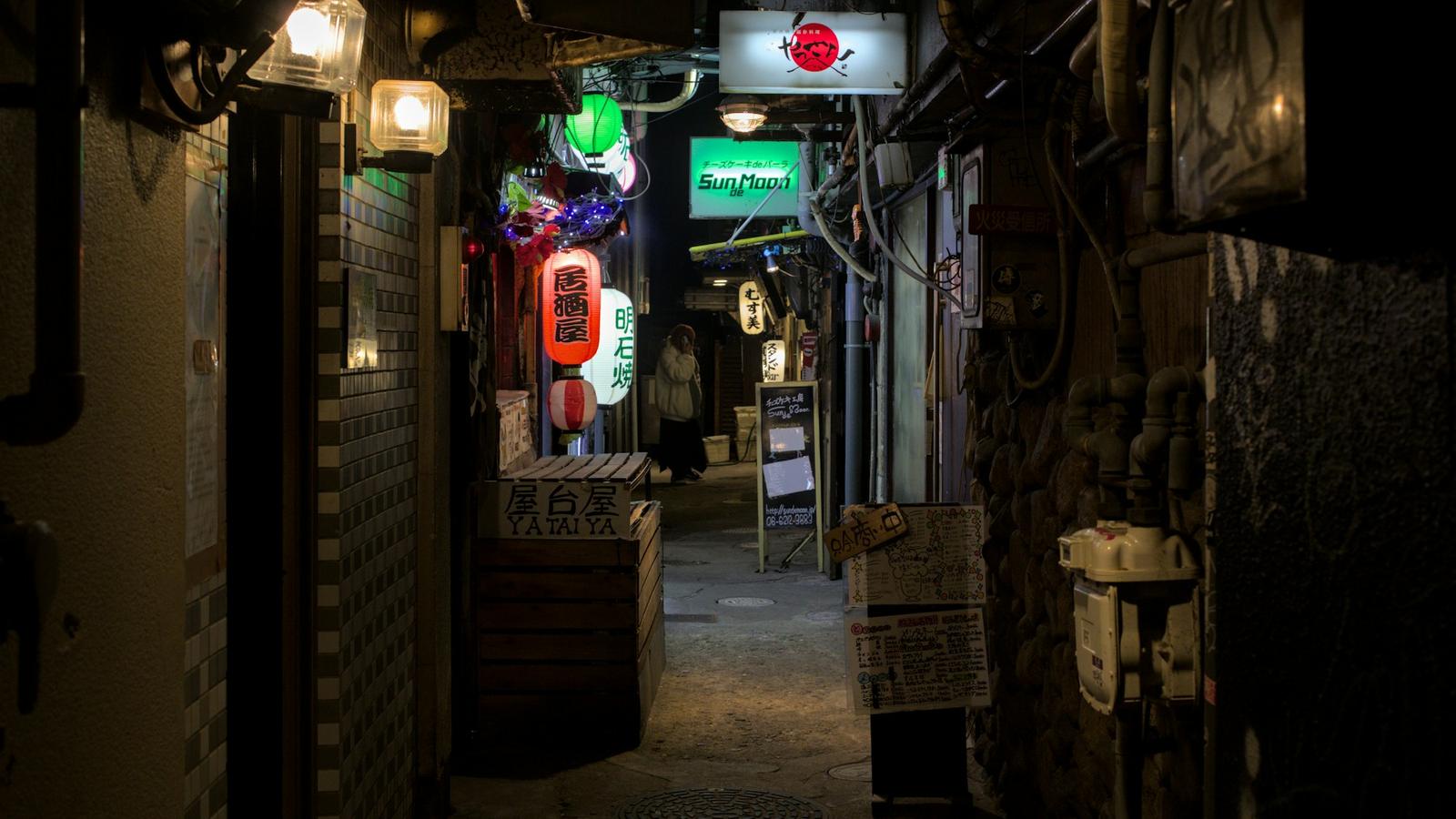
Japan's second food city has a reputation problem. The food is excellent; the trouble lies in how it is usually presented to visitors. Most Osaka itineraries start and end at Dotonbori: the canal, the neon, the giant mechanical crab, the Glico running man. It is photogenic and worth an evening, but most of Osaka's food culture lives elsewhere.
The Osaka that many Tokyo business travelers come down for eats in Kitashinchi to the north and in pockets of Minami that most tourists walk past without noticing. This article is about that Osaka.
Key points
- Osaka's serious dining is in Kitashinchi, where many kappo counters take new guests mainly through a Japanese-speaking introduction, and in the back streets of Minami. Dotonbori is worth seeing once.
- For a trip built around food and culture, stay in Namba; for business mixed with leisure, Umeda. The two are about ten minutes apart on the Midosuji subway line.
- Nara and Kobe both work as day trips from an Osaka base.
THE REAL FOOD CITY
Osaka's claim to being Japan's true food city is older than Tokyo's culinary reputation. The concept of kuidaore, "eat until you drop", is an Osaka expression. The city has a different relationship with food than any other in Japan: more direct, less reverential, warmer. A chef in Osaka is more likely to lean across the counter and ask what you thought of the last dish. At a Tokyo counter, the same exchange tends to be quieter.
What this produces in practice is a dining culture of real depth that operates at every price point. The highest tier is concentrated in Kitashinchi. The tier below it, which would be the top of the scale in most cities, is spread through Namba, Shinsaibashi, and the backstreets of Nishi-Shinsaibashi. The tourist tier is Dotonbori. They are very different experiences.
Osaka's food culture stands beside Tokyo's on its own terms, with more conversation across the counter and less ceremony.
KITASHINCHI: WHERE TOKYO EXPENSE ACCOUNTS GO
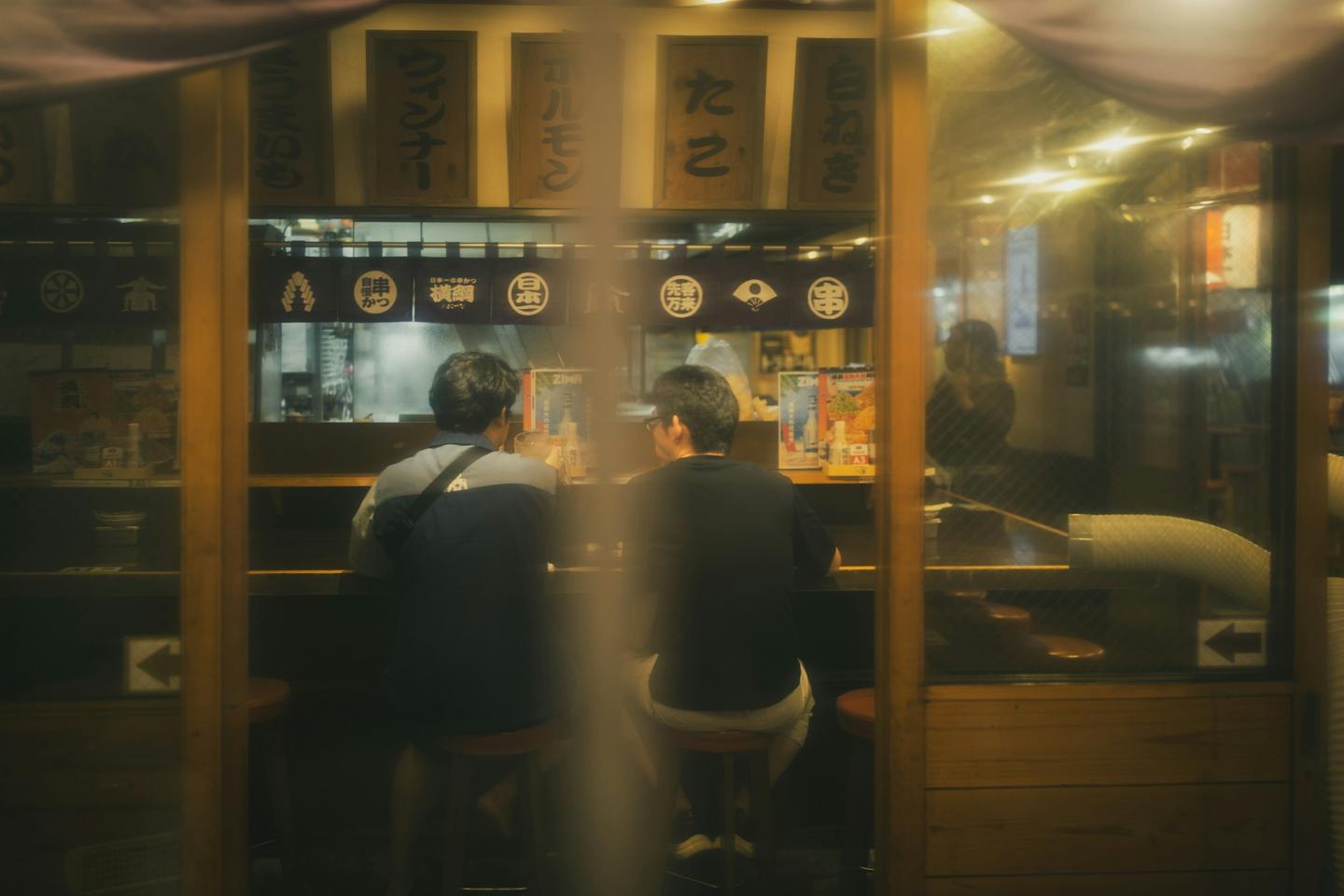
Kitashinchi, the district immediately north of Osaka's central business area, is where serious private dining happens in this city. The comparison that locals use (half proud, half resigned) is that Tokyo expense accounts come here. Intimate kappo counters, private dining rooms and places that take new guests mainly by introduction sit close together on its narrow blocks.
Kappo is an Osaka dining form: the chef cooks directly in front of you at a counter, composing dishes from whatever is good that day, in whatever order makes sense. There is no printed menu. The interaction between chef and guest is central to the experience. It is less formal than a full kaiseki progression, more personal, and often more surprising. Hamasaku, one of the restaurants credited with the counter style, opened in Shinmachi, Osaka, in 1924 and says it brought counter kappo to Tokyo, in Ginza, in 1928. In the current MICHELIN Guide selection for Osaka, eleven Japanese restaurants have Kitashinchi addresses (Sonezakishinchi and Dojima 1-chome). The Guide's note on one of them, Fukunoya, describes a long kappo menu with pike conger in summer and pufferfish in winter, the two seasonal fish worth asking about at any Osaka counter.
The practical challenge for international travelers: many of the serious Kitashinchi establishments take new guests mainly through a Japanese-speaking introduction. Many are not listed on reservation platforms, and some do not have websites. We can request a seat at counters of this kind on your behalf; whether one is offered depends on the evening's availability and on the chef's own judgement.
A private kappo counter in Kitashinchi: eight to twelve seats, chef cooking two meters in front of you, courses composed moment by moment from the morning's market. No menu card. The chef will explain each dish if you ask. Many such counters seat regulars and introduced guests first, and few appear on booking platforms.
MINAMI: THE BACKSTREET COUNTERS
Minami, the southern entertainment district that takes in Namba and Shinsaibashi, is less formal than Kitashinchi and eats just as well. The trap is that its most visible offerings (the conveyor-belt sushi near the station, the chain tempura restaurants, Dotonbori itself) give no indication of what sits one or two streets back.
Kushikatsu (skewered, battered, and deep-fried proteins and vegetables) is Osaka's most distinctive contribution to Japanese cuisine. The famous name is Kushikatsu Daruma, which opened in 1929 on the site of Shinsekai's old Luna Park and now has branches across Minami and Kita; it is worth visiting once for the experience. The serious kushikatsu counters are elsewhere: smaller, individually owned, with the cook standing behind the fryer deciding what comes next based on what's good today. The one rule, no double-dipping in the communal sauce, applies everywhere, and there is no exception. If you want more sauce after the first bite, scoop it up with a piece of the cabbage served alongside and pour it over the skewer, the way Daruma's own history explains.
Minami is also where Osaka's yakitori, standing sushi bars, and small izakaya culture thrive. The backstreets of Nishi-Shinsaibashi, particularly the lanes east of the main shopping boulevard, contain some of the city's most characterful small restaurants, places that have not changed their format in thirty years and have no intention of doing so.
A proper kushikatsu counter in Minami, away from the Dotonbori chains: the cook behind the fryer, a short printed list of what is available today, the oil fresh and clean, the batter light. Skewers arrive in the order the cook decides: asparagus wrapped in wagyu, shrimp, lotus root, chicken skin, quail egg. It is Osaka cooking at its most direct.
WHERE TO STAY
Osaka's luxury hotel market is stronger than its reputation suggests. For international-standard luxury, the two we would look at first are The St. Regis Osaka (formal, precise service, 160 rooms on Midosuji, the tree-lined boulevard through Honmachi) and Conrad Osaka, whose 164 rooms fill the 33rd to 39th floors of Nakanoshima Festival Tower West, with the lobby on the 40th and views over Nakanoshima and the river. The Conrad's height is the reason to choose it: the city and the river sit below the windows. It connects underground to Higobashi station on the Yotsubashi subway line. Two newer houses have opened since: Four Seasons Hotel Osaka in Dojima in August 2024, with 175 rooms, and Waldorf Astoria Osaka at Grand Green Osaka by Umeda in April 2025, with 252 rooms. We compare all four in The Best Luxury Hotels in Osaka 2027.
The Ritz-Carlton Osaka, in Umeda, has been open for more than a quarter of a century as Japan's first Ritz-Carlton; its rooms are on the 24th to 37th floors, and the interiors take an 18th-century British aristocratic residence as their model. It remains a reliable choice close to Osaka Station. If you would like to stay down among the streets, the machiya townhouse hotels in the Namba area (there are a small number of high-quality options) put you in the atmospheric south, within walking distance of Dotonbori, Hozenji Yokocho, and the backstreet dining that is the real reason to be in this part of Osaka.
Umeda (north) is Osaka's business hub: the main JR station, the underground shopping city, corporate towers. Efficient, clean, practical. Namba (south) is atmospheric: older streetscapes, more small restaurants, the canal, the night life. For travelers visiting Osaka primarily for food and culture, Namba is the right base. For travelers mixing business meetings with leisure, Umeda. The two areas are about ten minutes apart on the Midosuji subway line.
SHINSEKAI: THE OSAKA THAT WAS NEVER TIDIED UP
Shinsekai is not for everyone. The district opened in 1912 with the Luna Park amusement park and a first Tsutenkaku shaped like the Arc de Triomphe with the upper half of the Eiffel Tower on top, then fell into a long decline. It is rough around the edges, eccentric, and entirely genuine. The first tower was taken down in 1943 after a fire in the cinema at its foot; the present Tsutenkaku, 100 meters tall, went up in 1956 with money from local people. It is surrounded by kushikatsu restaurants, retro pachinko parlors, and the kind of lived-in streetscape that no amount of urban redevelopment has yet touched. The observation deck costs ¥1,500 for adults and now runs on timed entry, so the ticket comes with a reserved entry time.
Shinsekai is interesting precisely because nobody has tidied it up for visitors. It is what parts of Osaka used to look like. The kushikatsu there is honest and unpretentious. The locals are blunt and friendly in equal measure. This is the Osaka-ben dialect and the Osaka manner: direct, self-deprecating, unexpectedly warm once you engage.
Osaka-ben, the city's dialect, sounds rougher than standard Japanese to outside ears. In practice it carries directness, self-deprecating humour and a reluctance to take anything too seriously, and many visitors find the city warmer than its manner first suggests.
DAY TRIPS: NARA AND KOBE
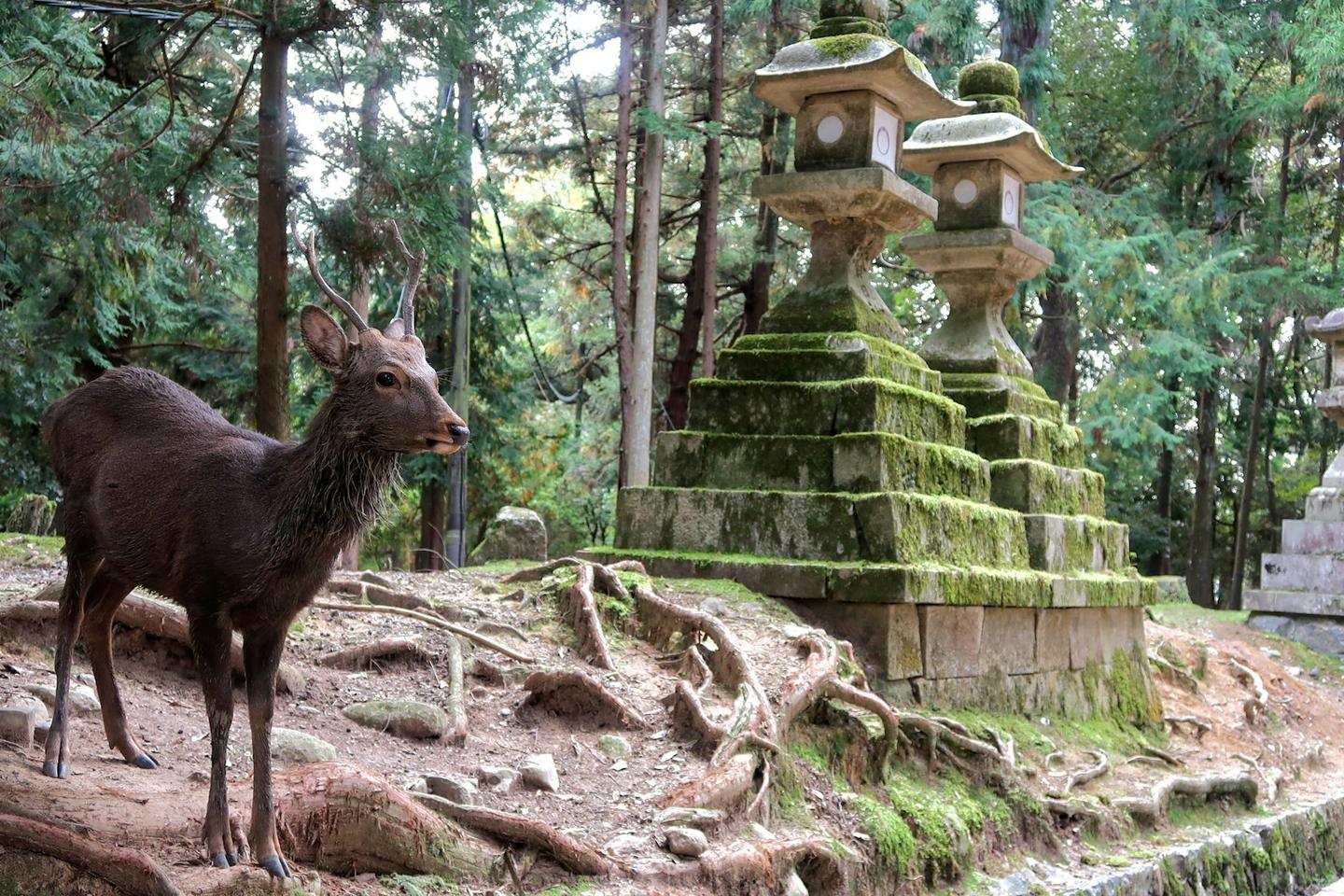
Osaka's position makes it a good base for two rewarding day trips. Nara, about 35 minutes from Osaka-Namba by Kintetsu rapid express or express (¥680 one way), was Japan's first permanent capital and contains some of the country's oldest and largest Buddhist monuments. Todai-ji describes its Great Buddha Hall as the largest wooden structure in the world. Kasuga Taisha, founded in 768 and hung with some 3,000 donated lanterns, is one of Shinto's most atmospheric shrines. The deer that roam freely through the park have been a national natural monument since 1957. They will take crackers from your hand; when one bows, hand the cracker over promptly, because the Nara Deer Preservation Foundation warns that teasing deer with crackers can excite them into butting.
Kobe, about 15 minutes by shinkansen from Shin-Osaka or about 30 minutes by Hankyu limited express from Umeda, is a different register entirely. The city's port history produced one of Japan's most cosmopolitan and architecturally distinctive streetscapes. The Kitano Ijinkan district, where foreign merchants built Western-style houses in the Meiji era, has a character of its own. And Kobe beef (specifically, wagyu raised in Hyogo Prefecture and meeting strict certification criteria) is served here at its source. A lunch at a Kobe beef restaurant near the port is a straightforward, memorable half-day addition to an Osaka base.
WHAT TOKYO TRAVELERS MISS
Travelers who see Osaka only briefly from Tokyo, or skip it for a longer Tokyo stay, can miss what gives Osaka its own place in a Japan itinerary: the warmth. Tokyo is a great city in every conventional sense, and also a reserved one. Osaka is less so. The shopkeeper who explains in gestures what you should try, the chef who leans over and asks genuinely how the meal is going, the stranger who helps with directions and then walks you there. This is Osaka's register, and it is distinct.
The concept of kuidaore captures something real: in Osaka, food is a form of hospitality. The city's highest compliment is feeding you well and watching you enjoy it. This is different from Tokyo, where the compliment is an immaculate plate that asks nothing of you emotionally. Neither is better. They are different pleasures, and a Japan itinerary with time for both is richer for it.
SOURCES AND HOW WE CHECKED
We first published this page on June 18, 2026, and checked its facts again against the pages below on October 28, 2026. We did not contact the hotels, the restaurants, Tsutenkaku, the railway, the temple, the shrine or the deer foundation. Rooms, menus, hours, fares and train times change, so we check them again close to your dates when we arrange the trip.
- Conrad Osaka, hotel information, access and floor guide (PDF, Japanese): the building, 164 rooms, room floors 33 to 39, the 40th-floor lobby, the underground link to Higobashi
- MICHELIN Guide, The St. Regis Osaka: address on Midosuji in Honmachi, 160 rooms, style
- The Ritz-Carlton Osaka, overview: location in Umeda, Japan's first Ritz-Carlton, room floors, interior design
- Hamasaku, Ginza (Japanese): founding in Shinmachi, Osaka, in 1924, counter kappo in Ginza from 1928, seasonal courses
- MICHELIN Guide, Osaka restaurants and Fukunoya: the Japanese restaurants with Kitashinchi addresses; the kappo menu, pike conger and pufferfish
- Kushikatsu Daruma, history, taste and branch list (Japanese): founding in 1929 on the Luna Park site, the no-double-dip rule, the cabbage, branches in Minami and Kita
- Tsutenkaku, archive and hours and admission (Japanese): the 1912 tower and Luna Park, its shape, the 1943 demolition, the 1956 rebuilding with local money, the 100 m height; the ¥1,500 adult ticket and timed entry
- Kintetsu Railway, To Major Sightseeing Areas: about 35 minutes and ¥680 from Osaka-Namba to Kintetsu-Nara
- Todai-ji, Daibutsu-den: the temple's description of the hall as the largest wooden structure in the world
- Kasuga Taisha, about the shrine: founding in 768, the 3,000 donated lanterns
- Nara Deer Preservation Foundation, history of protection and safety notes (Japanese): the 1957 designation as a natural monument, advice on feeding crackers
QUESTIONS, ANSWERED
What is Kitashinchi and why do Tokyo business travelers go there?
Kitashinchi is Osaka's best-known entertainment and dining district, located north of the city center. Its narrow blocks are dense with private kappo counters and omakase restaurants, and eleven Japanese restaurants in the current MICHELIN Guide selection for Osaka have Kitashinchi addresses. Many establishments take new guests mainly through an introduction, usually from a Japanese-speaking intermediary. Tokyo expense accounts have fueled this district for decades. It is not tourist infrastructure.
Is Dotonbori worth visiting?
Dotonbori is worth seeing once as a spectacle: the neon, the Glico running man sign, the canal. It is not where serious food happens in Osaka. The notable dining is in Kitashinchi, parts of Minami away from the main tourist drag, and the private counters that do not advertise.
What is kappo dining and how is it different from kaiseki?
Kappo is an Osaka-born style of counter dining in which the chef cooks directly in front of guests, more interactive and less ceremonial than kaiseki. There is no printed menu; dishes are composed around the season and the chef's judgment. It is one of Japan's most distinctive dining formats and Osaka, particularly Kitashinchi, is its spiritual home.
Which luxury hotels in Osaka do you recommend?
The St. Regis Osaka and Conrad Osaka (33rd to 40th floors, Nakanoshima skyline) are the two we would look at first for international-style luxury. The Ritz-Carlton Osaka is a long-established alternative near Umeda. For a more immersive experience, traditional machiya hotels in the Namba area place guests closer to the atmospheric south of the city.
PLANNING YOUR DAYS IN OSAKA
We shape Osaka days around how you like to eat, from a Kitashinchi kappo counter to a kushikatsu bar in Minami, together with hotels, transport and the rest of your journey.
Start planningWe reply within 24 hours, in writing
Some of the restaurants and bars we arrange seat guests only by introduction or membership. We ask on your behalf; the table and the evening are the house's decision. We do not publish their names.