There is a reason people hesitate before adding Hiroshima to an itinerary. The assumption is that a visit means a solemn afternoon at the Peace Memorial Museum and an obligation to be moved. The museum deserves to be taken seriously, and it is one part of what the city offers a thoughtful visitor.

Where they are

In Hiroshima Prefecture on the Seto Inland Sea: the city on the coast, Miyajima an island a short crossing to the southwest.
- Shin-Osaka Station to Hiroshima Station, by Shinkansen, about 1 hr 20 min
- Hiroshima Station to Miyajimaguchi, by train, about 27 min
- Miyajimaguchi to Miyajima, by ferry, about 10 min
Times come from the official pages of the operators, local authorities and venues. Map based on Natural Earth and OpenStreetMap (© OpenStreetMap contributors).
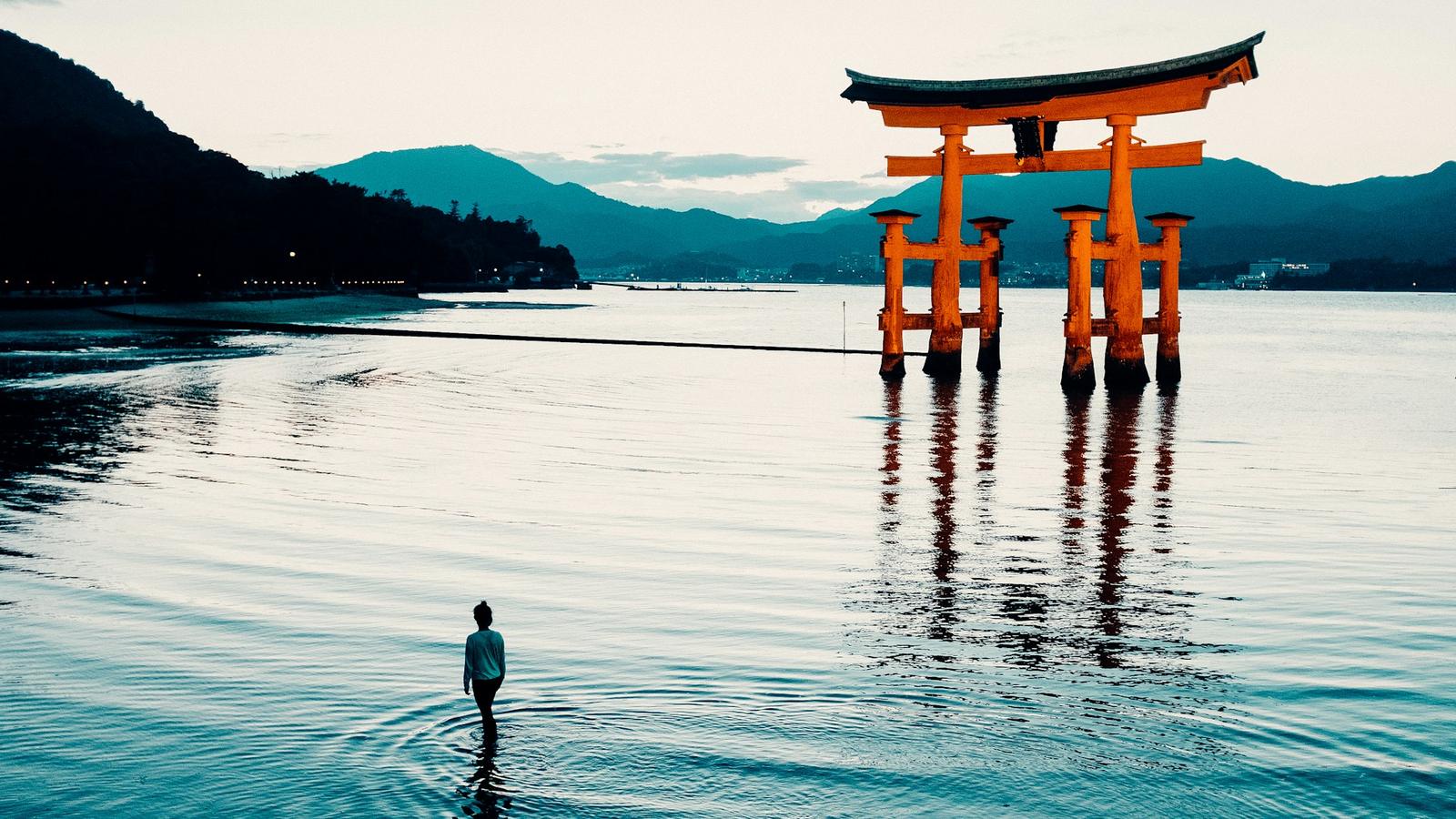
Hiroshima is an easy, outward-looking city. It was rebuilt from nothing in the postwar decades and rebuilt with intention: wide boulevards, excellent public transport, a food culture of its own. A short train and ferry ride away, Miyajima island holds one of the most recognizable sights in Japan, ryokan that make an overnight stay worthwhile, and, if you time the tides, the torii standing in the sea in the evening light.
Key points
- The Peace Memorial Museum opens at 7:30am (its published hours, checked in October 2026). Entry between 7:30 and 8:30am is by online reservation only, so reserve a web ticket; arriving within the first thirty minutes means seeing the permanent collection in near-solitude, and by 10am the queue at the entrance can be significant.
- The torii at Miyajima appears to float only when the tide is above about 250 cm, and you can walk out to its base only when it falls below about 100 cm (Miyajima Tourist Association), so the visit is timed against the tide tables.
- Staying the night on Miyajima gives you the island after the last ferry from the mainland, at 22:42, and before the first of the morning, at 06:25 (JR's regular timetable, checked in October 2026).
- Two nights, one in Hiroshima and one on Miyajima, is the version the article recommends. A day trip from Kyoto or Osaka is possible, but rushed.
- Hiroshima Prefecture farms about sixty percent of Japan's oysters (2023 figures), and they are in season from October through March.
HIROSHIMA AS IT IS TODAY
The narrative around Hiroshima is so dominated by August 1945 that most travel writing forgets to mention what the city has become. It has a population of 1.2 million. It has a professional football club (Sanfrecce Hiroshima) with a devoted local following. It has a covered shopping arcade, the Hondori, at the center of the city. It has an oyster culture that makes a strong case for eating simply in western Japan.
The Peace Memorial Park occupies a deliberate space at the epicenter of the 1945 bombing. The A-Bomb Dome, the skeletal ruin of the former Hiroshima Prefectural Industrial Promotion Hall, which survived the blast, is a UNESCO World Heritage Site. The park and the dome are genuinely moving in a way that is hard to anticipate. But the experience of the city extends well beyond them, and visitors who arrive expecting only gravity leave surprised by the warmth and energy of the place.
The A-Bomb Dome was inscribed on the UNESCO World Heritage List in December 1996, and the city keeps it as it stood after the blast.
THE PEACE MEMORIAL MUSEUM: DONE PROPERLY
The Hiroshima Peace Memorial Museum is rigorous, unflinching, and remarkably well-organized. The permanent collection documents August 6, 1945 through personal objects, photographs, and testimony in a way that avoids both sentimentality and political editorializing. It is the kind of institution that changes how you think about something, which is a rare achievement for any museum.
The practical issue is that it is extremely popular. By 10am on any given morning, the queue at the entrance can be significant and the galleries inside are crowded. The calmer way in is early. The museum opens at 7:30am all year, and entry between 7:30 and 8:30am is by online reservation only, so reserve a timed web ticket and arrive within the first thirty minutes to see the permanent collection in near-solitude. The first hour lets you read the galleries slowly. A private guide who can orient the visit and give historical context before you enter adds to it.
Admission is ¥200 for adults and free for junior high school students and younger. The museum closes at 7pm from March to July and from September to November, at 8pm in August and at 6pm from December to February, with last entry thirty minutes before closing. It is closed on December 30 and 31 and for a few days in mid-February (February 15 to 20 in 2027), and it may hold visitors at the door when the galleries are full.
A private guide provides historical and political context before you enter, allowing the objects and testimony inside to land without the interpretive weight being carried by the exhibit labels alone. After the museum, a walking circuit of the Peace Park (the cenotaph, the Children's Peace Monument, the A-Bomb Dome) takes approximately ninety minutes and takes in memorials that many visitors pass by.
HIROSHIMA'S FOOD: THE REASON TO STAY TWO NIGHTS
Hiroshima has two food identities that deserve serious attention. The first is oysters. Hiroshima Prefecture alone farms about sixty percent of Japan's oysters by volume and close to half by value (2023 figures from the Fisheries Agency). From October through March, the oysters here, eaten raw, grilled with butter and soy, or deep-fried in panko, are at their best. In the city the simplest way in is at the okonomiyaki counter: the stalls at Okonomimura list oysters as a topping and in their oyster specials.
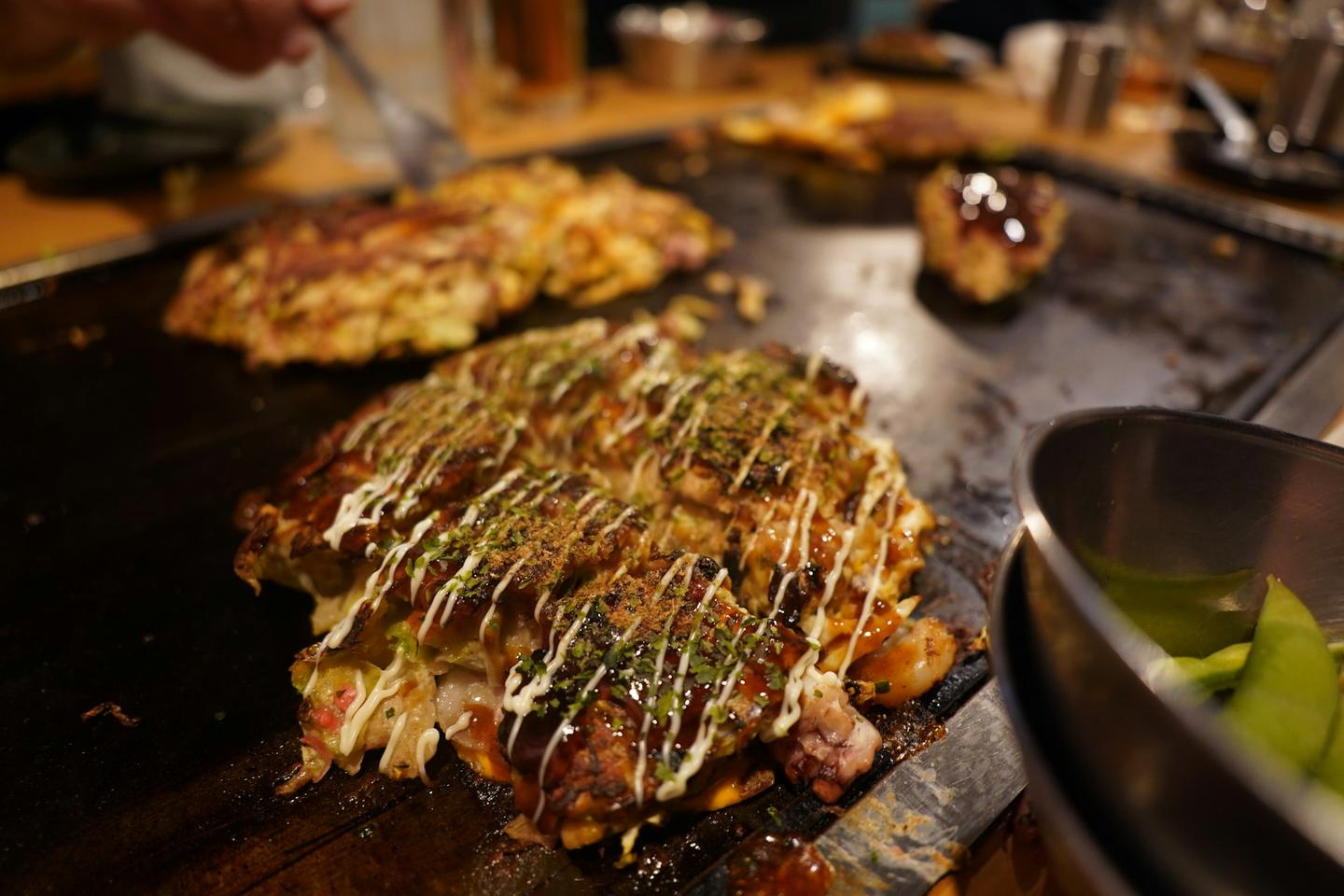
The second is Hiroshima-style okonomiyaki. The distinction from Osaka-style matters: in Hiroshima, the pancake layers are built sequentially (batter, then cabbage, then noodles, then egg) rather than mixed together. The result is denser, more complex, and a real source of local pride. Okonomimura, a multi-floor building in central Hiroshima housing more than twenty okonomiyaki stalls, is the easiest place to start. Go at dinner, choose a stall by watching the cook, and eat at the counter.
The building has its own history. After the war about fifty okonomiyaki stalls gathered on the Shintenchi square in the city center, and the name Okonomimura, okonomiyaki village, came from a writer describing that scene. When the square became a park in 1963 the stalls moved into a two-storey building in front of it, and in 1992 into the present tower, where twenty-five shops share the second to fourth floors. Each shop keeps its own hours and closing day; some open at 11am and close once the day's ingredients sell out, so check ahead if you plan a late dinner.
Okonomimura began as about fifty postwar stalls on the Shintenchi square, and each of its shops still keeps its own hours.
MIYAJIMA ISLAND AND THE FLOATING TORII
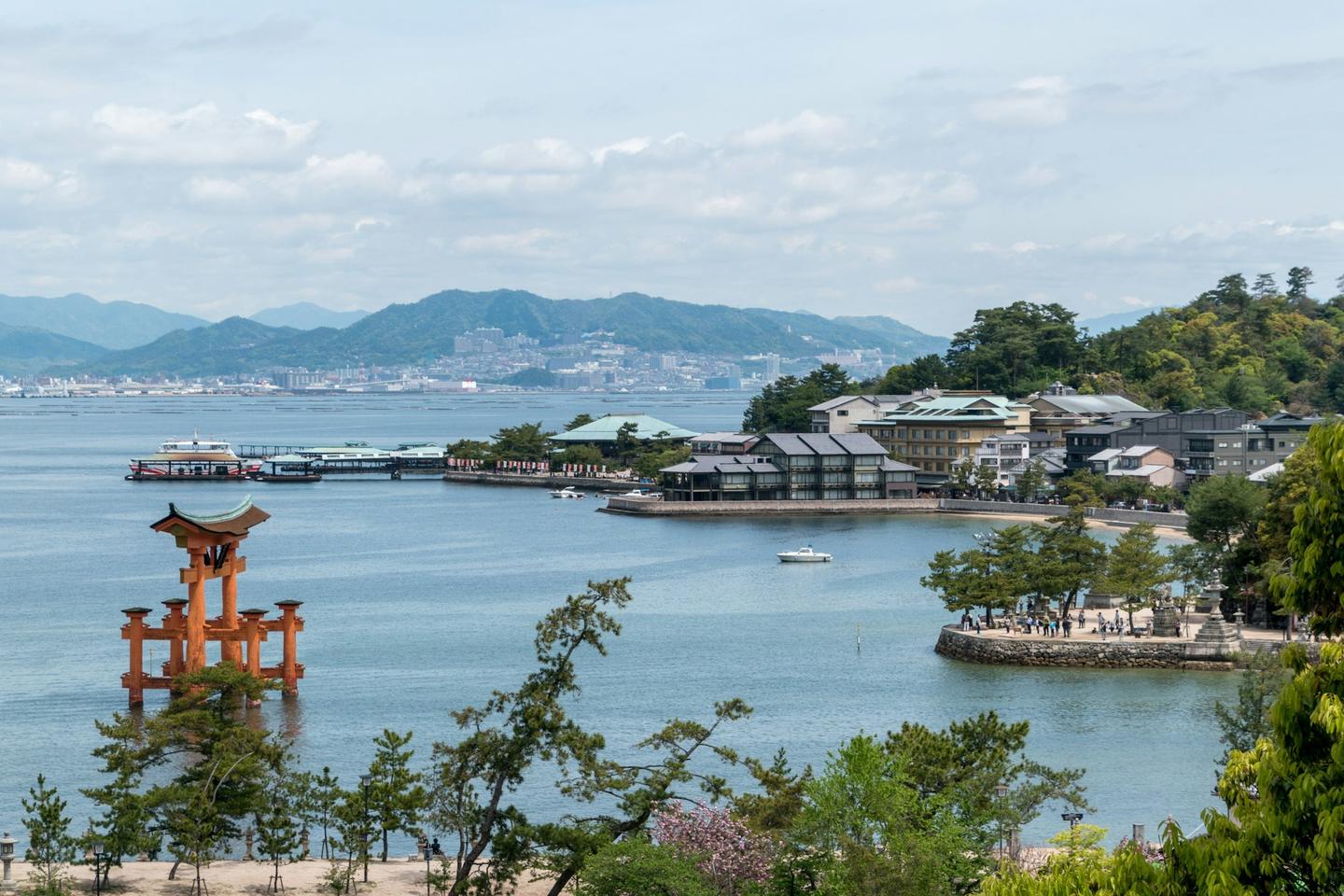
Miyajima, officially Itsukushima, is under an hour from Hiroshima by train and ferry. The island is home to Itsukushima Shrine, a UNESCO World Heritage Site built over the tidal flats of the Seto Inland Sea. The great torii gate of the shrine stands in the water offshore, and when the tide is high enough, both gate and shrine appear to float. The island has been held sacred since the earliest times; the present buildings date from the 13th century and follow the 12th-century plan of Taira no Kiyomori, with the sea in front and Mount Misen behind.
The present torii was rebuilt in 1875 and stands 16.6 metres tall. Its main pillars are natural camphor trunks, and the whole gate, about sixty tonnes, simply rests on the seabed on a footing of pine piles. The shrine opens at 6:30am every day and closes at 6pm from March to mid-October, at 5:30pm from mid-October to November and at 5pm in December; entry is ¥300 for adults.
CNN calls the torii one of Japan's most recognizable photo spots. Finding it is easy. The difficulty is seeing it without the crowds of the middle of the day. Staying the night helps. The last ferry from the mainland leaves Miyajimaguchi at 22:42, and the first of the morning at 06:25. In those hours the island belongs almost entirely to the people staying on it.
The JR crossing takes about ten minutes and costs ¥200 one way for adults. Since October 1, 2023, visitors also pay the Miyajima Visit Tax of ¥100 per visit, or ¥500 for a year of visits, collected with the ferry fare; preschool children are exempt. CNN reported that the money pays for things like public toilets and upkeep of the shrine, and transport IC cards are accepted at the JR ferry gates.
The torii appears to float only at high tide, and only on tides that rise above about 250 cm; you can walk out to its base when the level drops below about 100 cm. The Miyajima Tourist Association publishes a year of tide times for Hiroshima Port, with the hours for each, and notes that Miyajima runs slightly earlier. Check them when planning the Miyajima overnight, so that your arrival and departure line up with high tide. At low tide, the seabed is exposed and visitors walk out to the gate's base, a different experience but equally worth having. When the tide tables for your dates allow, an overnight stay can include both: high tide in the evening and a low-tide walk the next morning, before the day-trippers arrive.
MIYAJIMA OVERNIGHT: THREE RYOKAN
Three places to stay on the island, each suited to a different kind of night. Jukeiso sits on a hill above the shrine, and its sea-facing rooms look over Itsukushima Shrine, the five-storied pagoda and the torii. Dinner is a seasonal kaiseki built on Seto Inland Sea seafood (sea bream, octopus, Hiroshima anago), with an autumn and winter menu centred on Hiroshima oysters; vegetarian dishes are prepared on advance request. There is a private open-air bath with a night view of the island. The inn has an English website, and from 3pm it sends a car to meet guests at the pier if you call before boarding the ferry; on foot it is about twenty minutes.
Iwaso is one of the island's long-established ryokan, founded in 1854 in the Momijidani gorge at the foot of Mount Misen, set back from the busy main street of the island. Rooms are in the main building, a newer wing and four single-storey detached cottages built between the late Taisho and early Showa eras, and the inn draws its own hot spring, Wakamiya Onsen, a rarity on the island. The atmosphere is cedar and tatami, the sound of the Momijidani river, deer wandering past the window at dawn. It is about fifteen minutes on foot from the ferry pier. Iwaso suits travelers who want a classical ryokan, with its own hot spring and the gorge around it.
For a modern stay, Itsukushima Iroha is the island property in the MICHELIN Guide hotel selection. The guide describes fifteen rooms, many looking out to the Seto Inland Sea or the peak of Mount Misen, furnished with 20th-century European and American design pieces, and a restaurant that applies French technique to Setouchi produce and local seafood.
LOCAL FOOD ON MIYAJIMA: OYSTERS AND MOMIJI MANJU
Beyond the ryokan dinner, Miyajima's main street offers two food experiences worth knowing about. The oysters grilled on charcoal braziers by the waterfront vendors are exactly what they appear to be, simple and seasonal. Buy them and eat them standing with the sea in front of you.
Momiji manju, maple-leaf shaped cakes filled with red bean paste, are the island's signature confection. Eat them fresh and warm; several shops bake them to order. The fried version, age-momiji, a registered name of Momijido, a Miyajima confectioner founded in the late Meiji era, is battered and deep-fried and tastes considerably better than it sounds. Momijido's island shops close at around 5:30pm, so buy one before the day-trippers leave. The boxed ones sold at the airport are for taking home.
ONE DAY OR TWO
Hiroshima and Miyajima can technically be done as a day trip from Kyoto or Osaka. The Shinkansen from Shin-Osaka to Hiroshima takes about an hour and twenty minutes on the fastest Nozomi services. A rushed version covers the Peace Memorial Museum and a ferry to Miyajima in a single day. It leaves little time for either.
We would suggest two nights: one night in Hiroshima city (or a very good hotel near the station) and one night on Miyajima. This allows the Peace Memorial Museum at opening time on day one, an afternoon in the covered markets and Okonomimura, the ferry to Miyajima for high-tide arrival, an overnight at Jukeiso or Iwaso, the island at dawn before the day-trippers arrive, and a Shinkansen back from Hiroshima by midday on day three. It is an entirely manageable structure from either Kyoto or Osaka base.
SOURCES AND HOW WE CHECKED
We first wrote this page from desk research on October 5, 2026, and read every page below again on October 28, 2026. We did not contact the museum, the shrine, the ferry company, the ryokan or the shops. Opening hours, tide times, fares and menus change, so we check them again close to your dates when we arrange the trip. On November 3, 2026 we added the City of Hiroshima page on the A-Bomb Dome's World Heritage listing.
- Hiroshima Peace Memorial Museum, visitor information: opening and closing hours by month, online reservation for 7:30 to 8:30am entry, admission, closed days
- UNESCO World Heritage Centre, Itsukushima Shinto Shrine: the island as a sacred place, the 13th-century buildings and the 12th-century plan of Taira no Kiyomori
- Itsukushima Shrine, visiting hours and fees (Japanese): opening hours by season and the ¥300 entry
- Miyajima Tourist Association, the great torii (Japanese): 1875 rebuilding, height, camphor pillars, weight and footing
- Miyajima Tourist Association, annual tide table (Japanese): the 250 cm and 100 cm levels for the floating view and the walk to the torii
- JR West Miyajima Ferry, timetable (Japanese): first and last sailings on the regular timetable, crossing time
- JR West Miyajima Ferry, fares (Japanese): ¥200 fare, the separate ¥100 visit tax, IC cards
- Hatsukaichi City, outline of the Miyajima Visit Tax (Japanese): start date, ¥100 per visit or ¥500 a year, exemptions, collection with the fare
- CNN Travel, Japan implements tourist tax at famous floating shrine: the torii as a photo spot and what the tax pays for
- Jukeiso, official site, cuisine and access (Japanese): views, seasonal kaiseki, vegetarian requests, private bath, pickup and walking time
- Iwaso, history of the inn (Japanese) and English page: founding in 1854, Momijidani, detached cottages, Wakamiya Onsen, walking time
- MICHELIN Guide, Itsukushima Iroha: number of rooms, views, interiors and restaurant
- Fisheries Agency, the state of oyster farming (PDF, Japanese): Hiroshima's share of Japan's farmed oysters by volume and by value in 2023
- Okonomimura, history and shop page, Hassho (Japanese): postwar stalls, 1963 and 1992 buildings, the shops and floors, oyster menus, hours
- Momijido (Japanese): age-momiji, the shop's founding, island shop hours
- City of Hiroshima, Atomic Bomb Dome registered as World Heritage: inscription in December 1996
QUESTIONS, ANSWERED
How long should I spend in Hiroshima and Miyajima?
A minimum of two full days is recommended: one day in Hiroshima city (Peace Memorial Museum, the grounds of Hiroshima Castle, whose keep has been closed since March 2026, and Okonomimura) and one day on Miyajima island. If your schedule allows, a night on Miyajima gives you the island in the evening and early morning, after most day visitors have left, and the torii at dawn.
When should I go to see the floating torii gate at Miyajima?
The torii gate of Itsukushima Shrine appears to 'float' only at high tide, on tides above about 250 cm; you can walk out to it when the level is below about 100 cm. Check the Miyajima Tourist Association's tide table for the day of your visit. A high tide early in the morning or at dusk gives softer light for photographs. At low tide, visitors can walk out to the base of the gate across the exposed seabed. Both are worth seeing, and a night on the island makes it easier to catch each one.
Is it appropriate to visit Hiroshima as a tourist?
Yes, Hiroshima actively welcomes international visitors to the Peace Memorial Museum and Peace Park. The museum is a rigorous, forward-looking institution with a clear message about nuclear disarmament. Hiroshimans are proud of their city's transformation and generally welcome visitors who approach the experience with genuine respect and curiosity.
Which ryokan should I choose on Miyajima island?
Iwaso, open since 1854 in the Momijidani gorge with its own hot spring, suits a classical ryokan stay. Jukeiso sits on a hill above the shrine, with sea-facing rooms and seasonal kaiseki. Itsukushima Iroha, in the MICHELIN Guide hotel selection, is the modern choice. Staying overnight allows guests to experience the island after the day-trippers depart, including the torii gate illuminated at dusk.
ADD HIROSHIMA & MIYAJIMA TO YOUR ITINERARY
Tell us your dates and what you have in mind. We will tell you what is realistically open to you, and what is not.
Start planningWe reply within 24 hours, in writing
Some of the restaurants and bars we arrange seat guests only by introduction or membership. We ask on your behalf; the table and the evening are the house's decision. We do not publish their names.