The question behind "how far in advance should I book Japan" is usually a different question: have I already missed the thing I most want? The answer depends almost entirely on which week you are travelling and how narrow your requirements are, and it ranges from eighteen months to about six weeks.
Here is the working rule we use. Count backwards from the one element the trip cannot do without. For most trips that is a specific ryokan, a specific week, or a specific table. Everything else can be arranged around it, and almost everything else can be arranged later than people fear.
Key points
- Count backwards from the one thing the trip cannot do without, usually a specific ryokan, a specific week or a specific table.
- Peak weeks with a fixed property need twelve to eighteen months; peak weeks with a flexible property, six to nine; shoulder seasons, three to five. Outside peak weeks, six to ten weeks is possible, with trade-offs.
- Book in order: the shape of the trip, the scarce night, the city hotels, the flights, then restaurants and guides as their books open.
- If you are late, move the week, change the base, or let the named property go.
FIND OUT WHAT IS STILL AVAILABLE →
THE FOUR WINDOWS
Twelve to eighteen months: peak weeks with a fixed property. Cherry blossom (late March to early April), the autumn foliage weeks in November, and New Year. If the trip depends on a named ryokan with a handful of rooms, or a room with a private open-air bath in one of those weeks, this is the window. Ask each property when its calendar opens, and be ready on that day.
Many of these windows open on a fixed day, so the date matters as much as the month. Gora Kadan in Hakone opens a month's dates at 12:30 on the 1st, six months ahead, by phone only at first and online from the middle of that month; its New Year dates open on September 1. Hoshino Resorts hotels take reservations a year ahead, and HOSHINOYA properties eighteen months ahead.
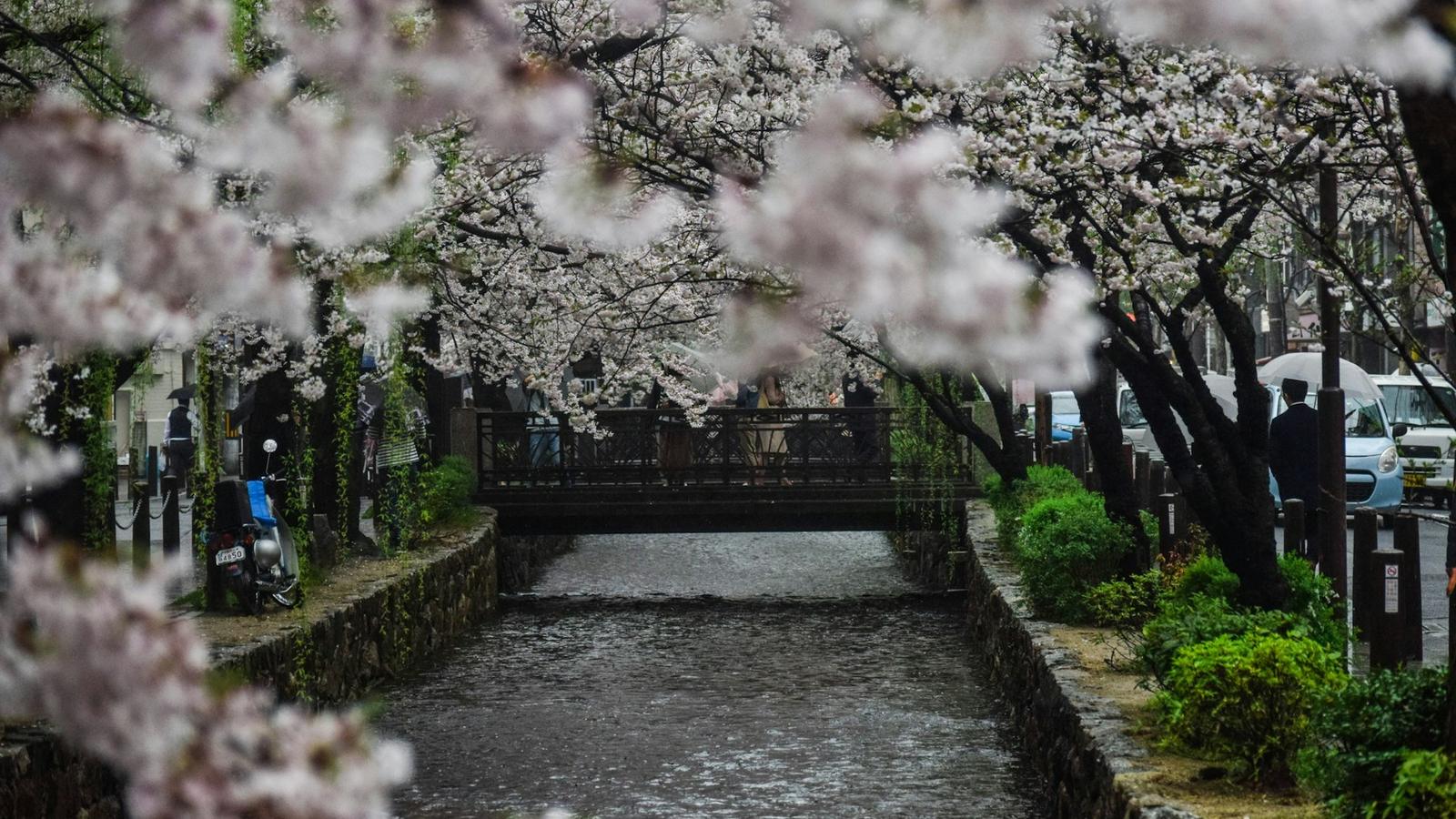
Cherry blossom is the hardest of these to aim at, because the week moves. The Japan Meteorological Agency's records show Tokyo's first flowering on March 14 in 2021 and 2023, March 29 in 2024 and March 19 in 2026, against a 1991–2020 normal of March 24, and Kyoto's full bloom anywhere from March 24 to April 5 over the same years. The Japan Meteorological Corporation publishes its first forecast for the season around the turn of the year, two to four months ahead, long after the twelve-month window above has opened. In 2026, Weathernews and the Japan Meteorological Corporation both issued forecasts on January 8.
Six to nine months: peak weeks, flexible property. The same seasons, but with the willingness to take an excellent second choice. This is a common realistic starting point, and the timing is comfortable.
Three to five months: shoulder seasons. Late May and early June, September, early December. Most of Japan is available at this range, including good rooms in Kyoto, and the trip can usually be built much as you imagined it.
Six to ten weeks: possible, with trade-offs. Outside peak weeks, a good two-city trip can still be assembled. At this range the constraint is the restaurants: the counters that matter typically open their books one to three months out, and some take reservations only by phone, in Japanese, on a specific day. Others release seats online on a fixed day: on its TableCheck page, Yakiniku Cocochi in Koenji opens reservations at midnight on the 1st of each month for dates two months ahead.
Some things cannot be done early at all. JR seat reservations, for example, open at 10:00 Japan time one month before the day of travel and not before, so a trip planned a year ahead still waits for that morning for its train seats.
What cannot be bought later
Three things, reliably. A ryokan of any reputation in a peak week. A small counter at a specific date and time. And any experience that depends on one host's time, such as a private tea gathering or a craftsperson's workshop, because those rest on one person's calendar.
Many of the most traditional inns still work by telephone. Hiiragiya in Kyoto, founded more than 200 years ago, takes reservations by phone from 8:00 to 21:00 Japan time alongside its online booking, and a particular room is usually something you ask for in that conversation.
Holding a restaurant seat also comes with rules. On its TableCheck page, Sushi Zai in Hiroo charges 100% for cancellations within 72 hours and may treat a table as cancelled when guests are more than 15 minutes late and cannot be reached; Pocket Concierge's etiquette guide says cancellations the day before or on the day usually cost the full fee. Some counters stay outside online booking altogether. Sukiyabashi Jiro takes guests from overseas only through their hotel's concierge, accepts no proxy bookings and asks for photo ID, and Michelin left it out of the 2020 Tokyo guide because the general public could no longer reserve.
"Flights and city hotels are the parts people rush to book first, and the parts that stay available longest. The scarce things are smaller and quieter."
THE ORDER TO DO IT IN
Sequence matters more than lead time. Booking in the wrong order is how people end up with an excellent hotel in the wrong city on the wrong night.
First, fix the shape. How many nights, in how many places, in which order. Nothing should be booked before this exists, because every booking made earlier becomes a constraint the plan has to work around.
Second, the scarce night. The ryokan, or whichever single element is hardest to get. The rest of the itinerary bends around it.
Third, the city hotels. Almost always available later than people assume, and worth holding until the shape is certain.
The national figures show why. The Japan Tourism Agency's accommodation survey for 2025 put average room occupancy at 74.1% for city hotels and 75.3% for business hotels, but 38.2% for ryokan, with Osaka the fullest prefecture at 78.6%. Demand is still rising: Nippon.com counts a record 42.7 million international visitors in 2025, about 10 million more than in 2019. Averages hide the peak weeks and the famous names, and that is the point: most rooms stay available, and a few are very scarce. In Kyoto the pressure shows in price. DMO KYOTO's figures, reported by the trade paper Travel Voice, put the average daily rate of the city's hotels at a record ¥20,195 in 2024, against ¥15,610 in 2019.
Fourth, the flights. Once the first and last nights are fixed. Booking flights first is how a trip acquires an awkward arrival time it lives with for two weeks. Japan Airlines now opens seats 360 days before departure, from midnight Japan time, on domestic and international routes alike, a change from March 26, 2024 reported by Travel Voice. A trip planned a year ahead can therefore fix its flights early, as soon as those two nights are settled.
Last, restaurants and guides, at the window each of them opens. This is often eight to ten weeks out, well after everything else is settled.
WHEN TO START FOR YOUR SEASON
The short answer to how far in advance to plan a luxury trip to Japan: twelve to eighteen months ahead if the trip depends on one named ryokan in cherry blossom, the November foliage or New Year; six to nine months for those weeks with a flexible choice of hotel; three to five months for the shoulder seasons; and six to ten weeks outside the peak weeks, with trade-offs. The table sets the four windows against the calendar, with the first thing we secure in each.
| Travel weeks | Start planning | Secure first |
|---|---|---|
| Cherry blossom, late March to early April | 12 to 18 months ahead with a named ryokan; 6 to 9 months without | The ryokan, then the Kyoto nights |
| Autumn foliage, November | 12 to 18 months ahead with a named ryokan; 6 to 9 months without | The Kyoto or Hakone nights; the colour has been arriving later, so we look at early December too |
| New Year | 12 to 18 months ahead | The inn: some open their New Year dates on a set day, Gora Kadan on September 1 |
| Late May to early June, September, early December | 3 to 5 months ahead | The ryokan, then the city hotels |
| Other weeks | 6 to 10 weeks can work | The restaurants, whose books open one to three months out |
Applied to 2027, those rules give the following. For cherry blossom in late March and early April 2027, the one-year window at Hoshino Resorts is already open, and Gora Kadan opened its March dates on September 1 and its April dates on October 1, 2026. For the autumn leaves of November 2027, Hoshino Resorts opens one year ahead, date by date, the eighteen-month window at HOSHINOYA has been open since May 2026, and Gora Kadan's six-month rule puts November on May 1, 2027, at 12:30. For the New Year of 2027 to 2028, the same inn's rule puts December 31 to January 3 on September 1, 2027, by phone only. For cherry blossom in 2028, HOSHINOYA's window opened in September and October 2026. Two things wait however early you start: shinkansen seats, which go on sale at 10:00 Japan time one month before the day of travel, and the counter restaurants, which open their books on their own day.
IF YOU ARE ALREADY LATE
Late is rarely fatal; it changes which trip you take. Three moves recover most of it.
Move the week. Shifting departure by ten days out of a peak window reopens most of the country. The second week of December and the first half of June are both considerably better than their reputation. The autumn colour has been coming later too: in 2024 the leaves turned late, and DMO KYOTO reported, via Travel Voice, that Japanese guest nights in Kyoto's hotels were higher in December than in November for the first time.
Check the national holidays before you fix the dates. The Cabinet Office lists them: in 2027, Golden Week falls on April 29 and May 3 to 5, and the September holidays on September 20 and 23, so the five-day September break of 2026 does not repeat.
Change the base. When Kyoto is full, staying in Osaka or on the Lake Biwa side and travelling in usually adds thirty minutes or so each way and keeps the shape of the trip. If you do stay in Kyoto, budget for its accommodation tax: from March 1, 2026 it rises with the room rate, to ¥10,000 per person per night for rooms of ¥100,000 or more, as Time Out reported.
Let one thing go. Usually the named property. A trip planned six weeks out around genuinely good rooms is better than a trip built around one famous room and compromised everywhere else.
A related piece: the holiday weeks to avoid entirely. If the dates themselves are still open, the season-by-season guide is the place to start.
SOURCES AND HOW WE CHECKED
We read every page below on October 28, 2026. We did not contact the inns, the railway or the agencies. Booking rules and holidays change, and bloom dates move every year, so we check them again for your dates when we arrange the trip.
- Japan Meteorological Agency, cherry flowering dates 2021–2026 (Japanese): Tokyo and Kyoto first flowering by year and the 1991–2020 normals
- Japan Meteorological Agency, cherry full bloom dates 2021–2026 (Japanese): Tokyo and Kyoto full bloom by year
- Japan Meteorological Corporation, 2026 cherry blossom forecast (Japanese): the final forecast of April 23, 2026 and the comparison with normal years
- Nippon.com, Cherry Blossom Forecast 2025: Let It Bloom: the first forecast of January 9, 2025 and its lead time
- Nippon.com, Japan's Cherry Blossom Forecast 2026: how the 2026 forecast was revised earlier
- JR West, reservation conditions: seat reservations from 10:00 one month before travel
- Japan Tourism Agency, accommodation survey, 2025 final results (PDF, Japanese) and survey page: occupancy by type of property, Osaka's 78.6%
- Cabinet Office, national holidays (Japanese): the 2026 and 2027 holiday dates
- Hiiragiya, official site: reservations by phone and online, phone hours, history of more than 200 years
- Nippon.com, Japan Welcomes Record 42.7 Million International Visitors in 2025 (January 23, 2026): the 2025 total and the gap with 2019
- Travel Voice, the average daily rate of hotels in Kyoto City reached a record high in 2024 (February 14, 2025): DMO KYOTO's ¥20,195 rate for 2024 and December guest nights overtaking November
- Travel Voice, JAL opens reservations 360 days ahead on domestic and international flights (Japanese, December 28, 2023): booking from midnight 360 days before departure, from March 26, 2024
- Time Out Osaka, Kyoto to increase hotel tax by up to 900 percent (October 7, 2025): Kyoto's accommodation tax bands from March 1, 2026
- TableCheck, Yakiniku Cocochi Honten reservation page (Japanese): reservations released at midnight on the 1st for two months ahead
- Gora Kadan, Hakone, FAQ (PDF) (Japanese): reservations open at 12:30 on the 1st of the month six months ahead, by phone first and online from mid-month; New Year dates from September 1; cancellation fees
- Hoshino Resorts, booking FAQ: reservations from one year ahead, eighteen months for HOSHINOYA
- TableCheck, Sushi Zai reservation page: 100% cancellation fee within 72 hours, the 15-minute rule for late arrival
- Pocket Concierge, dining etiquette in Japan: full charge for cancellations the day before or on the day, arriving early, fragrance, photography
- Sukiyabashi Jiro, shop and reservations (Japanese): guests from overseas book only through their hotel concierge, no proxy bookings, photo ID
- Restaurant Online, World-famous sushi restaurants stripped of their Michelin stars (November 26, 2019): why Michelin left Sukiyabashi Jiro out of the 2020 Tokyo guide
QUESTIONS WE ARE ASKED ABOUT TIMING
Is it too late for cherry blossom in 2027?
For a well-known inn on a fixed week, often yes: Gora Kadan opened its April 2027 dates on October 1, 2026, and Hoshino Resorts takes bookings a year ahead. For the trip itself, it is rarely too late if you are willing to move the week or be flexible about where you sleep.
When do restaurants open their books?
It varies by house: some at the start of the previous month, some ninety days out, a few only by introduction. This is the element most worth handing to someone in Japan, because it depends on being able to call at the right hour.
How long does planning itself take?
The design stage is typically a few weeks of back-and-forth. Starting eight months out leaves time to secure the scarce things while they still exist; the work itself still takes only a few weeks.
How far in advance should you plan a luxury trip to Japan?
Twelve to eighteen months for cherry blossom, the November foliage or New Year if the trip depends on one named ryokan, and six to nine months for those weeks with a flexible choice of hotel. Three to five months is enough for late May, September and early December, and six to ten weeks can still work outside the peak weeks.
Can I reserve shinkansen seats months in advance?
No. Seat reservations open at 10:00 Japan time one month before the day of travel, and not before. We fix the trains in the itinerary early and reserve the seats on that morning.
FIND OUT WHAT IS STILL AVAILABLE
Send us the dates you are considering and the one thing the trip has to include. We will tell you what is realistic for that week before you commit to anything.
Begin planningWe reply within 24 hours, in writing
Some of the restaurants and bars we arrange seat guests only by introduction or membership. We ask on your behalf; the table and the evening are the house's decision. We do not publish their names.