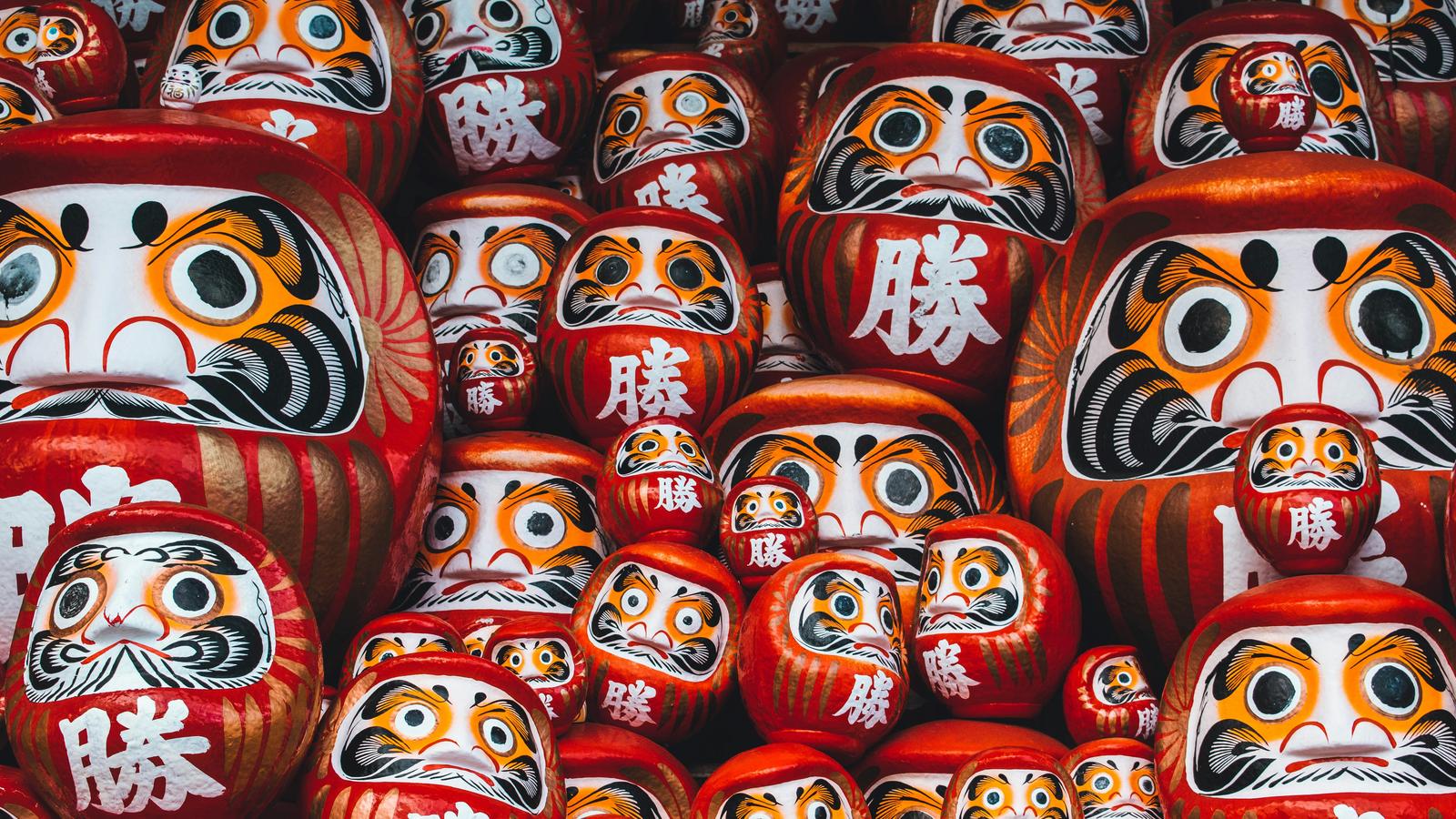
A daruma is a round, weighted papier-mâché figure of Bodhidharma, the monk who founded Zen in China, sold in Japan as a good luck charm for a goal or a new year. Its eyes are left blank. You fill in one eye when you make the wish and the other when it comes true, and because it rights itself every time it is pushed over, it stands for the saying "fall down seven times, get up eight". The makers' cooperative in Takasaki, in Gunma, says its members make most of Japan's papier-mâché daruma, about 900,000 a year in its survey of around 2003, and in 2026 the year's first daruma market filled the avenue outside Takasaki Station on January 1 and 2.
Below are the face and the eyes, the colours, what happens to a daruma when its year is over, and where to find one: Takasaki's workshops, the markets of January to March, and Katsuoji outside Osaka. We checked each fact on October 28, 2026, on the pages of the temples, the Takasaki makers' cooperative and the market organisers, and read a museum, a Japanese encyclopedia and press reports for the history; the sources are at the end.
Key points
- A daruma is modelled on Bodhidharma seated in zazen with his red robe over his head and his hands and feet hidden inside it, according to Shorinzan Darumaji in Takasaki.
- Shorinzan Darumaji, the Takasaki cooperative and Jindaiji in Tokyo all start with the eye on your right as you face the daruma; Katsuoji in Osaka signs the opposite eye first. The cooperative says there is in fact no fixed order.
- Shorinzan Darumaji says the colours carry no difference in meaning: a daruma takes on its meaning when you fill in the eye.
- The daruma markets: Takasaki on January 1 and 2 (in 2027 as well), Kitain in Kawagoe, northwest of Tokyo, every January 3, Shorinzan on January 6 and 7, Fuji's Bishamonten festival on the 7th to 9th days of the lunar new year, and Jindaiji in Tokyo usually on March 3 and 4.
- At Shorinzan Darumaji you can paint your own daruma any day, without booking, from ¥1,500.
WHAT A DARUMA IS
The figure is named after Daruma Daishi, Bodhidharma. Shorinzan Darumaji tells his story this way: born about 1,600 years ago, a prince of Kanchipuram in southern India, he became a monk, sailed to China in old age and sat facing a cave wall near the Shaolin temple for nine years. The round daruma is that seated figure, red because of the robe drawn over his head, with his hands and feet hidden inside it.
The daruma sold as a good luck charm began in Takasaki. Shorinzan Darumaji, a Zen temple of the Obaku school on a hillside in Hanadaka, says that after the eruption of Mount Asama in 1783 and the famine that followed, its ninth abbot, Togaku, carved a wooden mould from a one-brush painting of the seated Bodhidharma by the temple's founder, Shin'etsu, and taught a farmer of Toyooka village, Yamagata Tomogoro, how to make papier-mâché daruma from it. They were first sold at the temple's fair on the seventh day of the new year.
The tumbling toy is older than the Takasaki daruma. The entry on daruma toys in the Japanese encyclopedia Nipponica, written by Saito Ryosuke, says a small tumbler called okiagari koboshi was made first, in the Muromachi period, and that papier-mâché tumbling daruma appeared in Edo probably after the Kyoho era (1716 to 1736); of all the shapes, the daruma became the most popular. In Takasaki, the cooperative's timeline and the City of Takasaki both point to a print of 1829 showing daruma sold at the first market of the year in Tamachi, in the centre of town.
The Takasaki face
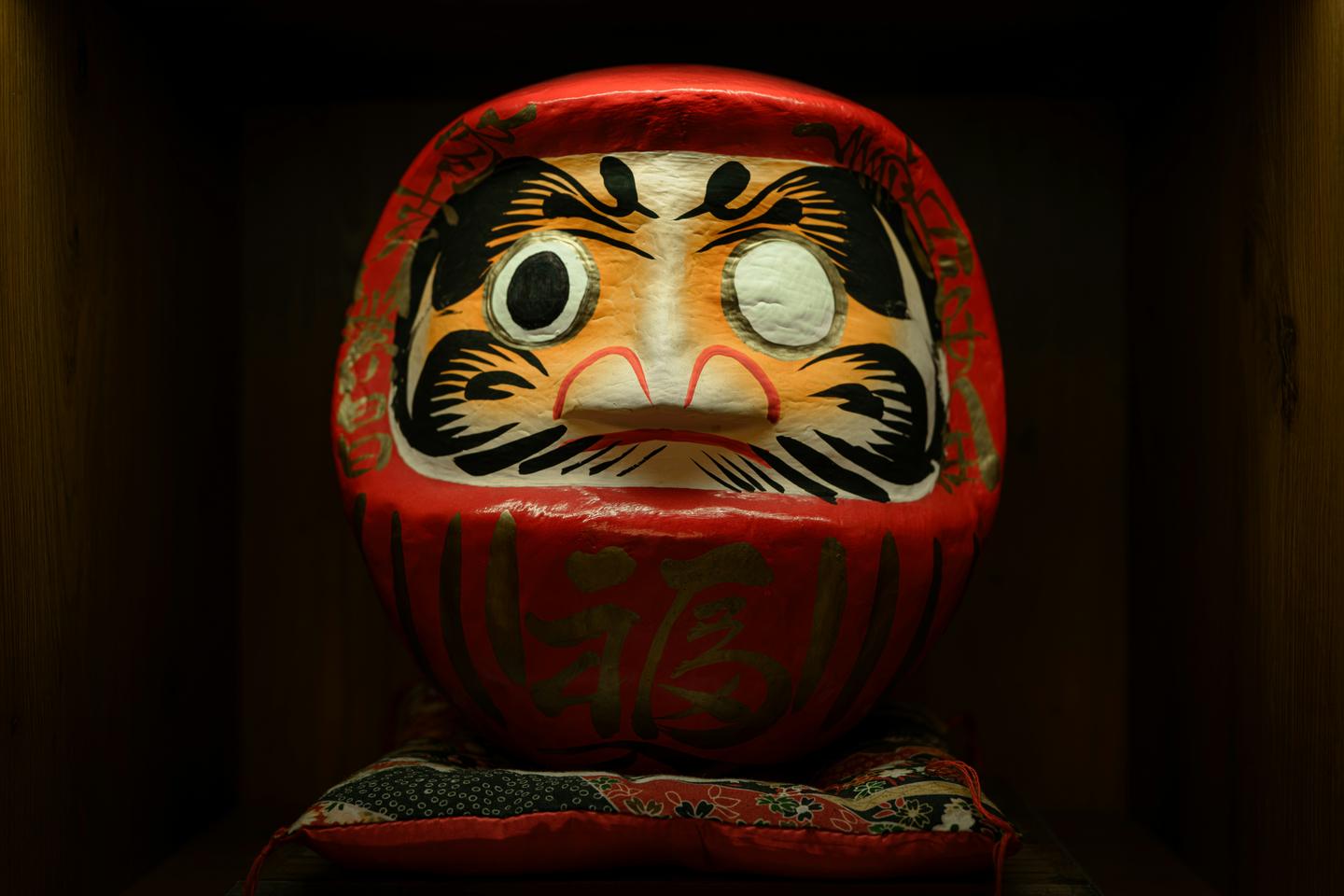
A Takasaki daruma has the eyebrows of a crane and a moustache shaped like a turtle, the crane and turtle being Japan's two auspicious animals. Wishes such as safety for the household or good business are written on either side of the face, the body is decorated in gold, and the belly reads fukuiri, "fortune within". The Gunma Daruma Manufacturers' Cooperative, whose forerunner was founded in 1915, has more than 50 member makers, and Takasaki daruma were designated a traditional craft of Gunma in 1993 and registered as a regional trademark in 2006. Today the paper body is formed in a mould by vacuum, weighted at the base, coated in gofun, a white powder made from shells, and dipped or sprayed red; the face is still painted by hand, one by one.
The paper body is a recipe of its own. In a January 2026 profile by ZOZO Artisan, Norikazu Shimizu, fifth-generation head of a Takasaki workshop, tears recycled paper by hand, mixes in paper from a mayonnaise factory, and changes the blend each day with the temperature and humidity; the moulded bodies then dry slowly on shelves, and a run of rainy days can warp them. The cooperative says daruma began as winter work in the farming off-season, and the City of Takasaki says the workshops are busiest at the end of the year, supplying the January markets.
ONE EYE FOR THE WISH AND ONE FOR THANKS
The custom is broadly the same wherever you buy one: you give the daruma one eye as you make a wish or set a goal, and the second when the wish comes true or the year has passed safely. Shorinzan Darumaji asks you to quiet the mind first. If a monk at the temple has already marked the first eye with a dot, you paint the full eye over that dot.
Which eye comes first depends on whom you ask:
| Source | First eye | Second eye |
|---|---|---|
| Shorinzan Darumaji, Takasaki | On your right as you face it | The other, when the wish is granted or the year has passed safely |
| Gunma Daruma Manufacturers' Cooperative | The daruma's left eye, on your right; recommended, though the order is not fixed | The other, when the wish is granted |
| Jindaiji, Tokyo, at the March market | The daruma's left eye, with the Sanskrit letter a, for beginnings | The daruma's right eye, with un, for fulfilment, then returned to the temple |
| Katsuoji, Minoh, Osaka | The daruma's right eye, on your left, as a signature | The daruma goes onto the temple's shelves once the goal is reached |
The cooperative's answer is the most relaxed: it recommends the left eye, citing the old idea that the left is the higher seat, then says there is in fact no rule on the order. Filling in the eye, it says, stands for opening the eye of the mind. The makers once painted wide-open eyes themselves before handing a daruma over; buyers painting their own came later.
The two eyes also belong to Japanese elections. The cooperative's timeline dates the first hissho daruma, "certain victory" daruma made for an election, to April 1955, and the Nipponica entry says the custom of filling in the eyes is still followed today for passing entrance exams and winning elections.
Katsuoji's version
Katsuoji, in the hills above Minoh, north of Osaka, is known for its kachi daruma, "winning daruma". The temple says the word "winning" here means overcoming your own weaker self, and that writing a goal on the daruma and giving it an eye is like signing a pledge to yourself, kept by doing your best each day. You write the purpose on the base, a goal for the next 365 days on the back, and sign the daruma's right eye before filling it in black. When the goal is reached, the daruma is placed on the temple's daruma shelves with thanks.
SEVEN FALLS AND EIGHT RISINGS
A daruma has a weight in its base, so however you push it, it rolls upright again. That is the saying nanakorobi yaoki, fall down seven times and get up eight, and the Takasaki cooperative reads the steady, low centre of the figure as a calm mind able to face any difficulty.
In Gunma the saying had a second, practical meaning. The province was silk country, and a silkworm sheds its skin four times before it spins a cocoon. Farmers said a silkworm "rises" when it breaks out of its old skin and starts to move again, so a daruma that always rose became the guardian of the silkworm harvest. The cooperative traces the spread of the daruma to farmhouses across northern Kanto to that wish for a good crop of cocoons, and its timeline records that sales grew after the port of Yokohama opened in 1859 and silk exports took off. The same opening brought in an imported scarlet pigment, and with it brighter red daruma.
The Gunma Prefectural Museum of History made the same point in its 2024 collection exhibition, Darumasan Daishugo, which set wooden moulds given by Takasaki makers beside daruma from across Japan: a figure that always rights itself served as a charm for silkworms in some places and as a charm for the sea in others.
RED AND THE OTHER COLOURS
Red is the classic daruma. Besides Bodhidharma's robe, the cooperative's history gives a second reason: in Edo, when smallpox spread, people believed red things kept illness away, and red daruma were set by children's pillows.
At the markets you will also find daruma in other colours, and many guides give each colour its own wish. Asked whether the colours mean different things, Shorinzan Darumaji answers that they do not: a daruma takes on its meaning through the wish you make when you fill in its eye. Choose the colour you like, and the size that suits where it will sit. The cooperative adds a custom about size: when a wish comes true, some people buy a slightly larger daruma for the next one, and if it did not, the makers suggest the same size again.
WHEN THE YEAR IS DONE
A daruma is usually kept for a year, or until its wish is fulfilled, and then returned to be burned in a ceremony called otakiage. The cooperative asks that it never be thrown away as rubbish, and suggests taking it to a nearby shrine or temple, or to a local New Year bonfire where seasonal decorations are burned.
- Shorinzan Darumaji receives daruma every day from 9:00 to 17:00 at a desk between the main hall and the Daruma Hall, with an offering of whatever you choose. Its largest burning is on January 15, and every daruma left in the main hall is given a memorial service at the year-end cleaning in December. It accepts daruma, talismans and charms only, without bags or boxes.
- The Takasaki Daruma Market collects daruma from visitors, and the cooperative has them burned later in January as priests chant sutras. The Yomiuri Shimbun reported about 10,000 daruma burned on January 22, 2025; in 2026 the ceremony was on January 29 in Hanadaka, the district of Shorinzan.
- Jindaiji opens a place to leave daruma from February 28 before its March market.
- Katsuoji places fulfilled daruma on its shelves.
The charms and talismans of shrines, and the other lucky objects of the Japanese New Year, are in Why Japanese Shrines Say You Receive an Omamori → and Japanese Lucky Charms and the Seasons They Belong To →.
WHERE TO FIND ONE
Takasaki
Takasaki is the place to see daruma made. The cooperative's makers are centred on the Toyooka and Yawata districts, and the City of Takasaki puts the number of master craftspeople at about 70. Shorinzan Darumaji stands above them on its hill, about 20 minutes by taxi from the West Exit of Takasaki Station, or 5 minutes by taxi or 20 minutes on foot from Gunma-Yawata Station. The German architect Bruno Taut lived in a cottage in its grounds, Senshintei, from August 1934 for two years and three months, and a stone beside it is carved with his words "Ich liebe die japanische Kultur", I love Japanese culture. The temple's shop is open from 10:00 to 16:00.
The temple's daruma painting room, Zuiunkaku, is open every day, closing only for snow or typhoons. You paint a plain daruma yourself: ¥1,500 for one 12 cm high or ¥2,000 for 15 cm, tax included, in about 30 minutes with no time limit, from 10:00 to 15:30. No booking is needed, though groups of ten or more are asked to book, and a monk can then perform the eye-opening for the daruma you painted.
On August 9, Takasaki Daruma Day, the cooperative holds Darumatsuri. In 2026 it ran from 10:00 to 15:00 at Toyooka Wakamiya Hachimangu, with papier-mâché making in the old way and a daruma ring toss, and it opened with a memorial service for Yamagata Tomogoro at Joanji nearby. Nippon Tabi Magazine gives the ninth day of the eighth month of 1862 as the day he died.
The daruma markets
Daruma are sold all year, but the custom of a new daruma for a new year fills the markets of January to March; at Takasaki's, the makers call out to the crowd from their own stalls. Five of the best known:
| Market | Where | When | What to know |
|---|---|---|---|
| Takasaki Daruma Market | The avenue outside the West Exit of Takasaki Station, Gunma | January 1 and 2, 2027, 10:00 to 16:00, on the avenue outside Takasaki Station's West Exit | The organisers call it the earliest daruma market of the year in Japan. In 2026 the avenue closed to traffic from 9:00, and about 24 food stalls, a stage of 20 groups and a painting workshop joined the daruma sellers. A 2.8 m daruma stands on the street. |
| Hatsudaishi Daruma Market | Kitain (Kawagoe Daishi), Kawagoe, Saitama, northwest of Tokyo | January 3 every year | January 3 is the festival day of Ganzan Daishi, the Tendai monk also honoured as Jie Daishi, and as the first of the year it is called Hatsudaishi. Kitain, given the title of head temple of the Tendai school in the Kanto region in the early Edo period, says daruma stalls came to line its grounds as more people came to pray there at the New Year. In 2026 the streets around the temple closed to traffic from 9:00 to 17:30 and its car park closed for the day; the temple asks visitors to come by train or bus. Hon-Kawagoe Station is about 15 minutes away on foot. |
| Shorinzan Nanakusa Taisai Daruma Market | Shorinzan Darumaji, Takasaki | January 6 and 7 on the temple's calendar | The fair where Takasaki's daruma were first sold, at the temple where they began. |
| Bishamonten Taisai | Myohoji, Fuji, Shizuoka | The 7th to 9th days of the first month of the old lunar calendar, so the date moves each year | The city of Fuji calls it one of Japan's three great daruma markets. |
| Jindaiji Daruma Market | Jindaiji, Chofu, western Tokyo | Usually March 3 and 4 | About 300 stalls, mostly daruma, as the temple's plum trees bloom. Monks write a Sanskrit letter in the left eye of daruma bought there, 9:00 to 16:30. |
On market days, expect crowds and traffic controls; Jindaiji asks visitors to come by public transport, and the temple says more than 100,000 people come over the two days. For when these fall against the rest of the Japanese year, see The Japanese Festival Calendar, a Reason to Come Each Month →; the November markets for bamboo rakes, another lucky charm of the year's end, are in Tori no Ichi 2026, the Tokyo Fair Where a Rake Gathers Fortune →.
Katsuoji in Osaka
Katsuoji is the 23rd temple of the Saigoku pilgrimage, with grounds of 80,000 tsubo, about 26 hectares, in the hills above Minoh. Its daruma are sold at the temple, and entry is ¥500 for adults. It is open from 8:00 to 17:00, to 18:00 on Saturdays, and about 15 minutes by taxi from Minoh-Kayano Station. A temple notice of April 2026 says its car park takes reservations only on Saturdays, Sundays, holidays and set days such as New Year: you reserve on the temple's website up to 14 days ahead, without a reservation fee, and pay for parking on site. In the autumn leaf season, mid-November to early December, the temple lights the maples after dusk for evening visits it calls Kinshu no Yoimairi.
WHERE STAYGO COMES IN
STAYGO plans private trips across Japan from Tokyo. A daruma can fit a trip on the day of a market, or in a quiet hour with the people who make them. If you would like to paint your own and give it its first eye in a maker's workshop in Takasaki, tell us your dates and we will ask what can be arranged and come back with what each workshop offers. Shorinzan Darumaji's painting room is open to anyone without booking, and sits easily in a day in Gunma. Hotels, workshops, dining and guides are arranged by us and settled with each of them in the simplest way available, usually at the hotel or on the day. Trips are planned on our Signature plan, or as Bespoke for longer and more complex trips.
SOURCES AND HOW WE CHECKED
We read the pages listed below on October 28, 2026, and the pages on Kitain's daruma market on November 2, 2026. We did not contact the temples, the cooperative or the organisers. Dates, hours and prices come from the temples' and organisers' own pages; the museum, the encyclopedia, the newspaper and the craft features were used for history and background. Customs differ from temple to temple, and dates and prices can change.
- Shorinzan Darumaji, the birthplace of the good luck daruma, Bodhidharma and frequently asked questions: origin, face, eyes, colour and red robe
- Shorinzan Darumaji, daruma memorial service and annual events: returning a daruma, the January 15 burning and the January 6 and 7 market
- Shorinzan Darumaji, daruma painting, hours and access and Bruno Taut: prices, hours, booking and the cottage
- Gunma Daruma Manufacturers' Cooperative, about Takasaki daruma, history, how they are made and frequently asked questions: silkworms, smallpox, output, craft, eye order, size and returning, the 1829 print and the first election daruma of 1955
- Gunma Daruma Manufacturers' Cooperative, about the cooperative, Takasaki Daruma Market 2026 and Darumatsuri 2026: members, market dates and hours, August 9, and the Darumatsuri venue and memorial service
- Takasaki Daruma Market, official site and the 2026 burning, the 2026 programme: earliest market, the 2.8 m daruma, traffic, stalls and workshop, and the January 29 ceremony
- Gunma Official Tourist Guide, Takasaki daruma: a new daruma at New Year
- Jindaiji, the daruma market: dates, stalls, visitors, the eye letters and the place to return daruma
- Kitain (Kawagoe Daishi), Hatsudaishi daruma market, Nippon Tabi Magazine, Kawagoe Daishi Kitain Hatsudaishi and Tobu Railway, First shrine visit of the year at Kita-in Temple: January 3 and the name Hatsudaishi, the Tendai temple, and traffic and parking in 2026
- City of Fuji, Koho Fuji, April 2025: the Bishamonten festival at Myohoji and its lunar dates
- Katsuoji, winning daruma and hours and access, car park notice and autumn leaves: the name, the eye and the pledge, hours, entry, taxis, car park reservations and the evening visits
- City of Takasaki on Google Arts & Culture, Takasaki Daruma: about 70 master craftspeople, the 1829 print and the busy year-end season
- Gunma Prefectural Museum of History, collection exhibition Darumasan Daishugo (2024): the wooden moulds and the self-righting daruma as charms for silkworms and the sea
- Nipponica (Shogakukan) on Kotobank, Daruma (toy), by Saito Ryosuke: okiagari koboshi, papier-mâché daruma in Edo, and the eye custom for exams and elections
- ZOZO Artisan, profile of a Takasaki daruma maker (January 6, 2026): the paper, moulding and drying
- The Yomiuri Shimbun via Asia News Network, Old daruma dolls burned in purification rite in central Japan city (January 24, 2025): about 10,000 daruma burned on January 22, 2025
- Nippon Tabi Magazine, 知られざるニッポン vol.67 (January 6, 2022): Yamagata Tomogoro and the year he died
QUESTIONS PEOPLE ASK ABOUT DARUMA
Which eye do you fill in first on a daruma?
Shorinzan Darumaji and the Takasaki makers' cooperative fill in the eye on your right as you face the daruma, its own left eye, when the wish is made, and the other when it comes true. Katsuoji in Osaka signs the opposite eye first, and the cooperative says there is in fact no fixed order.
What do the different daruma colours mean?
Red comes from Bodhidharma's red robe, and in Edo red was believed to keep smallpox away. Many guides give other colours their own wishes; Shorinzan Darumaji says the colours carry no difference in meaning: the daruma takes on its meaning from the wish you make when you fill in its eye.
What do you do with a daruma after your wish comes true?
Give it its second eye, and when its year is over take it back to be burned in an otakiage ceremony. The Takasaki cooperative asks that it never be thrown away as rubbish. Shorinzan Darumaji receives daruma every day from 9:00 to 17:00, and Jindaiji opens a place for them from February 28.
When are the daruma markets in Japan?
Takasaki's runs on January 1 and 2 in 2027, 10:00 to 16:00, outside Takasaki Station's West Exit, Kitain's in Kawagoe, Saitama, every January 3, Shorinzan Darumaji's on January 6 and 7, the Bishamonten festival in Fuji on the 7th to 9th days of the lunar new year, and Jindaiji's in Tokyo usually on March 3 and 4.
Can you paint your own daruma in Japan?
Yes. Shorinzan Darumaji in Takasaki has a painting room open every day from 10:00 to 15:30: ¥1,500 for a 12 cm daruma or ¥2,000 for 15 cm, with no booking needed except for groups of ten or more.
A DARUMA OF YOUR OWN
Tell us when you will be in Japan, and if you would rather paint a daruma in a maker's workshop in Takasaki or be there for one of the markets. We will ask what can be arranged and come back with how it would fit your days.
Begin planningWe reply within 24 hours, in writing
Some of the restaurants and bars we arrange seat guests only by introduction or membership. We ask on your behalf; the table and the evening are the house's decision. We do not publish their names.